Elon Musk has said it repeatedly: as Full Self-Driving improves, the price goes up. But a growing number of industry analysts are pushing back on that narrative — and the market dynamics they're pointing to are hard to dismiss.
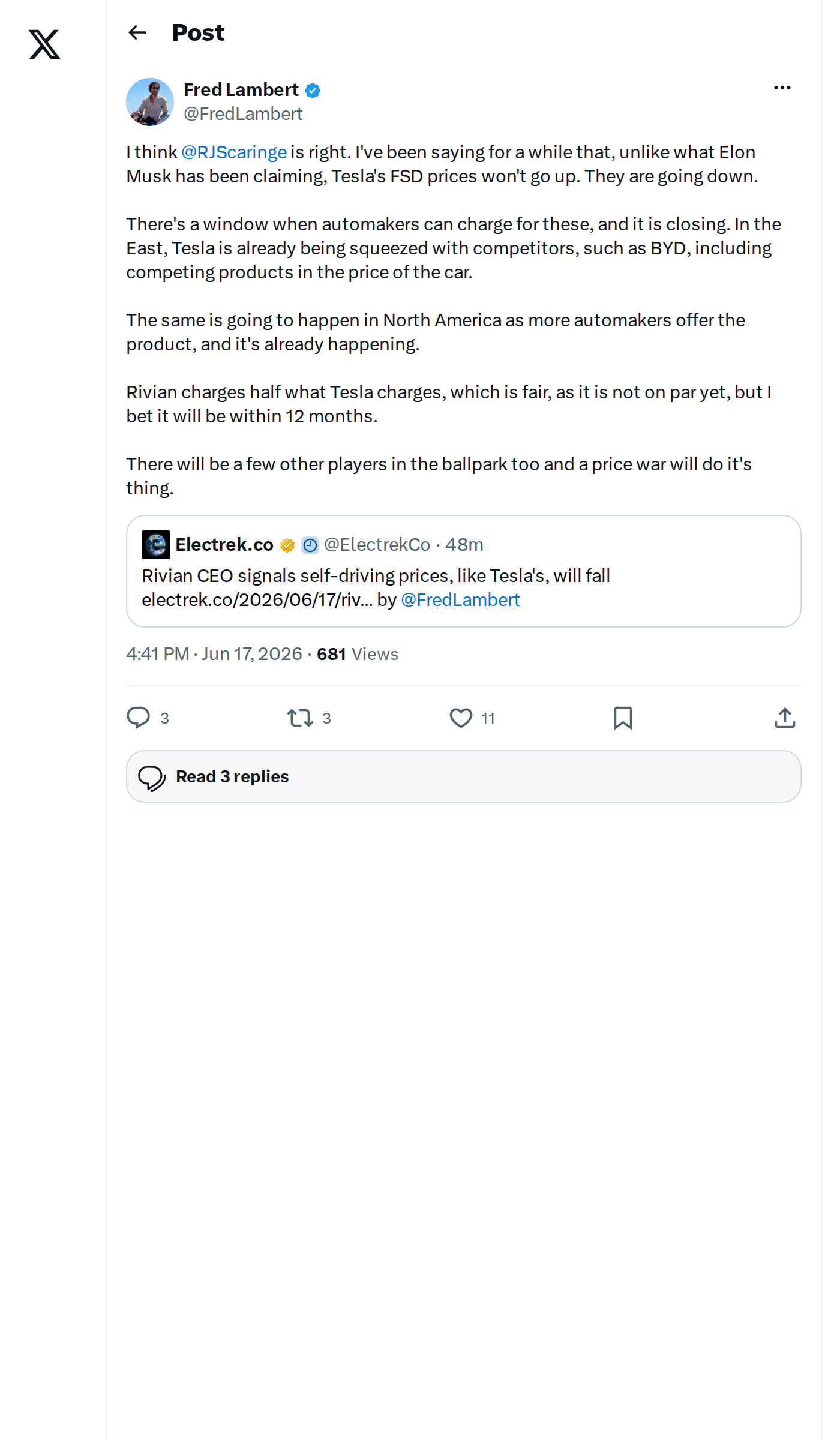
Fred Lambert, a prominent EV industry analyst, argued this week that Tesla's FSD pricing is almost certainly heading in the opposite direction. The core argument: there's a limited window during which automakers can charge premium prices for driver-assistance software, and that window is closing faster than Tesla's official stance acknowledges.

The Official Position vs. Market Reality
Tesla's current stance is straightforward: FSD (Supervised) costs $99 per month in the United States, and that price is expected to rise as the system matures toward unsupervised autonomy. Musk has framed this as a value proposition — pay now before the price climbs. As of February 2026, Tesla also eliminated the one-time purchase option entirely, making the monthly subscription the only path to FSD access for new buyers.
The internal logic holds up in isolation. FSD v14.3 rolled out in April 2026, and version 15 — built on a significantly larger model architecture — is in active development. If the technology genuinely reaches unsupervised operation, charging more for it isn't unreasonable.
But Lambert's argument isn't really about what the technology is worth. It's about what the market will actually bear.
The Competitive Squeeze — Especially in the East
The pressure Lambert references is most visible in China and broader Asian markets, where domestic automakers have been aggressive about bundling advanced driver-assistance features at little or no additional cost. For Tesla, which competes directly in those markets, charging a meaningful monthly premium for FSD becomes increasingly difficult when rivals are treating comparable capabilities as standard equipment.
This isn't a hypothetical future scenario. Tesla has already faced margin compression in China, adjusting vehicle prices multiple times in response to local competition. The same competitive logic that forced vehicle price cuts could apply to software subscriptions — perhaps more acutely, since software pricing is even more visible and comparable across brands.
Lambert's position also aligns with a broader industry pattern: as autonomous driving features proliferate across the market, they shift from premium differentiators to expected baseline features. The window to monetize them as standalone subscriptions narrows as that shift accelerates.
What This Means for Current FSD Subscribers
For Tesla owners currently paying $99/month, the near-term picture is unlikely to change dramatically either way. Tesla has shown no indication of an imminent price cut in the U.S. market, and Musk's public statements continue to point toward increases tied to capability milestones.
The more relevant question is what happens if and when FSD reaches unsupervised operation — the moment Tesla has consistently cited as the trigger for a significant price increase. If Lambert and others are correct that competitive pressure will override that strategy, owners who are holding off on subscribing may find the calculus shifts in their favor over time rather than against it.
One data point worth noting: as of May 2026, Musk acknowledged publicly that no major automaker has expressed interest in licensing Tesla's FSD technology. That limits one potential revenue path Tesla had floated, putting more weight on the direct consumer subscription model — and more pressure on getting that pricing strategy right.
The debate between Musk's price-increase narrative and Lambert's market-pressure thesis won't be settled by analysis alone. It'll be settled by what Tesla actually does when the next capability milestone arrives and the company has to decide whether the market will follow its pricing lead — or push back.
📋 Tracking Tesla software? See every firmware, FSD and app version in one place in our Tesla Software Update Tracker.
Related Gear
Gear up your Tesla with tested, custom-fit BASENOR accessories — shop Tesla accessories →
Sources & reporting notes
The links below identify the material source records used for this report.
- @FredLambert on X (2026-06-17T16:41:05.000Z) — Direct source
Source links are preserved as published or accessed. See our editorial standards and corrections policy.
The BASENOR Editorial Desk covers Tesla, SpaceX, and related technology, curating reporting from primary sources — official accounts, regulatory filings, and software release data. Every article passes source-record and fact-checking review before publication. About the newsroom.
This report was curated by the BASENOR Editorial Desk from the sources listed above. Read our editorial standards or email editorial@basenor.com to report an error.