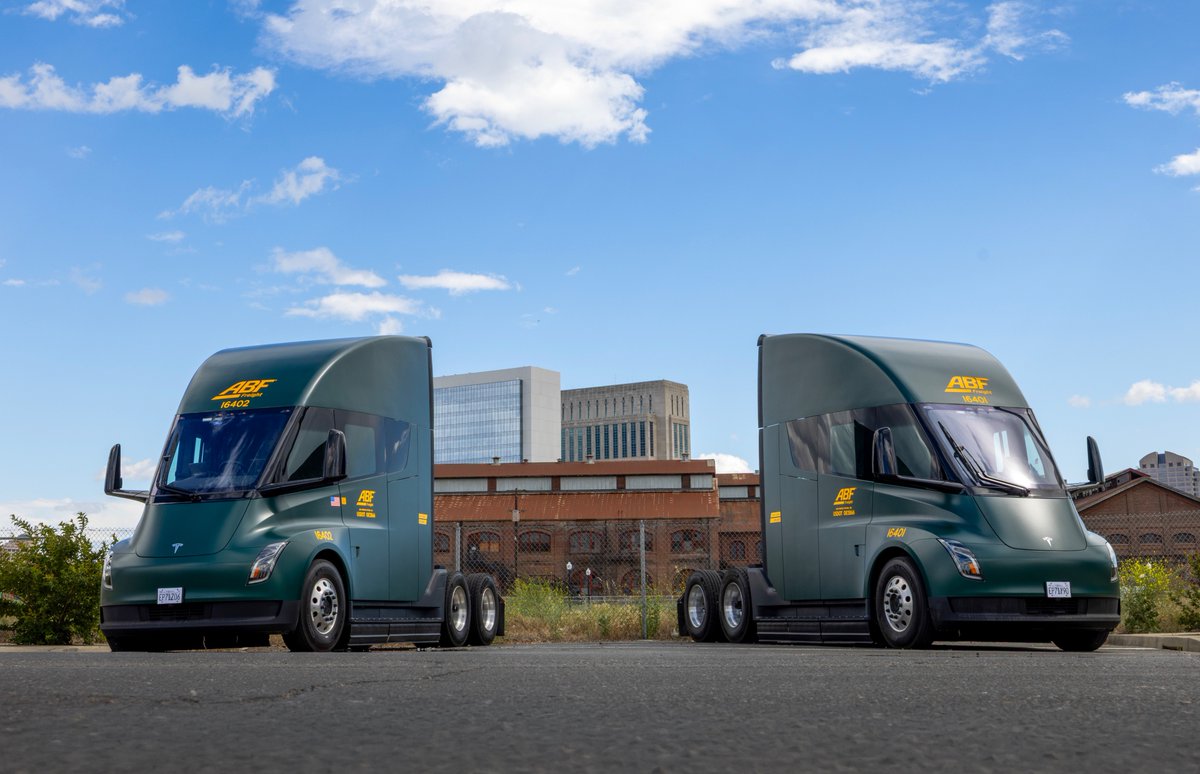
ArcBest's less-than-truckload subsidiary ABF Freight has officially purchased two Tesla Semi trucks, converting a 2025 pilot program into a real fleet commitment. The decision comes after a three-week trial that logged 4,494 miles across some of California's most demanding freight corridors — and the efficiency numbers held up.

What the Pilot Actually Showed
The 2025 pilot ran ABF's Tesla Semi on real dispatch lanes — not a controlled test track. Routes included terminal runs between Reno, Nevada, and Sacramento, California, regional Bay Area operations, and rail shuttle work. The truck also tackled a 7,200-foot climb over Donner Pass, the kind of grade that exposes weaknesses in any powertrain.
The headline number: 1.55 kWh per mile average energy efficiency, which according to ArcBest's own data generally matched the performance of its diesel counterparts on equivalent routes. Average daily range came in at 321 miles — workable for regional linehaul, though ArcBest was transparent that longer-haul expansion will depend on charging infrastructure catching up.
| Metric | Result |
|---|---|
| Pilot duration | 3 weeks |
| Total miles covered | 4,494 miles |
| Average daily range | 321 miles |
| Energy efficiency | 1.55 kWh/mile |
| Max elevation challenge | 7,200 ft (Donner Pass) |
Drivers Liked It — and That Matters
Fleet operators know that a truck drivers won't run willingly is a truck that sits. ABF's drivers flagged the Tesla Semi's center seat configuration, wide visibility, and intuitive controls as genuine positives — not just PR talking points. Comfort and ease of use on multi-hour regional runs are the kind of feedback that actually moves a procurement decision forward.

Where the Trucks Are Headed
The two purchased Semis will primarily support linehaul operations within California, with planned expansion into Reno and potentially other corridors as charging infrastructure develops. ArcBest was candid that broader deployment across longer routes isn't yet practical — the limiting factor isn't the truck, it's the network of chargers along freight corridors.
That infrastructure gap is the recurring theme across every early Tesla Semi adopter. The truck's performance in real dispatch conditions has consistently impressed; the question for fleet operators is always whether they can keep it charged between runs without operational disruption.
Tesla, for its part, has targeted volume Semi production for 2026, with the first units off the high-volume line at Gigafactory Nevada expected in the first half of the year. ArcBest's purchase — modest in scale but significant as a validated real-world data point — arrives at exactly the moment Tesla needs commercial operators to publicly back the platform. Expect more freight names to follow if the charging infrastructure story continues to improve.
Related Gear
Gear up your Tesla with tested, custom-fit BASENOR accessories — shop Tesla accessories →
Sources & reporting notes
The links below identify the material source records used for this report.
- @SawyerMerritt on X (2026-06-11T14:32:43.000Z) — Direct source
- @SawyerMerritt on X (2026-06-11T14:32:44.000Z) — Direct source
Source links are preserved as published or accessed. See our editorial standards and corrections policy.
The BASENOR Editorial Desk covers Tesla, SpaceX, and related technology, curating reporting from primary sources — official accounts, regulatory filings, and software release data. Every article passes source-record and fact-checking review before publication. About the newsroom.
This report was curated by the BASENOR Editorial Desk from the sources listed above. Read our editorial standards or email editorial@basenor.com to report an error.