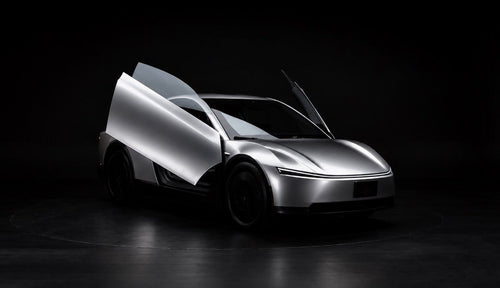
Three separate threads on X this week converged on the same conclusion: Tesla's Cybercab is better positioned than its critics admit. Fresh ride-hailing data dismantles the most common knock on the two-seat design, a closer look at the vehicle's conversational AI reveals something closer to a co-pilot than a voice assistant, and an IRA credit breakdown suggests the battery economics are more aggressive than most analysts have modeled.
1. The two-seat design is backed by actual trip data — not assumptions
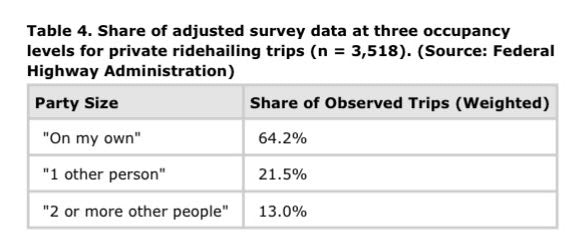
The loudest skepticism around the Cybercab has always been its passenger capacity: two seats, no more. Critics argue that consumers buying four- and five-seat vehicles signals demand for that space. Sawyer Merritt pushed back hard on that framing this week, citing a Federal Highway Administration study showing that roughly 85% of private ride-hailing trips involve just one or two passengers — with 64.2% of trips carrying a single rider.
The distinction matters. What people buy for personal ownership — where occasional family trips, cargo capacity, and optionality all factor in — is a poor proxy for what a robotaxi fleet actually needs to serve. A vehicle optimized for the 85% use case isn't a compromise; it's a deliberate product decision. According to background research, Tesla also targets an operating cost below $0.30 per mile for the Cybercab, a figure that only works at scale with a purpose-built, stripped-down platform. Carrying two seats instead of five is part of how that number gets achieved.
2. The conversational AI goes well beyond voice commands
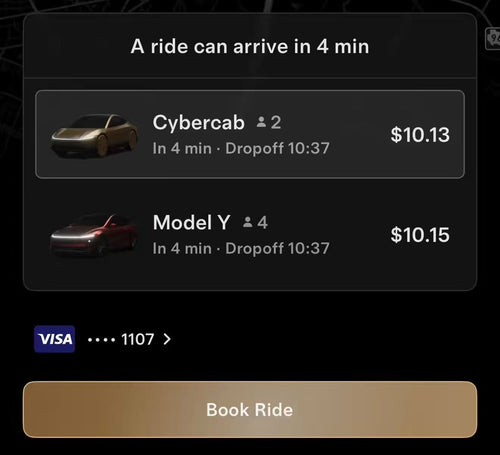
Whole Mars Catalog described the Cybercab's passenger interaction this way: you'll be able to talk to the car like a cab driver — ask it to do whatever you want, as long as it's legal and won't hurt anyone.
That framing is more meaningful than it sounds. Most in-car voice systems today are command-and-response: say a specific phrase, get a specific action. What's being described here is a conversational agent — one that can handle open-ended requests, route changes mid-trip, music preferences, and presumably questions about the ride itself. According to background research, the Cybercab's on-board voice interface is powered by a specialized version of ChatGPT, functioning as a multimodal agent capable of anticipating road behavior and interacting vocally with passengers. The system is designed to react to unexpected situations and navigate complex intersections — meaning the AI isn't just listening to passengers, it's also processing the environment in real time. For riders accustomed to awkward, keyword-dependent car interfaces, this represents a meaningful step change in what a driverless ride actually feels like.
3. IRA battery credits could push the pack cost under $3,000
The third data point is the one with the most direct financial implication. Whole Mars Catalog flagged that with the IRA battery production credit factored in, the cost of a full Cybercab battery pack could come in under $3,000.
Here's the math behind it. The Cybercab carries a 47.6 kWh usable battery pack built on 4680 cells. The IRA provides a production credit of $35 per kWh for battery cells and $10 per kWh for battery modules — up to $45 per kWh if both apply. On a 47.6 kWh pack, that's a potential credit of roughly $2,142. When stacked against Tesla's already-aggressive 4680 cell cost targets and a stated build cost goal of under $30,000 for the full vehicle, the battery pack becomes one of the cheapest line items on the bill of materials for a vehicle of this capability. A sub-$3,000 pack cost isn't just a talking point — it's the kind of structural cost advantage that makes a $0.30/mile operating target credible rather than aspirational.
Taken together, these three threads sketch a Cybercab that is more defensible on design, more capable on software, and more competitive on economics than the skeptic narrative suggests. The real test remains deployment scale — but the underlying numbers are holding up.
🚕 Following the Robotaxi rollout? See every operating city, launch date and announced market in our Tesla Robotaxi Tracker.
Related Gear
Gear up your Tesla with tested, custom-fit BASENOR accessories — shop Tesla accessories →
Sources & reporting notes
The links below identify the material source records used for this report.
- @wholemars on X (2026-11-07T22:29:02.000Z) — Direct source
- @SawyerMerritt on X (2026-11-07T22:35:17.000Z) — Direct source
- @wholemars on X (2026-11-07T22:45:52.000Z) — Direct source
Source links are preserved as published or accessed. See our editorial standards and corrections policy.
The BASENOR Editorial Desk covers Tesla, SpaceX, and related technology, curating reporting from primary sources — official accounts, regulatory filings, and software release data. Every article passes source-record and fact-checking review before publication. About the newsroom.
This report was curated by the BASENOR Editorial Desk from the sources listed above. Read our editorial standards or email editorial@basenor.com to report an error.