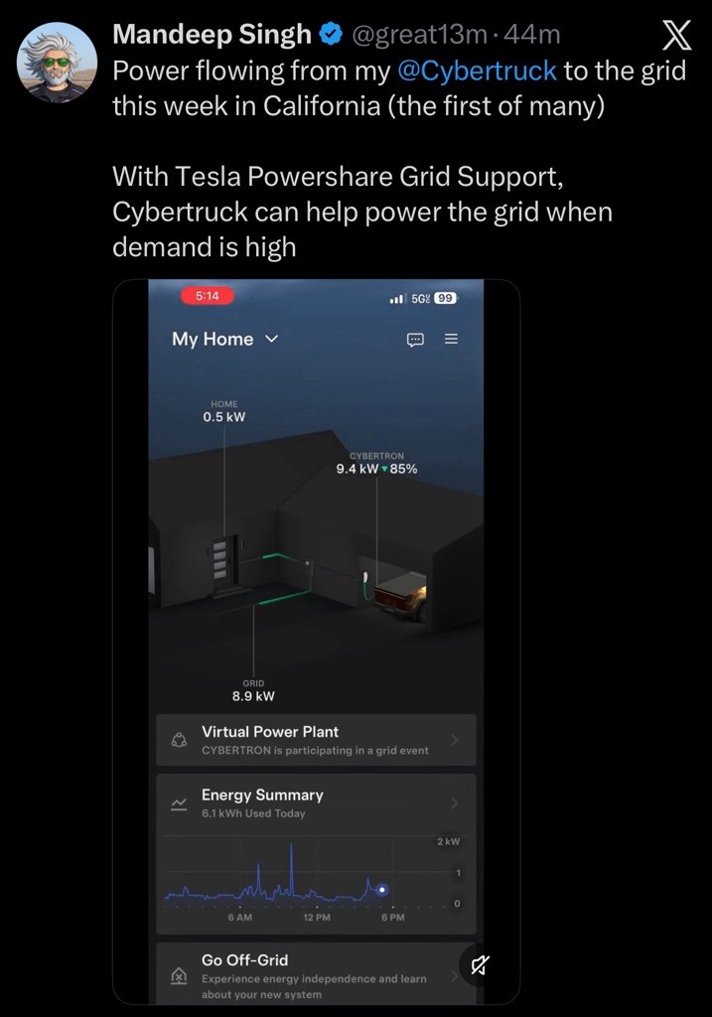
Tesla Energy confirmed this week that the Cybertruck is now actively powering the electrical grid — a milestone that transforms the vehicle from a consumer truck into a node in the broader energy infrastructure. The announcement, made via the official @teslaenergy account, marks the commercial activation of Powershare Grid Support, a program that lets Cybertruck owners sell stored energy back to the grid during high-demand periods in exchange for bill credits.

How Powershare Grid Support Works
The Cybertruck's 123 kWh battery — roughly equivalent to nine Powerwalls — gives it meaningful capacity to contribute to grid stabilization events. When a utility signals high demand, enrolled Cybertrucks discharge stored energy back through the home's electrical system and onto the grid. Owners receive bill credits in return. The system requires firmware version 2026.14 or later, and the entire process is managed through the Tesla app, where owners can set minimum battery reserve levels so the truck is never left depleted.
The technical approach here is worth noting. According to verified sources, Tesla built Powershare around AC power rather than DC-based Vehicle-to-Grid (V2G) architectures used by some other automakers. That decision makes the required hardware — a Powershare Gateway and a Universal Wall Connector — simpler and less expensive to install than DC-coupled alternatives. It also means the system connects through standard residential electrical equipment rather than requiring purpose-built grid infrastructure at the home.
Rollout So Far
Tesla Energy launched Powershare Grid Support in February 2026, initially in select Texas markets through partnerships with CenterPoint Energy and Oncor. The program expanded to California in April 2026, with the Cybertruck, Powershare Gateway, and Universal Wall Connector approved for participation in PG&E's residential Vehicle-to-Everything (V2X) pilot program. This week's announcement from Tesla Energy signals the program has reached a stage of broader operational confidence — though geographic availability remains tied to utility partnerships.
Powershare Grid Support at a Glance
| Battery Capacity | 123 kWh (~9 Powerwalls) |
| Home Backup Output | Up to 11.5 kW continuous |
| Home Backup Duration | 3+ days for average home |
| Required Firmware | 2026.14 or later |
| Required Hardware | Powershare Gateway + Universal Wall Connector |
| Compensation | Utility bill credits |
| Warranty Impact | None (via Tesla Electric for early adopters) |
| Current Markets | Texas (CenterPoint, Oncor), California (PG&E V2X pilot) |
The Bigger Picture for Tesla Energy
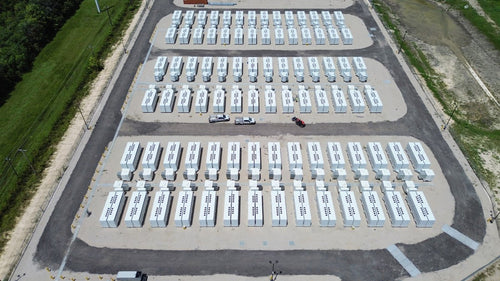
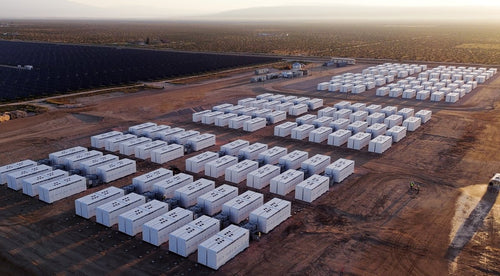
This isn't just a truck feature — it's a strategic expansion of Tesla's energy business. Every enrolled Cybertruck effectively becomes a distributed battery asset on the grid, the same role Megapacks play at the utility scale. If Tesla can aggregate tens of thousands of Cybertrucks into a virtual power plant, the combined capacity becomes commercially significant to utilities managing peak demand events.
The Powerwall integration piece remains the outstanding item. According to background research, full coordination between the Cybertruck's inverter and the Powerwall's inverter — where the Powerwall discharges first and the truck acts as extended storage — was still in development as of this announcement. The technical challenge involves two grid-forming devices negotiating which one takes the lead role in forming the home microgrid. That integration, when it arrives, will make the Cybertruck-plus-Powerwall combination significantly more capable as a home energy system.
For Cybertruck owners in eligible markets, the calculus is straightforward: the hardware investment in a Powershare Gateway and Universal Wall Connector unlocks both grid compensation and home backup capability from a battery they already own. The warranty protection for early adopters removes what was previously a meaningful objection. Whether the bill credits justify the hardware cost will depend on local utility rates and the frequency of grid support events — but the infrastructure to participate is now live.
Related Gear
Gear up your Cybertruck with tested, custom-fit BASENOR accessories — shop Cybertruck accessories →
Sources & reporting notes
The links below identify the material source records used for this report.
- @teslaenergy on X (2026-08-29T01:45:55.000Z) — Direct source
Source links are preserved as published or accessed. See our editorial standards and corrections policy.
The BASENOR Editorial Desk covers Tesla, SpaceX, and related technology, curating reporting from primary sources — official accounts, regulatory filings, and software release data. Every article passes source-record and fact-checking review before publication. About the newsroom.
This report was curated by the BASENOR Editorial Desk from the sources listed above. Read our editorial standards or email editorial@basenor.com to report an error.