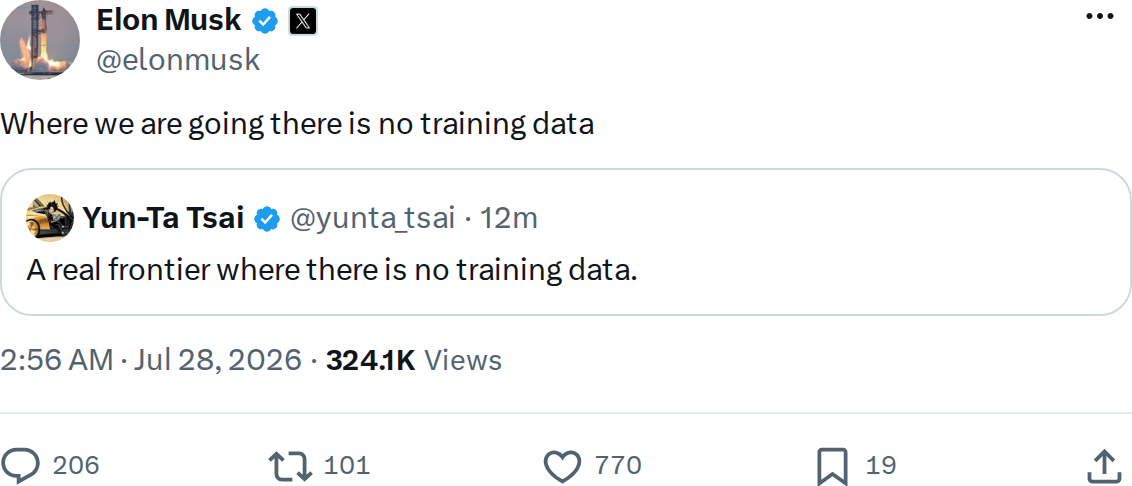
Elon Musk posted seven words on Monday night that sent AI researchers into a quiet frenzy: 'Where we are going there is no training data.' It sounds like a movie quote, but the context is serious — and for Tesla owners and anyone watching xAI, it points to a genuine inflection point in how advanced AI systems are being built.

What does 'no training data' actually mean?
Traditional AI models — including early versions of Grok and the neural networks behind Tesla FSD — are trained on massive datasets of human-generated content: text, images, video, sensor logs. The problem is that this well is running dry. According to Musk's own statement in January 2025, the 'cumulative sum of human knowledge has been exhausted in AI training,' with that threshold effectively crossed during 2024. Academic projections have suggested publicly available data for large AI models could be depleted by 2026. Musk's tweet signals that the next generation of AI can't simply wait for more human-generated data to appear — it has to operate differently.
So how do you train AI when there's nothing left to train on?
The leading answer is synthetic data — AI generating its own training material. Rather than learning from human-written text or human-driven miles, a model produces examples, evaluates them, critiques its own outputs, and iterates. Musk has pointed to this approach as the path forward, though he has also flagged its risks: AI models are prone to 'hallucinations,' and feeding flawed synthetic outputs back into training can compound errors over time. Researchers at the UK's Alan Turing Institute have warned this cycle can cause 'model collapse,' where quality degrades with each synthetic generation. Getting synthetic data pipelines right is genuinely hard.
How does this connect to Tesla FSD specifically?
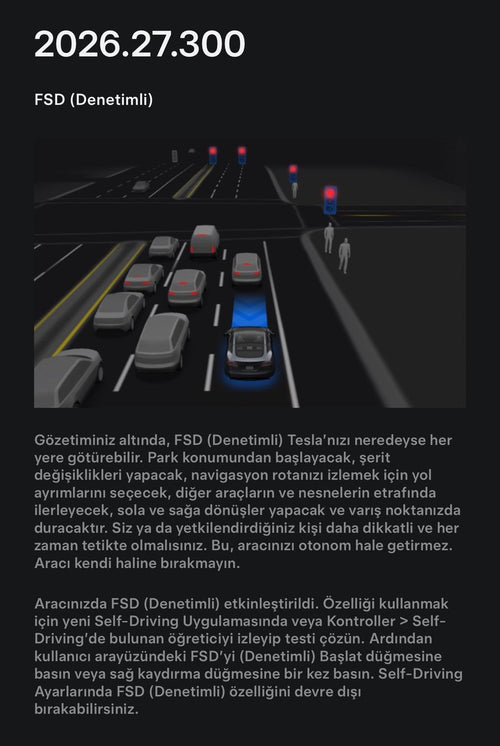
Tesla is already deep into synthetic data territory. The company's Neural Video Engine is purpose-built to generate artificial driving environments — rare road conditions, unusual pedestrian behaviors, edge-case traffic scenarios — that real-world fleet data alone can't supply at the needed scale or diversity. Nvidia CEO Jensen Huang specifically called out Tesla's FSD approach in January 2026, praising its handling of 'data collection, curation, synthetic data generation, and all of their simulation technologies.' Musk's tweet likely reflects the same reality FSD engineers are living: the frontier driving scenarios that matter most for full autonomy simply don't exist in recorded footage yet. You have to synthesize them.
What does this mean for xAI and Grok?
xAI is simultaneously pushing toward what Musk has called AGI — artificial general intelligence — with a projected timeline as early as 2026. Training for Grok 4.6, a 2-trillion-parameter model that Musk described as 'superior in all aspects' to its predecessor, entered its final stages around July 18, 2026. At that scale, the scarcity of novel, high-quality human-generated training data becomes a hard constraint. Moving 'where there is no training data' almost certainly means xAI is betting on self-supervised learning, AI-generated reasoning chains, and synthetic benchmarks to push Grok beyond what any existing human corpus can teach it.
Should Tesla owners read anything into this?
Indirectly, yes. Every FSD capability improvement that requires understanding genuinely novel scenarios — a flooded intersection, an unmarked construction detour, a child darting between parked cars in a configuration the fleet has never seen — depends on synthetic data filling the gaps real-world collection can't. Musk's comment suggests that the teams working on both Grok and FSD are operating in the same frontier: building AI that can reason and improve in environments where no human ever thought to label a dataset. That's the underlying bet behind Tesla's autonomy roadmap, and it's a significant one.
Related Gear
Gear up your Tesla with tested, custom-fit BASENOR accessories — shop Tesla accessories →
Sources & reporting notes
The links below identify the material source records used for this report.
- @elonmusk on X (2026-07-28T02:56:34.000Z) — Direct source
Source links are preserved as published or accessed. See our editorial standards and corrections policy.
The BASENOR Editorial Desk covers Tesla, SpaceX, and related technology, curating reporting from primary sources — official accounts, regulatory filings, and software release data. Every article passes source-record and fact-checking review before publication. About the newsroom.
This report was curated by the BASENOR Editorial Desk from the sources listed above. Read our editorial standards or email editorial@basenor.com to report an error.