
SpaceX has agreed to walk away from roughly $738 million in federal broadband subsidies under the Broadband Equity, Access, and Deployment (BEAD) program. In exchange, Starlink will supply its satellite internet hardware for free to eligible rural American households, guarantee minimum speeds of 100 Mbps down and 20 Mbps up, and commit to serving those locations for the next decade. The arrangement, disclosed in a new model agreement with the National Telecommunications and Information Administration (NTIA), reshapes how the largest low-earth-orbit provider participates in Washington's flagship rural broadband push.
The trade-off is straightforward: SpaceX gets exempted from most of BEAD's financial audits, procurement rules, and administrative reporting, while taxpayers avoid writing a nine-figure check. Starlink still has to prove its network performs.

What SpaceX Is Agreeing To
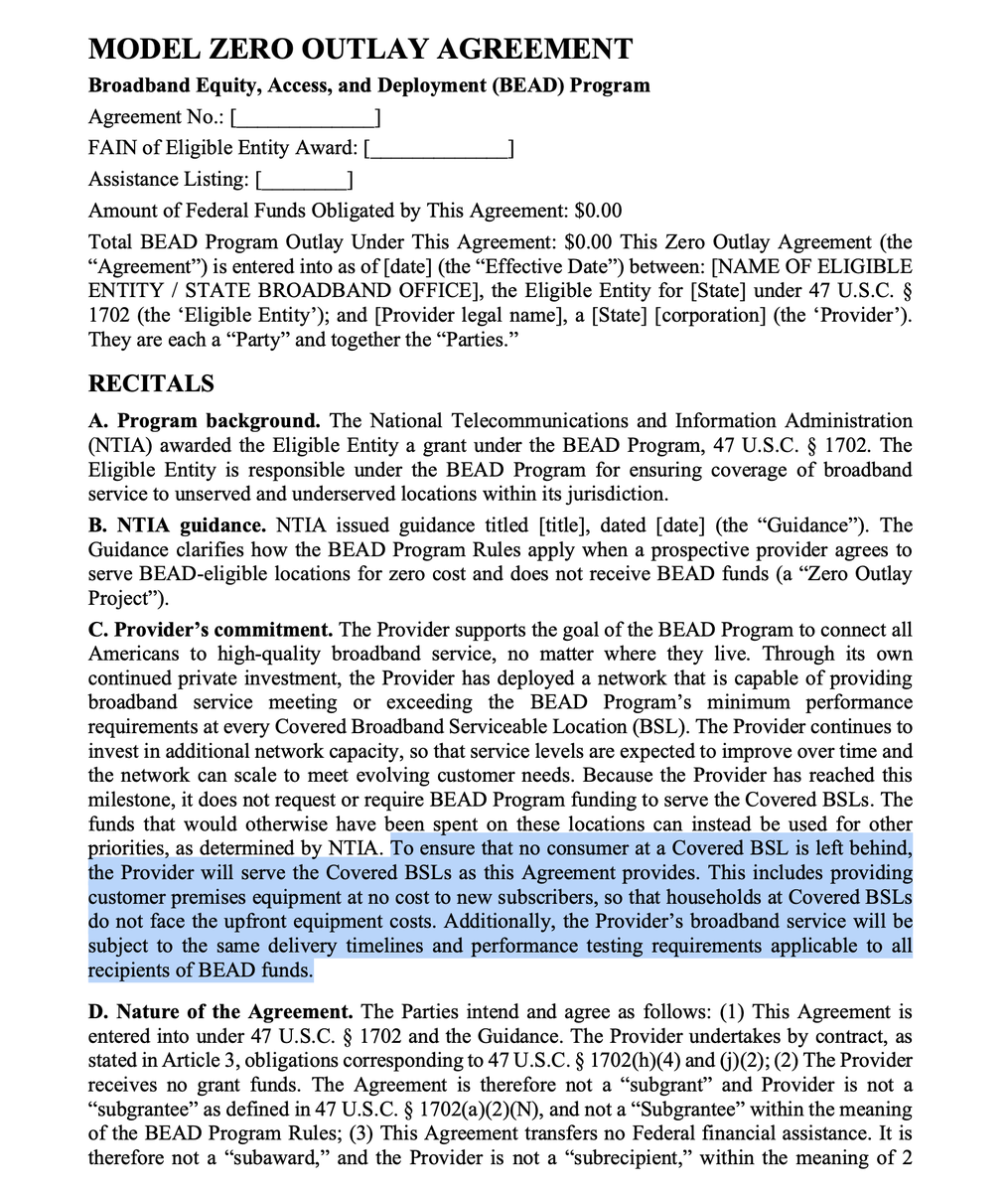
The NTIA's statement, as surfaced by Sawyer Merritt, lays out the obligations clearly: “To ensure that no consumer at a Covered BSL is left behind, the provider (SpaceX) will serve the covered BSLs as this agreement provides. This includes providing customer premises equipment at no cost to new subscribers, so that households at covered BSL do not face the upfront equipment costs.”
Under the deal, SpaceX commits to:
- Provide free Starlink hardware to eligible households at Covered Broadband Serviceable Locations (BSLs).
- Guarantee minimum download speeds of 100 Mbps and upload speeds of 20 Mbps.
- Offer a low-cost monthly internet plan for qualifying subscribers.
- Deliver service for at least 10 years.
- Remain subject to federal network performance testing, on the same timeline that applies to other BEAD recipients.
In return, SpaceX is released from most of BEAD's non-performance paperwork — the procurement mandates, financial audits, and administrative reporting that traditional grantees have to shoulder. Performance testing, the one piece that actually matters to end users, stays in place.
Key Figures
| Term | Value |
|---|---|
| Subsidy forgone | ~$738 million |
| Minimum download speed | 100 Mbps |
| Minimum upload speed | 20 Mbps |
| Service commitment | 10 years |
| Standard Starlink kit cost (previously) | $349 upfront |
| Residential plan range (today) | $55–$130/month |
How We Got Here
BEAD was designed as a fiber-first program under the prior administration, which initially left satellite providers like Starlink on the sidelines. That stance has shifted over the past year as officials revisited whether tens of billions in federal fiber subsidies would actually reach the hardest-to-serve homes within the program's timelines. Low-earth-orbit satellite service became the pragmatic answer for the most remote BSLs — the ones where trenching fiber would cost tens of thousands of dollars per address.
Starlink has been signaling where it wants to go commercially for months. According to reporting from PCMag and Telecompetitor, the company began offering its standard residential kit — dish, Wi-Fi router, cables, and mounting hardware — for free to new customers in select U.S. areas starting around April 2025, typically with a 12-month service commitment. In September 2026, Starlink expanded a separate offer that bundles a free Starlink Mini rental with any active Residential plan. The NTIA agreement formalizes that “hardware for free” posture and extends it, with federal backing, to the specific rural addresses BEAD is meant to cover.
This is also a continuation of SpaceX's broader rural push. Earlier this month we covered how Starlink is reshaping rural education worldwide, and last week's news that Starlink is bringing internet to foster homes across 16 countries. The through-line is the same: the company increasingly wins ground by giving hardware away and monetizing the service tail.

Why the Trade-Off Makes Sense for Both Sides
For the NTIA, the math is attractive. BEAD recipients that take the money also take on heavy compliance machinery: procurement rules, audits, Davis-Bacon-style wage reporting, and periodic administrative filings that persist for years. Those requirements made sense for providers trenching fiber across counties, but they add overhead with little marginal benefit when the “build” is really the manufacturing and shipping of a satellite dish. By letting SpaceX opt out of that paperwork — in return for the company eating the subsidy — the agency keeps $738 million on the federal ledger and still gets rural households connected.
For SpaceX, the calculus is equally clean. Starlink is already producing user terminals at scale, and the company has been subsidizing hardware costs to drive residential subscriber growth for over a year. Agreeing to give kits to BEAD-eligible households is largely a formalization of what Starlink is doing commercially in many rural ZIPs anyway. What SpaceX gets in return — exemption from the heaviest BEAD compliance obligations — is genuinely valuable, because the reporting and audit regime would have slowed the pace at which Starlink can activate locations.
The 10-year service commitment and the mandatory low-cost plan are the real consumer protections. They prevent a scenario where free hardware is used as a loss leader for subscriptions that later become unaffordable, and they ensure the Covered BSLs stay connected for a full decade regardless of commercial churn.
What Starlink Still Has to Prove
The one piece SpaceX is not exempted from is network performance testing. BEAD's standard performance regime requires grantees to validate real-world speeds and latency at subscriber premises, not just in lab conditions. Starlink will be measured against the same 100/20 Mbps floor that every other BEAD recipient faces. That is a meaningful bar in congested service cells — Starlink's downlink performance has fluctuated in dense regions as the subscriber base has grown, and the company has been launching V2 Mini and V3 satellites to add capacity. Honoring 100/20 at every Covered BSL for 10 years will require continued aggressive launch cadence.
What to Watch Next
- State-level roll-ins. BEAD funds are allocated to states, which each run their own sub-award processes. Expect state broadband offices to begin designating Covered BSLs that will be served under the SpaceX model agreement rather than through fiber grants.
- The low-cost plan's price point. NTIA has not published the dollar figure for Starlink's BEAD low-cost offering. Given Starlink's standard residential tier runs $55–$130/month, the eligible-household plan will likely come in meaningfully below that floor.
- Performance testing results. The first round of mandatory speed and latency reporting under the agreement will be the clearest signal of whether Starlink can hold 100/20 as it onboards tens of thousands of new rural subscribers.
- Competitive response. Other fixed-wireless and satellite providers will push to be treated under similar “hardware-for-subsidy” swaps, which could reshape how BEAD money actually gets deployed through 2027.
For the moment, this is one of the cleaner wins the BEAD program has produced since its inception: hundreds of thousands of rural addresses get a credible path to 100/20 service, taxpayers keep the subsidy, and the provider trades money for speed-to-deploy. The next test is whether Starlink's capacity curve keeps up with the households it's now contractually obligated to serve through 2036.
Related Gear
Gear up your Tesla with tested, custom-fit BASENOR accessories — shop Tesla accessories →
Sources & reporting notes
The links below identify the material source records used for this report.
- @SawyerMerritt on X (2026-11-24T19:42:13.000Z) — Direct source
- @wholemars on X (2026-11-24T19:49:12.000Z) — Direct source
Source links are preserved as published or accessed. See our editorial standards and corrections policy.
The BASENOR Editorial Desk covers Tesla, SpaceX, and related technology, curating reporting from primary sources — official accounts, regulatory filings, and software release data. Every article passes source-record and fact-checking review before publication. About the newsroom.
This report was curated by the BASENOR Editorial Desk from the sources listed above. Read our editorial standards or email editorial@basenor.com to report an error.