
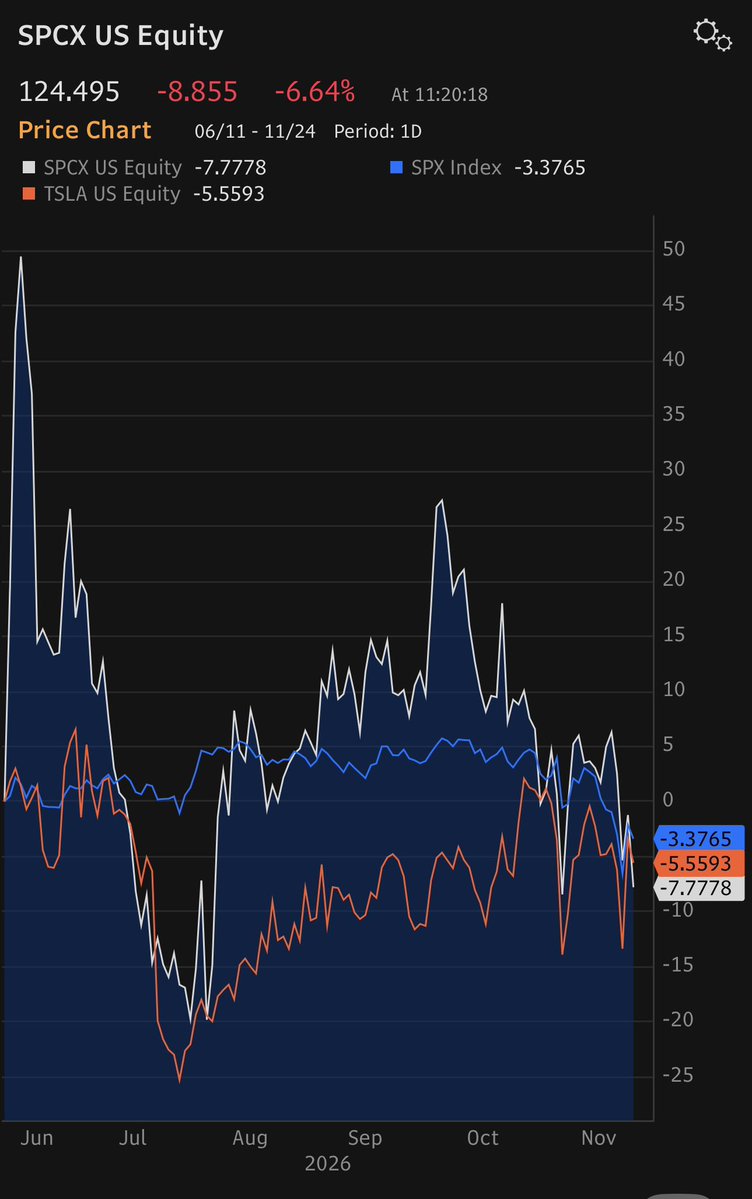
Tesla and SpaceX have reportedly named five directors to the special committees tasked with hashing out the terms of a potential merger between the two Elon Musk-led companies, according to a Financial Times report cited by fund manager Gary Black on November 24. The disclosure moves the long-rumored combination from boardroom concept to active deal negotiation — and if consummated, it would stand as the largest corporate merger ever attempted.
SpaceX shares (SPCX) traded down roughly 6% on the news, with Tesla (TSLA) off 5.6% since SpaceX's June IPO versus a 3.4% drop in the broader S&P 500, per Black. That price action tracks the classic pattern for all-stock deals, where the presumptive acquirer's shares typically soften as arbitrageurs position for the 12-to-18-month gap between announcement and close.

Who's on the Committees
The Financial Times reporting, relayed by Black, names three Tesla directors and two SpaceX directors to steer the negotiations:
- Tesla: Chair Robyn Denholm, Kathleen Wilson-Thompson, and Jack Hartung.
- SpaceX: Roelof Botha (Sequoia Capital) and Randy Glein (DFJ Growth).
The committee structure is the textbook mechanism for handling a merger between two companies that share a controlling shareholder and CEO. Musk himself is a conflicted party — he leads both firms and holds dominant equity positions in each — so he is not formally participating in negotiations, though he confirmed on SpaceX's third-quarter earnings call in October that he believes a tie-up would be “a good idea.” Our earlier coverage of the committees' formation laid out the governance framework being used here.
Financial advisors were engaged alongside the committees: Morgan Stanley and Goldman Sachs are advising SpaceX, while Evercore is advising Tesla. Their current workstream is valuation, exchange ratio, and the overlapping business lines between the two companies.
The Deal Math
Black's analysis assumes the most likely structure is an all-equity SpaceX-for-Tesla deal, with SpaceX as the acquirer issuing new shares to Tesla holders. At current market caps — SpaceX estimated around $1.9–$2.0 trillion and Tesla around $1.45–$1.55 trillion based on recent third-party reporting — plus a 25% control premium for Tesla, Black calculates SpaceX would need to issue roughly 52% in new share dilution to complete the exchange.
Totaled, the transaction would land near $3.6 trillion in combined value. For context, the current record-holders in M&A — Vodafone-Mannesmann in 1999 at roughly $200 billion, and AOL-Time Warner in 2000 at $165 billion — would be dwarfed by an order of magnitude.
Key Figures
| Metric | Value | Source |
|---|---|---|
| Estimated combined deal value | ~$3.6 trillion | Gary Black estimate |
| Assumed Tesla control premium | 25% | Gary Black estimate |
| Required SpaceX share dilution | ~52% | Gary Black estimate |
| SPCX move on report | −6% | Gary Black / market data |
| SPCX performance since June IPO | −7.7% | Gary Black |
| TSLA performance over same period | −5.6% | Gary Black |
| S&P 500 benchmark over same period | −3.4% | Gary Black |
| Tesla Megapack sales to SpaceX (9M 2026) | $626 million | Prior reporting |
Why the Acquirer's Stock Usually Sinks
Black flags the SPCX price action as a textbook arbitrage response. In an all-equity deal, holders of the target company (Tesla, in this scenario) know they will receive the acquirer's stock at close. To lock in the implied premium, arbitrage funds short the acquirer and go long the target. That selling pressure typically persists through the 12-to-18-month period between deal announcement and regulatory close, often pushing the acquirer's shares below their pre-announcement level.
The inverse — Tesla as the nominal acquirer buying SpaceX — is less likely because SpaceX's valuation is larger, which would require Tesla to issue even more dilutive stock. HSBC's bull case, which we analyzed last week, is built on exactly this asymmetry: Tesla shareholders would be exchanging their stock for exposure to SpaceX's rocket, Starlink, and Starmind economics at today's price.
How We Got Here
Musk publicly confirmed the special committees during SpaceX's Q3 earnings call on October 20, 2026. Bloomberg reported earlier this month that an announcement could come as soon as December. The naming of specific directors on both sides — the FT's reporting today — is the clearest signal yet that both boards are moving past exploratory talks into substantive negotiation.
The strategic logic from Musk's perspective centers on consolidating control of his AI, robotics, and compute stack under one entity. Potential synergies identified across reporting include chip design (the Terafab project we covered earlier this month), Optimus robotics, Starlink and Starmind connectivity, and the stated goal Musk outlined of SpaceX ARR exceeding $500 billion by late 2027. Tesla has also already been selling Megapack batteries to SpaceX — $626 million worth in the first nine months of 2026 — to power Starlink ground infrastructure.
The Hurdles That Still Matter
Even with committees staffed and bankers engaged, the deal is not a formality. Three obstacles stand out:
Tesla shareholder approval. A merger requires the affirmative vote of 50% of all outstanding Tesla shares — not just a majority of those voting. Musk has called this a “high hurdle” himself. SpaceX approval is easier because Musk personally controls over 50% of SpaceX voting power.
Regulatory review. SpaceX holds classified U.S. defense contracts through its launch and Starshield businesses. Tesla has substantial manufacturing exposure in China. Combining the two under one corporate roof will invite scrutiny from the Committee on Foreign Investment in the United States (CFIUS), the Department of Defense, and Chinese regulators — any of which could demand divestitures or structural concessions.
Valuation disagreement. Both companies are negotiating against their own shareholders' interests on the exchange ratio. Independent advisors will need to produce fairness opinions that both committees can defend, and the final ratio will set the baseline for any shareholder litigation that follows.
What to Watch Next
- A formal 8-K from Tesla confirming the committee membership and advisor engagement — anything beyond the FT's sourcing elevates this to confirmed corporate action.
- The exchange ratio when it leaks or is announced. A premium above 25% signals a stronger hand for Tesla shareholders; below 20% suggests SpaceX is winning the valuation argument.
- SPCX and TSLA share price spread — the discount at which TSLA trades to its implied deal value will tell you what the market is pricing for close probability.
- December timeline test. Bloomberg's earlier reporting pointed to a possible December announcement. If the month passes without a definitive agreement, the base case shifts to Q1 2027 at the earliest.
For Tesla owners, none of this changes anything in your car tomorrow. But if the deal closes on anything close to the terms being discussed, the share you own — or the equity sitting inside your 401(k) — would convert into a stake in a combined vehicle, robotics, AI, launch, and satellite business whose only real comparable in history is the conglomerates of the 1960s. The committees that were just staffed will decide the ratio at which that conversion happens.
Related Gear
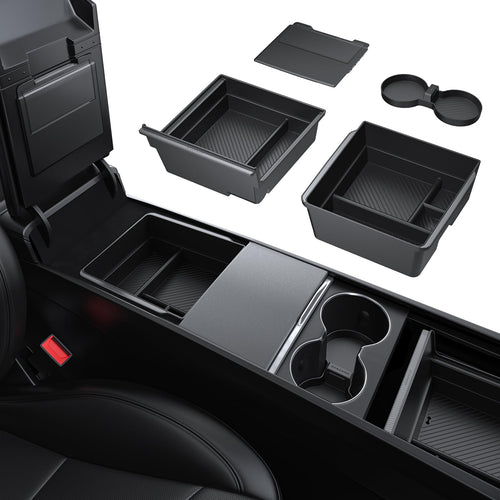
Gear up your Tesla with tested, custom-fit BASENOR accessories — shop Tesla accessories →
Sources & reporting notes
The links below identify the material source records used for this report.
- @garyblack00 on X (2026-11-24T16:23:49.000Z) — Direct source
Source links are preserved as published or accessed. See our editorial standards and corrections policy.
The BASENOR Editorial Desk covers Tesla, SpaceX, and related technology, curating reporting from primary sources — official accounts, regulatory filings, and software release data. Every article passes source-record and fact-checking review before publication. About the newsroom.
This report was curated by the BASENOR Editorial Desk from the sources listed above. Read our editorial standards or email editorial@basenor.com to report an error.