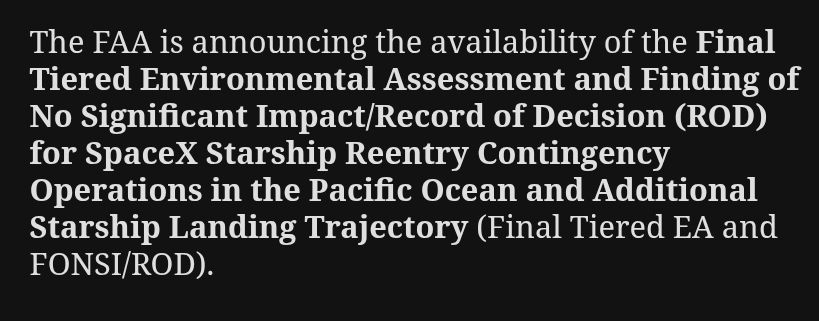
The FAA took a significant regulatory step for SpaceX on September 2, 2026, issuing its Final Tiered Environmental Assessment and Finding of No Significant Impact/Record of Decision (FONSI/ROD) for Starship reentry contingency operations in the Pacific Ocean. The ruling expands the authorized geographic footprint for Starship landings and adds an entirely new contingency zone — a meaningful license update that gives SpaceX more operational flexibility as it scales flight frequency.

What the FAA Actually Approved
The document's full title — "Final Tiered Environmental Assessment for SpaceX Starship Reentry Contingency Operations in the Pacific Ocean and Additional Starship Landing Trajectory" — signals that this isn't a single-point approval. It covers several distinct operational expansions simultaneously.
According to the FAA's assessment, the approved changes include:
- Expanded Hawaii and Central Pacific Landing Areas — previously evaluated zones have been formally enlarged, giving Starship more viable abort and landing options in the mid-Pacific corridor.
- Expanded Southeast Pacific Region Landing Area — the southern Pacific contingency footprint grows in parallel.
- New Northern Pacific Contingency Landing Area — a brand-new zone in the Northeast Pacific, specifically designated for an Eastern Range-to-Starbase trajectory. This is the most operationally significant addition: it covers the flight path from the Eastern Range (Cape Canaveral) back to Starbase in Boca Chica, Texas.
- Temporary airspace closures — authorization for TFRs (Temporary Flight Restrictions) tied to an additional Starship reentry trajectory returning to the Boca Chica launch site.

Why the Northern Pacific Zone Matters
The addition of a Northern Pacific contingency zone is the detail worth watching most closely. An Eastern Range-to-Starbase trajectory means SpaceX is formally planning for — and the FAA is formally authorizing — missions that launch from Florida's Space Coast and return to Texas. That's a fundamentally different operational profile than Starship's current Boca Chica-to-Boca Chica or Boca Chica-to-splashdown missions.
As NASASpaceflight reported, the license update "adds a Northern Pacific contingency zone for Eastern Range-to-Starbase flights" alongside the airspace authorization. The combination of an expanded landing envelope and new contingency corridors means SpaceX can route Starship across a broader arc of the Pacific without running into gaps in its regulatory coverage — a practical requirement for any vehicle flying at orbital or near-orbital velocities over international waters.

The Regulatory Process Behind the Approval
Regulatory Filing
Agency: Federal Aviation Administration (FAA)
Document: Final Tiered Environmental Assessment + FONSI/ROD
Published: September 2, 2026
Public Comment Period Closed: August 3, 2026
Scope: Modification of SpaceX existing vehicle operator license
The FONSI — Finding of No Significant Impact — is the key legal conclusion here. Under the National Environmental Policy Act (NEPA), a FONSI means the FAA determined that the proposed action won't have a significant effect on the environment, which allows the agency to proceed without a full Environmental Impact Statement. That's the faster of the two NEPA pathways, and it's the same mechanism that has governed previous Starship launch approvals at Starbase.
The public comment period for the Draft EA closed on August 3, 2026 — roughly a month before the final document was published. That relatively tight turnaround from draft to final suggests the FAA did not receive substantive objections that required significant revision.

What This Unlocks for Future Missions
Environmental approvals don't authorize a specific launch — they authorize a class of operations. What SpaceX now holds is the regulatory groundwork to modify its vehicle operator license to include these expanded zones. The next step is the license amendment itself, which can reference this EA rather than requiring a new environmental review from scratch.
In practical terms, this approval reduces one of the more unpredictable bottlenecks in Starship's launch cadence. Regulatory delays — not hardware — have historically been the long pole in the tent for Starship missions. An approved EA for Pacific contingencies means SpaceX's mission planners have more routing options pre-cleared, which should translate to fewer last-minute holds tied to airspace or environmental review gaps.
For SpaceX coverage, see our SpaceX coverage for context on how previous FAA approvals have shaped the Starship program's timeline.
🚀 Following the Starship program? See every test flight, official outcome and the next launch window in our SpaceX Starship Tracker.
Sources & reporting notes
The links below identify the material source records used for this report.
- @LabPadre on X (2026-09-02T16:07:14.000Z) — Direct source
- @NASASpaceflight on X (2026-09-02T16:30:07.000Z) — Direct source
Source links are preserved as published or accessed. See our editorial standards and corrections policy.
The BASENOR Editorial Desk covers Tesla, SpaceX, and related technology, curating reporting from primary sources — official accounts, regulatory filings, and software release data. Every article passes source-record and fact-checking review before publication. About the newsroom.
This report was curated by the BASENOR Editorial Desk from the sources listed above. Read our editorial standards or email editorial@basenor.com to report an error.