

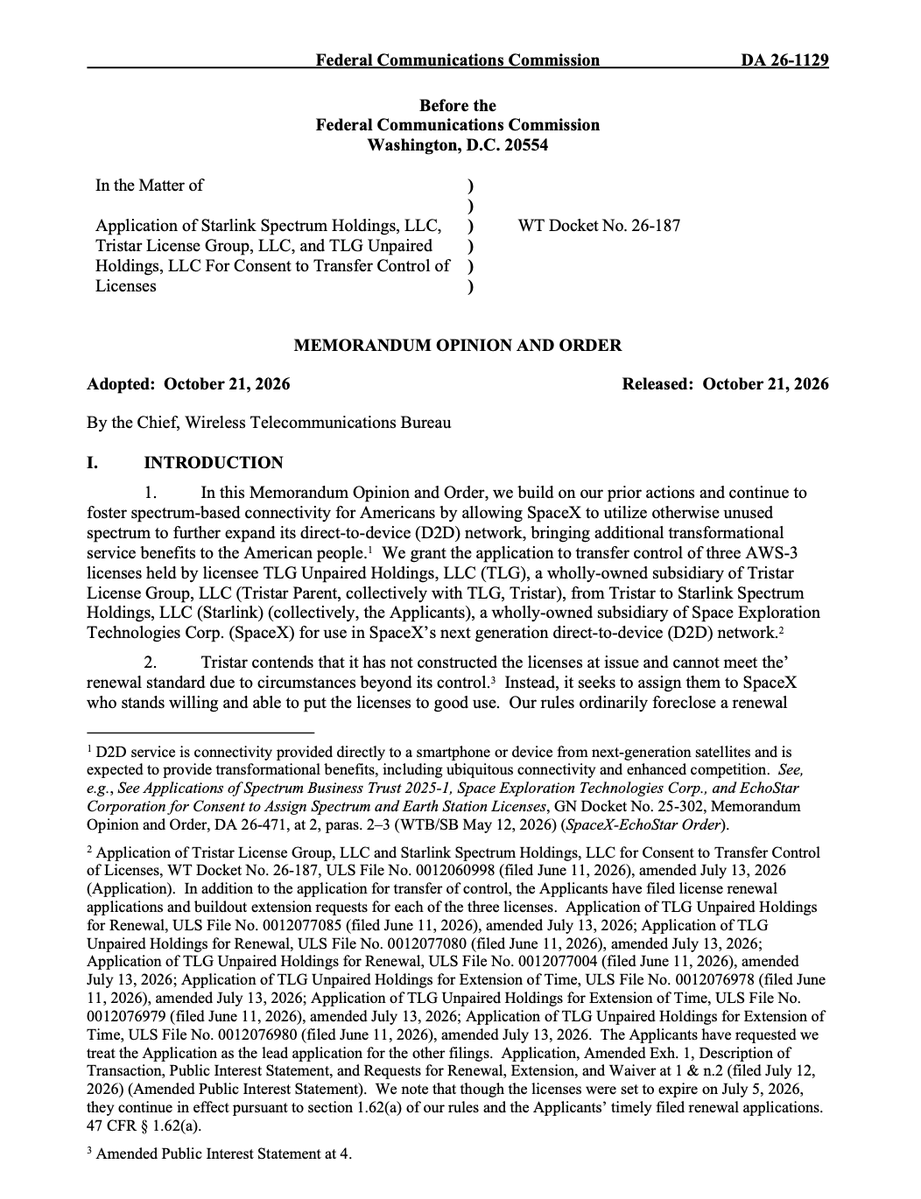
SpaceX has cleared a significant regulatory hurdle for its next-generation Starlink Mobile network. The FCC has officially approved the company's acquisition of three spectrum licenses from Tristar License Group, covering 15 MHz in the 1695–1710 MHz band — a chunk of airwaves that will underpin Starlink's push into direct-to-device mobile connectivity.

What exactly did the FCC approve?
The FCC granted SpaceX's subsidiary, Starlink Spectrum Holdings, approval to acquire three unpaired AWS-3 spectrum licenses from Tristar License Group. The licenses collectively cover 15 MHz of spectrum in the 1695–1710 MHz band. According to the FCC filing, the regulator also granted SpaceX waivers alongside the license transfer — the full details of those waivers were referenced in Sawyer Merritt's report but the tweet was truncated. The application was originally filed on June 11, 2026, and subsequently amended before receiving final approval.
What is the 1695–1710 MHz band, and why does it matter for Starlink?
This band sits within the AWS-3 (Advanced Wireless Services) spectrum range, which has historically been used for mobile broadband. For Starlink Mobile — SpaceX's direct-to-cell satellite service — holding licensed spectrum in this range is a prerequisite for operating as a legitimate mobile network rather than relying solely on partner carrier agreements. More spectrum means more capacity, better throughput, and the ability to serve more simultaneous users from low-Earth orbit satellites.
How does this fit into the broader Starlink Mobile roadmap?
Starlink has been building toward a full next-generation mobile offering that goes beyond its current direct-to-cell beta partnerships. Acquiring licensed spectrum directly — rather than operating under a partner carrier's license — gives SpaceX greater operational independence and flexibility to negotiate (or bypass) carrier deals. This FCC approval represents a concrete step toward that autonomous mobile network capability, though commercial launch timelines have not been officially confirmed in this filing.
What were the FCC waivers about?
The FCC granted waivers alongside the spectrum transfer, though the full text of Merritt's tweet was cut off before the specifics were visible. Waivers in spectrum transactions typically address build-out or deployment timeline requirements — regulators sometimes require licensees to demonstrate network coverage within set deadlines, and waivers can adjust those obligations. The underlying FCC filing is publicly available and linked in Merritt's follow-up post.

Does this affect Tesla owners specifically?
Not directly — at least not yet. But SpaceX and Tesla share a common ownership ecosystem, and Starlink connectivity has already appeared in Tesla vehicles in select markets. A more capable, independently licensed Starlink Mobile network could eventually translate into better in-vehicle connectivity options, particularly in areas where terrestrial cell coverage is thin. For now, this is an infrastructure move that sets the stage for future capabilities rather than triggering anything owners need to act on today.
The FCC filing is publicly accessible for anyone who wants to dig into the regulatory specifics. For the broader picture on SpaceX's satellite and connectivity efforts, see our SpaceX coverage.
Sources & reporting notes
The links below identify the material source records used for this report.
- @SawyerMerritt on X (2026-10-22T04:52:07.000Z) — Direct source
- @SawyerMerritt on X (2026-10-22T04:52:08.000Z) — Direct source
Source links are preserved as published or accessed. See our editorial standards and corrections policy.
The BASENOR Editorial Desk covers Tesla, SpaceX, and related technology, curating reporting from primary sources — official accounts, regulatory filings, and software release data. Every article passes source-record and fact-checking review before publication. About the newsroom.
This report was curated by the BASENOR Editorial Desk from the sources listed above. Read our editorial standards or email editorial@basenor.com to report an error.