Tesla's own crash telemetry has confirmed that Full Self-Driving was engaged during a fatal Model Y collision in Batavia, Illinois — a March 25, 2026 left-turn crash that killed 37-year-old Maggie Espinosa, a front-seat passenger and mother of five. The confirmation surfaced after Electrek's Fred Lambert matched a redacted Tesla submission to NHTSA against the local police report, closing the loop on an incident Tesla had disclosed only in anonymized form.
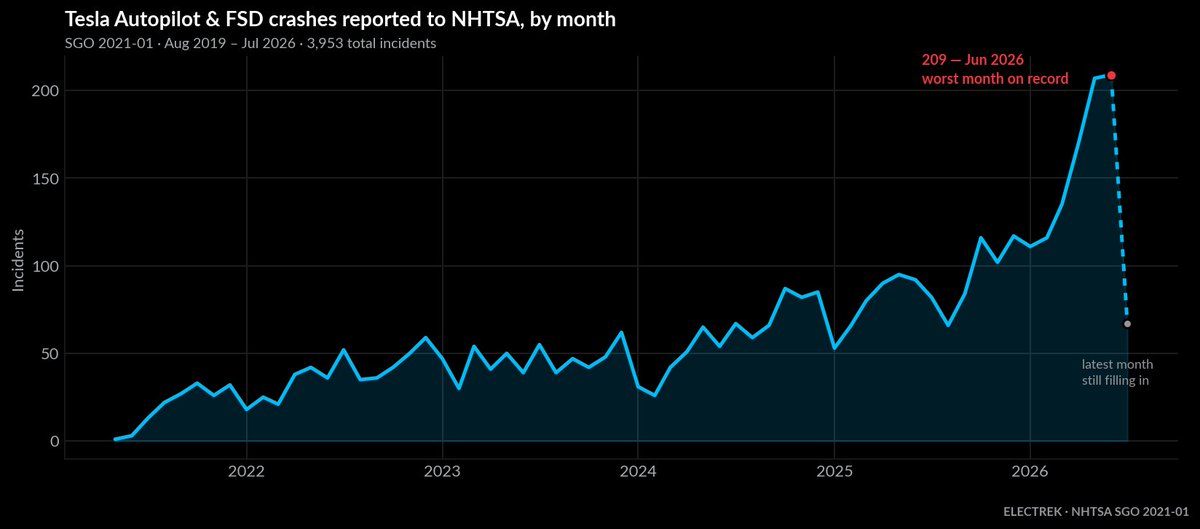
The crash adds to a growing dossier feeding NHTSA's engineering analysis of FSD, which was escalated in March 2026 over concerns the system fails to detect hazards and adequately warn drivers. For Tesla owners actively using Supervised FSD, this is the moment to re-examine how — and where — you're letting the system drive.

What Tesla's Data Confirms
According to the police report and Tesla's Standing General Order submission to NHTSA reviewed by Electrek and the Daily Herald, the 2026 Model Y was traveling southbound on Randall Road and attempted a left turn onto eastbound McKee Street at approximately 4:19 p.m. The pre-crash movement was logged as "Making Left Turn" at 24 mph. A northbound Dodge pickup with the right of way struck the Tesla in the intersection; a Nissan SUV was also involved.
The key line in Tesla's own filing: the automation "Engagement Status" is marked "Verified Engaged." Tesla also confirmed it possesses the event-data recorder log, telematics, and video footage of the crash. What Tesla redacted, citing confidential business information, is arguably just as important: the FSD software version running at the time and whether the intersection was inside FSD's approved operating area.
Key Facts
| Detail | Confirmed |
|---|---|
| Date & Time | March 25, 2026 — 4:19 p.m. |
| Location | Randall Rd & McKee St, Batavia, IL |
| Vehicle | 2026 Tesla Model Y |
| Maneuver | Unprotected left turn at 24 mph |
| FSD Status | Verified Engaged (per Tesla) |
| Fatality | Maggie Espinosa, 37, front passenger |
| Redacted by Tesla | FSD software version, ODD status, crash narrative |
What Owners Should Do Right Now
Supervised FSD is exactly that — supervised. This crash is a stark reminder that the driver remains legally and physically responsible for every intervention, and unprotected left turns across oncoming traffic are among the highest-risk maneuvers the system attempts. Here's a concrete checklist:
- Treat unprotected left turns as manual maneuvers. If FSD initiates a left across oncoming traffic and you have any doubt about gap size or approaching-vehicle speed, take over. Don't wait for the system to abort — it may not.
- Keep hands on the wheel and eyes forward. Passenger fatalities carry the same weight as driver ones. The driver is responsible for occupants too.
- Review your dashcam and Sentry retention settings. In the event of any FSD-involved incident, local dashcam footage on your USB drive is your independent record — Tesla holds the telematics, but you should hold the video. Confirm your USB is formatted correctly and Sentry/Dashcam is enabled under Controls > Safety.
- Check your FSD version. Go to Controls > Software to see your current build. If NHTSA's engineering analysis produces a recall or restriction, it will apply by version. Knowing yours matters.
- Report incidents through Tesla's in-car feedback and, if serious, to NHTSA directly at nhtsa.gov/report-a-safety-problem. The engineering analysis relies on complaint data — silence gets read as absence.
- Reconsider FSD use in low-visibility conditions. NHTSA's current probe specifically flags low-visibility performance. Rain, glare, dusk, and dawn are the periods to be most conservative.
Why the Redactions Matter
Tesla's decision to redact the FSD software version and whether the crash occurred inside the system's approved operational design domain (ODD) is legally permissible under NHTSA's Standing General Order, but it blocks the public — and independent researchers — from answering the two questions that matter most: was this a known-buggy build, and was FSD being used where Tesla says it should work?
Until NHTSA's engineering analysis concludes or a subpoena forces disclosure, owners should assume any version of Supervised FSD can misjudge an unprotected left turn. That's not a hypothetical — it's now backed by Tesla's own verified telemetry.
What to Watch Next
The Batavia Police Department's investigation remains open, and the Kane County State's Attorney's Office is reviewing the case. No charges have been filed. Separately, NHTSA's engineering analysis — the step immediately preceding a potential recall — continues. If the agency concludes FSD has a defect trend in intersection handling or low-visibility detection, remediation could come as a software-based recall pushed via OTA, similar to the December 2023 Autosteer recall.
For now, the practical takeaway is unchanged but sharpened: FSD is a driver-assist system, Tesla's own data will be used to reconstruct any crash you're involved in, and the human behind the wheel is still the last line of defense — especially at intersections.
Related Gear
Gear up your Model Y with tested, custom-fit BASENOR accessories — shop Model Y accessories →
Sources & reporting notes
The links below identify the material source records used for this report.
- @FredLambert on X (2026-09-01T15:09:26.000Z) — Direct source
Source links are preserved as published or accessed. See our editorial standards and corrections policy.
The BASENOR Editorial Desk covers Tesla, SpaceX, and related technology, curating reporting from primary sources — official accounts, regulatory filings, and software release data. Every article passes source-record and fact-checking review before publication. About the newsroom.
This report was curated by the BASENOR Editorial Desk from the sources listed above. Read our editorial standards or email editorial@basenor.com to report an error.