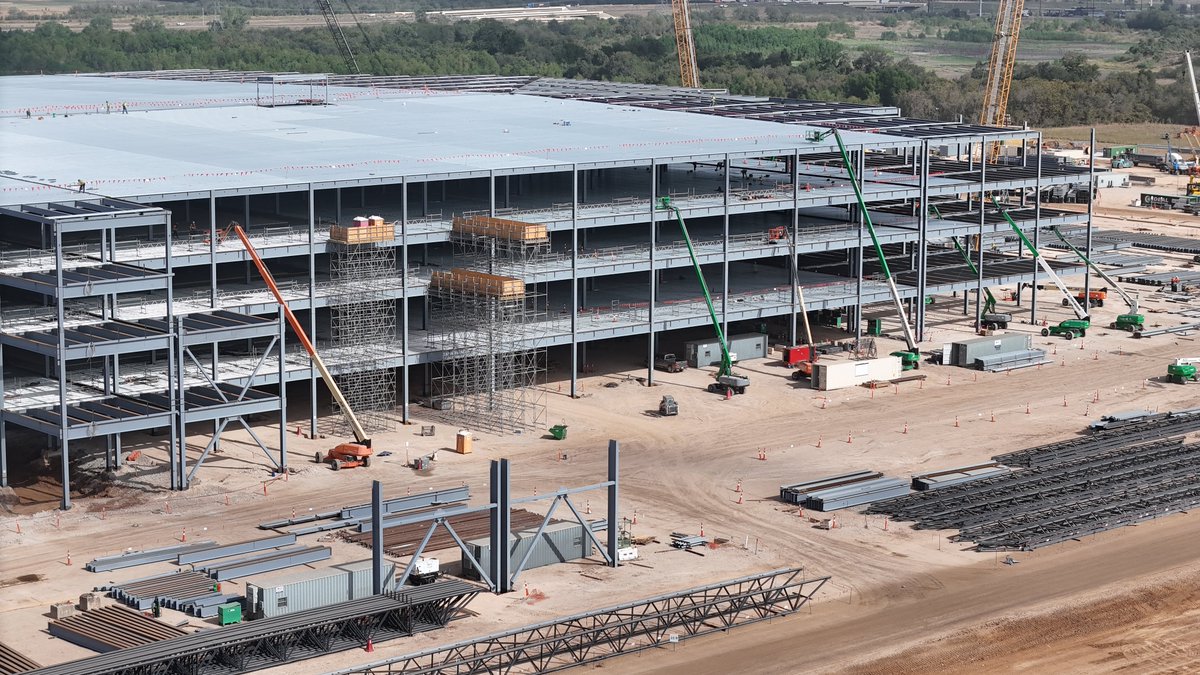
Construction at the dedicated Optimus robot factory on Giga Texas's North Campus is moving at a pace that's hard to ignore. Drone footage captured by Joe Tegtmeyer on September 17 shows a building that has evolved from a concrete slab into a rising multi-story steel superstructure in roughly six months — and the pace isn't slowing. Here are the five details worth paying attention to.

1. Steel Assembly Is Almost Done
According to Tegtmeyer's footage, the structural steel frame is now only about five column grids away from the north perimeter beam — meaning the primary skeleton of the building is effectively in its final stretch. Steel erection typically precedes cladding, mechanical rough-in, and interior buildout, so reaching this milestone signals the structure is close to being fully enclosed. Given that steel work began in earnest around August 2026, the pace of erection has been notably fast for a building of this scale.
2. Concrete Is Already Going In on Three Upper Floors
While steel crews are still finishing the frame, concrete pours are simultaneously underway on three upper floors. That kind of parallel workflow — steel going up at one end while concrete sets at the other — is a deliberate schedule compression technique. It suggests Tesla's construction team is not waiting for full structural completion before advancing interior floor work, which is consistent with the reported target of bringing high-volume production lines online in 2027.
3. Rebar and Footing Work Continues at Grade Level
Lower-level rebar placement and grade-beam footing work are still active, per Tegtmeyer's update. Grade beams are the reinforced concrete elements that tie foundation footings together and carry the load of walls above. Their continued presence in the footage confirms that portions of the building's perimeter or interior are still being brought up from ground level — consistent with a structure whose footprint, according to Texas Department of Labor Regulations documents filed August 31, 2026, is just under 7 million square feet across multiple stories.
4. The Scale Here Is Genuinely Unprecedented
It's worth pausing on what's actually being built. Earlier permit filings indicated a building extending over 4,000 feet in length. The TDLR documents point to a multi-story structure with a total floor area approaching 7 million square feet. For context, that's roughly six times the size of the original Gigafactory Nevada under one roof. Tesla's stated production target for this facility is up to 10 million Optimus units annually — a number that only makes sense at this kind of physical scale.
5. This Is Part of a Larger Integrated Campus
The Optimus factory doesn't stand alone. Construction on the adjacent Terafab AI chip fabrication facility — which will supply the silicon that runs Optimus robots — was actively underway as of early September 2026, according to previous reports. The two buildings form an integrated manufacturing campus: chips made in one building, robots assembled in the other. That co-location is a deliberate supply-chain decision, and it means the North Campus buildout at Giga Texas is considerably larger in scope than the Optimus factory footprint alone.
Construction began around late March 2026. Six months later, the steel frame is nearly complete, concrete is being poured on multiple floors simultaneously, and the site shows no signs of slowing. If the current pace holds, the structural shell could be complete well ahead of the 2027 mass-production target — leaving fit-out, equipment installation, and commissioning as the remaining long poles in the schedule.
🤖 Tracking Tesla's humanoid robot? See every Optimus production milestone and appearance in our Tesla Optimus Tracker.
Related Gear
Gear up your Tesla with tested, custom-fit BASENOR accessories — shop Tesla accessories →
Sources & reporting notes
The links below identify the material source records used for this report.
- @JoeTegtmeyer on X (2026-09-17T14:47:14.000Z) — Direct source
Source links are preserved as published or accessed. See our editorial standards and corrections policy.
The BASENOR Editorial Desk covers Tesla, SpaceX, and related technology, curating reporting from primary sources — official accounts, regulatory filings, and software release data. Every article passes source-record and fact-checking review before publication. About the newsroom.
This report was curated by the BASENOR Editorial Desk from the sources listed above. Read our editorial standards or email editorial@basenor.com to report an error.