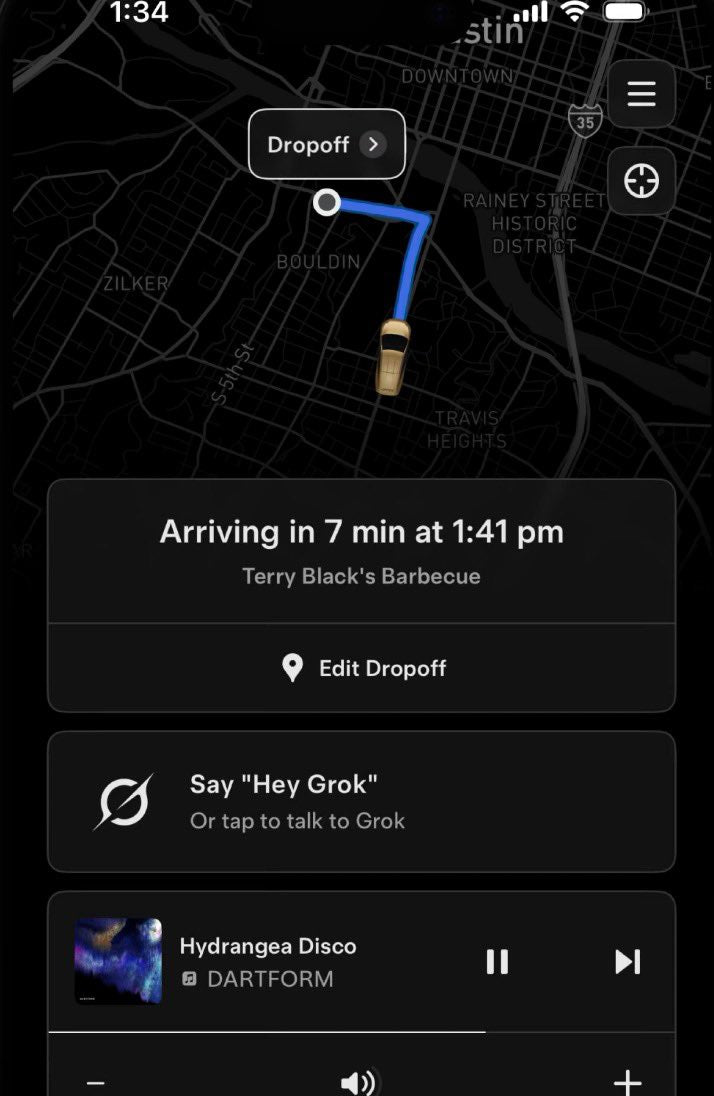
Grok is coming to the Robotaxi. Whole Mars Catalog confirmed on X that xAI's AI assistant will be integrated into Tesla's autonomous ride-hailing service — a move that takes Grok from a parked-car feature to something passengers will interact with mid-ride, in a fully driverless environment.

Here's what we know — and what's still open — about how Grok fits into the Robotaxi experience.
What exactly was confirmed?
Whole Mars Catalog, a reliable Tesla community tracker, posted that Grok support in Robotaxi is confirmed. No official Tesla or xAI statement has been published alongside this, but the confirmation aligns with the trajectory of Grok's rollout across Tesla's vehicle lineup over the past year.
Hasn't Grok already been in Teslas for a while?
Yes — but in personal vehicles, not in an autonomous ride-hailing context. According to Teslarati, Grok began rolling out to eligible Tesla vehicles with software update 2025.26 in July 2025, initially in the U.S. before expanding across North America, Europe, and Asia. That version was designed for owners interacting with their own car. Robotaxi integration is a different deployment: the vehicle has no human driver, and passengers are strangers to the platform, not registered Tesla owners. The UX requirements are meaningfully different.
What could Grok actually do inside a Robotaxi?
In current personal-vehicle deployments, Grok handles natural language queries — navigation context, vehicle controls, general questions — using conversational AI rather than fixed voice commands. In a Robotaxi setting, the most likely use cases are passenger assistance (trip status, destination changes, ambient questions), in-cabin entertainment, and real-time contextual information during the ride. Whether Grok in Robotaxi will have access to the same capabilities as the owner-facing version, or a more restricted passenger-mode build, hasn't been specified yet.
Does this require specific hardware?
In personal Tesla vehicles, Grok requires an AMD processor and a compatible software version. Robotaxi units — the Cybercab — are purpose-built hardware, so the hardware compatibility question is less of a variable here. What matters more is how xAI's backend infrastructure handles concurrent sessions across a fleet of driverless vehicles, which is a different scale problem than individual owner usage.
When will this go live for Robotaxi passengers?
No launch date has been announced. Tesla's Robotaxi service is currently in early commercial operation, and feature rollouts for the platform are on a separate cadence from standard OTA updates. Grok's inclusion appears confirmed as a planned feature, not necessarily a day-one capability for all passengers.
What does this mean for the overall Robotaxi experience?
An AI assistant in a driverless vehicle isn't a novelty feature — it's a functional necessity. Without a human driver to answer questions or handle edge cases, passengers need a reliable interface for everything from "how long until we arrive" to "I need to change the drop-off address." Grok's conversational architecture is better suited to that role than a traditional voice command system. If the integration is well-executed, it could meaningfully close the gap between a Robotaxi ride and having a knowledgeable human in the front seat. The real test will be how it handles ambiguous, high-stakes passenger requests in a live driverless environment — something no amount of parked-car testing fully replicates.
🚕 Following the Robotaxi rollout? See every operating city, launch date and announced market in our Tesla Robotaxi Tracker.
Related Gear
Gear up your Tesla with tested, custom-fit BASENOR accessories — shop Tesla accessories →
Sources & reporting notes
The links below identify the material source records used for this report.
- @wholemars on X (2026-09-03T15:38:54.000Z) — Direct source
Source links are preserved as published or accessed. See our editorial standards and corrections policy.
The BASENOR Editorial Desk covers Tesla, SpaceX, and related technology, curating reporting from primary sources — official accounts, regulatory filings, and software release data. Every article passes source-record and fact-checking review before publication. About the newsroom.
This report was curated by the BASENOR Editorial Desk from the sources listed above. Read our editorial standards or email editorial@basenor.com to report an error.