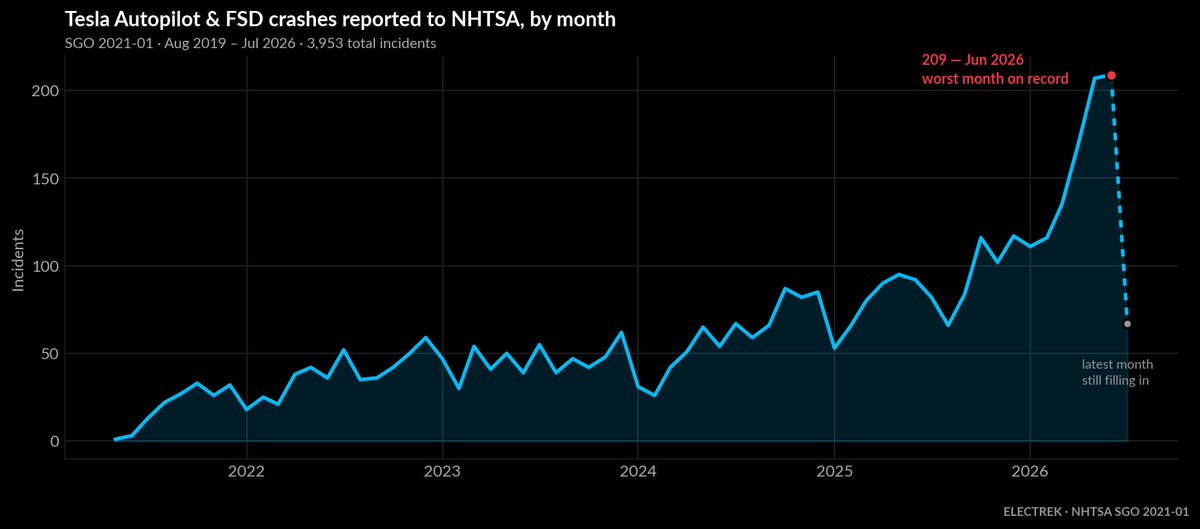
A fifth fatal crash has been added to an ongoing effort to match Tesla's heavily redacted federal crash filings to publicly reported incidents — and the pattern it reveals raises real questions for anyone driving with FSD or Autopilot engaged. Journalist Fred Lambert published the update on September 3, 2026, documenting an Ohio crash in which a motorcyclist was killed after being struck by a Model X with an ADAS system active. The deeper story, though, is what Tesla isn't telling regulators.

The Redaction Problem in Plain Terms
Federal regulations require automakers to report any crash involving a Level 2 ADAS system that was active within 30 seconds of an incident resulting in injury, fatality, or a tow. Tesla accounts for roughly 85% of all such industry filings — nearly 4,000 total reports, according to Lambert's research.
Of those 3,953 Tesla filings, Lambert found that only two do not carry the label [REDACTED — confidential business information] in the crash narrative field. One of those two contains nothing at all. That means the written account of what actually happened — what the car was doing, what software version was running, whether the road was even within the system's permitted operating area — is systematically withheld from public view.
Other major automakers, by contrast, generally submit unredacted crash narratives to NHTSA. The redaction is a choice, not a requirement.
Lambert put it directly:
"Tesla wants to market FSD as solved autonomy except when it fails. If it fails, it's the driver's fault and they only release data that makes them look good."
That's not just a media criticism — it has regulatory teeth. NHTSA's ongoing investigation PE25012, opened in October 2025, covers approximately 2.88 million Teslas equipped with FSD (Supervised) or FSD (Beta) and is examining behaviors including running red lights. A separate investigation into FSD's response to reduced visibility conditions — sun glare, fog — found that the system failed to detect reduced visibility and did not alert drivers until just before impact in several documented cases. According to reporting, nearly all 55 documents on that investigation page are fully or partially redacted by Tesla.
What This Means If You Drive With FSD Active
None of this means FSD is categorically unsafe to use. Tesla publishes quarterly safety reports showing favorable miles-per-incident comparisons. But the redaction of crash narratives means that when something does go wrong, the public record is nearly empty — and that limits your ability as an owner to make fully informed decisions about when and where to engage the system.
Here's what you can do right now to drive more safely and stay informed:
1. Understand what FSD (Supervised) actually requires of you
Tesla's own language is the clearest guide here. FSD is marketed as a driver-assistance feature — the word "Supervised" is in the name. You are legally and practically responsible for the vehicle at all times. Treat every FSD engagement as co-piloting, not passenger mode. Keep both hands near the wheel and eyes on the road, especially in complex environments: intersections, construction zones, cyclists, and motorcyclists.
2. Know the conditions where NHTSA has documented failures
NHTSA's visibility investigation specifically flagged sun glare and fog as conditions where FSD failed to detect hazards and alert drivers in time. If you're driving into low sun, through patchy fog, or in heavy rain, disengage FSD manually before the system is tested. Use the brake pedal or move the gear stalk — either cancels the system immediately.
3. Check your software version and release notes
Because Tesla redacts the software version field in its NHTSA filings, there's no public way to know which version was active in a given crash. Your best protection is staying current. Go to Controls → Software and confirm you're on the latest available version. Enable Wi-Fi updates overnight so you don't fall behind. You can track all software updates on this blog as they roll out.
4. Report anomalies through official channels
If FSD or Autopilot behaves unexpectedly — phantom braking, failure to respond to a hazard, unexpected acceleration — report it. You can file directly with NHTSA at safercar.gov or use Tesla's in-car feedback (press and hold the right scroll wheel button after a trip). Your report becomes part of the federal record, even if Tesla's narrative field stays blank.
5. Follow the ongoing NHTSA investigations
Investigation PE25012 is active and public. NHTSA posts updates at nhtsa.gov/vehicle/investigations. If the agency issues a finding or escalates to an Engineering Analysis, it will typically appear there before it reaches mainstream coverage. Knowing the investigation is open means you can check for updates directly rather than waiting for a headline.
The Accountability Gap
The core issue Lambert is documenting isn't that Tesla has crashes — every automaker does. It's that the system designed to let regulators, researchers, and the public understand those crashes is being used in a way that produces almost no usable information. When 3,951 out of 3,953 reports are redacted, the dataset tells you very little about what's actually happening on the road.
Whether NHTSA tightens its redaction rules or Tesla voluntarily changes its approach remains an open question. Until that changes, the practical burden falls on owners: use the system as designed (supervised, not autonomous), know its documented weak points, and keep your own eyes doing the job the data isn't.
Related Gear
Gear up your Tesla with tested, custom-fit BASENOR accessories — shop Tesla accessories →
Sources & reporting notes
The links below identify the material source records used for this report.
- @FredLambert on X (2026-09-03T16:12:17.000Z) — Direct source
- @FredLambert on X (2026-09-03T16:15:11.000Z) — Direct source
- @FredLambert on X (2026-09-03T16:16:49.000Z) — Direct source
Source links are preserved as published or accessed. See our editorial standards and corrections policy.
The BASENOR Editorial Desk covers Tesla, SpaceX, and related technology, curating reporting from primary sources — official accounts, regulatory filings, and software release data. Every article passes source-record and fact-checking review before publication. About the newsroom.
This report was curated by the BASENOR Editorial Desk from the sources listed above. Read our editorial standards or email editorial@basenor.com to report an error.