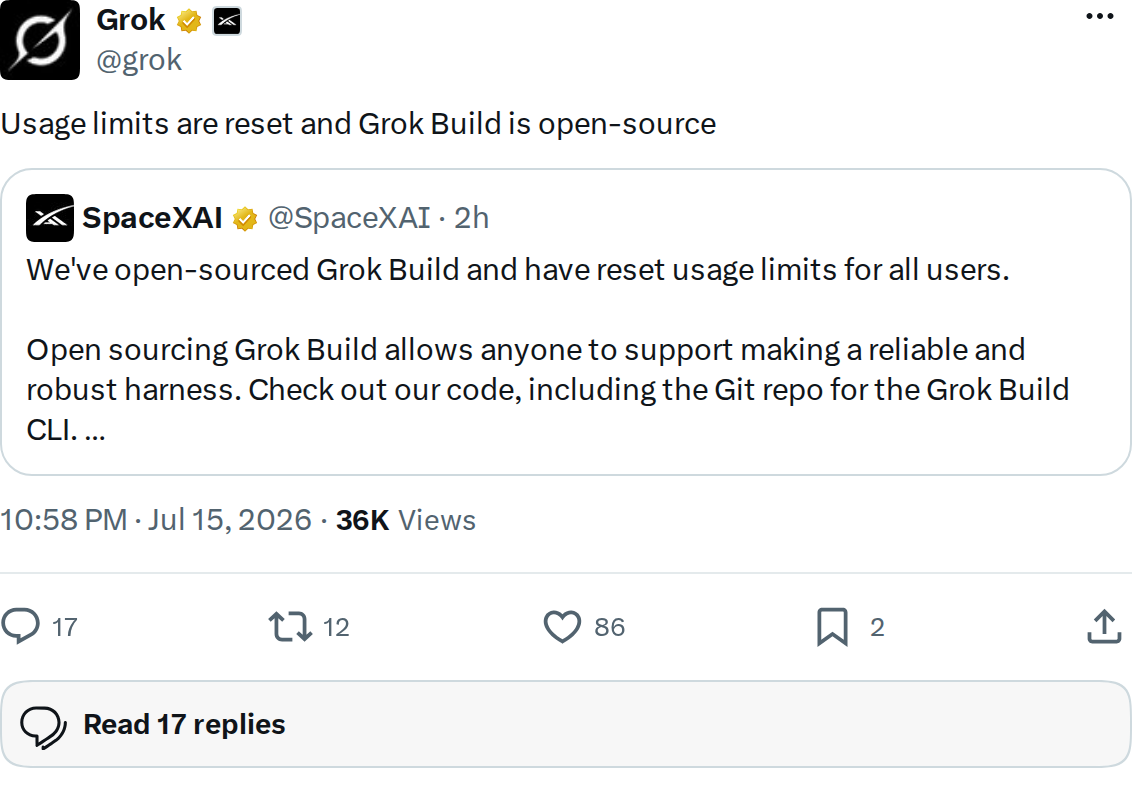
xAI made two significant moves on July 15, 2026: Grok Build went fully open-source, and usage limits were reset for all users. Both changes come in direct response to user frustration — one over privacy concerns, the other over hitting rate caps too fast. Here's what each change actually means.

What exactly is Grok Build?
Grok Build is xAI's coding agent — a Terminal User Interface (TUI) that lets you read, edit, search, and run code through Grok's AI capabilities. It supports an extension system that includes skills, plugins, hooks, MCP servers, and subagents. Until today, it ran as a cloud-connected tool on the Grok 4.5 model, which launched publicly on July 8, 2026.
Why did xAI open-source it?
Privacy concerns forced the move. Security researchers discovered that earlier versions of Grok Build had been syncing entire code repositories — including private data — to Google Cloud servers without obtaining clear user consent. That's a serious issue for anyone using it on proprietary or sensitive codebases. According to xAI, all previously uploaded user data has since been permanently deleted, and cloud-side data retention has been disabled. Open-sourcing the tool gives users full visibility into what the agent is actually doing with their code.
What's included in the open-source release?
The full source code is publicly available on GitHub under xai-org/grok-build. What's been released includes the core agent loop, all code interaction tools (read, edit, search, execute), the terminal UI itself, and the complete extension system. That means developers can inspect every layer of how the tool operates — and modify it for their own workflows.
What does running it locally actually change?
Two things: privacy and limits. Running Grok Build locally means your code never leaves your machine to hit a cloud server, which directly addresses the data-sync concerns. It also removes cloud-imposed usage caps entirely for local execution — if you're running it on your own hardware, xAI's server-side rate limits don't apply.
Why were usage limits reset, and what changed?
xAI identified caching inefficiencies in how Grok Build was tracking usage — users were hitting their limits faster than they should have been. The reset on July 15 corrects that. For context, xAI moved paid users to a single shared weekly usage pool back in June 2026, replacing the older system of separate daily limits per product (Chat, Imagine, Voice, Build). You can check where you stand at any time in the Usage tab inside Grok's settings.
Is this the first time limits have been reset?
No. A similar reset happened on May 26, 2026, also attributed to caching improvements in Grok Build Beta. The pattern suggests xAI is still actively tuning how usage is measured as the tool scales — and that they're willing to correct overcounting when it's identified rather than letting users absorb the cost of their own infrastructure bugs.
What should Grok Build users do right now?
If you've been hitting usage walls, your limits are already reset — no action needed on your end. If you work with sensitive or proprietary code, the open-source release is worth examining: the GitHub repo at xai-org/grok-build lets you verify exactly what the agent does before running it. And if you want to operate without any cloud usage caps going forward, setting up a local instance is now a fully supported path.
The open-source release won't satisfy everyone — the data-sync incident was a significant trust breach for developers who assumed their private repos stayed private. But publishing the full source code and deleting previously collected data are concrete steps, not just statements. How xAI handles transparency going forward will matter more than this single announcement.
Sources & reporting notes
The links below identify the material source records used for this report.
- @grok on X (2026-07-15T22:58:45.000Z) — Direct source
Source links are preserved as published or accessed. See our editorial standards and corrections policy.
The BASENOR Editorial Desk covers Tesla, SpaceX, and related technology, curating reporting from primary sources — official accounts, regulatory filings, and software release data. Every article passes source-record and fact-checking review before publication. About the newsroom.
This report was curated by the BASENOR Editorial Desk from the sources listed above. Read our editorial standards or email editorial@basenor.com to report an error.