A Tesla owner recently put Grok through its paces on one of the more technically demanding topics in the EV world: the full history of Tesla's Full Self-Driving software. The results were striking — not just because Grok got things right, but because it correctly identified when it had gotten things wrong.

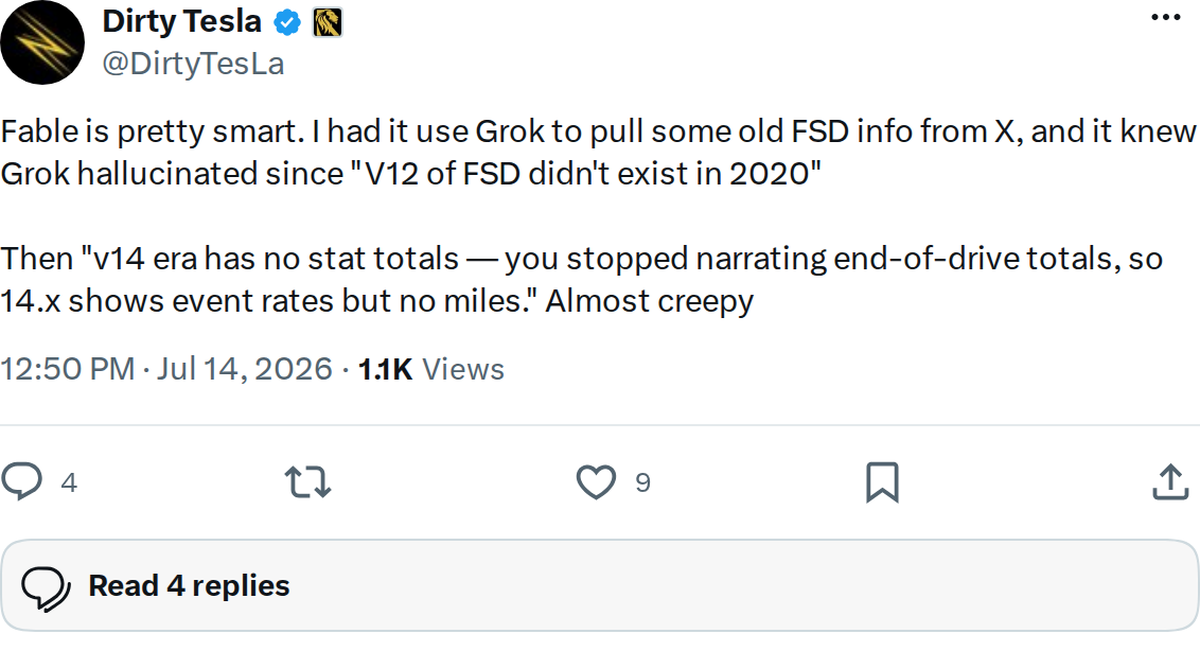
Using a tool called Fable to query Grok against historical X posts, @DirtyTesLa found that Grok flagged its own prior claim about FSD V12 existing in 2020 as a hallucination — because V12 simply wasn't released until years later. It then went further, accurately describing a subtle but important shift in how FSD v14.x reports driving data: the end-of-drive stat totals (total miles, for example) are gone, replaced by event rates. If you've noticed your post-drive summary looks different lately, that's why.
For owners who use Grok to research FSD performance, version history, or compare behavior across software generations, this has real practical implications. Here's how to get the most accurate results.
How to Query Grok for FSD History Without Getting Burned by Hallucinations
Grok's self-correction behavior is useful, but it only kicks in when you give it enough context to cross-reference. Vague questions get vague — and sometimes fabricated — answers.
Step 1: Anchor your question to a specific version range
Instead of asking "How has FSD improved over time?", ask "What changed between FSD v11 and v12?" or "What did FSD v13 add compared to v12?" Specific version numbers force Grok to retrieve concrete information rather than generate a plausible-sounding summary.
Step 2: Ask Grok to flag uncertainty explicitly
Add a line like "If you're not certain about any of this, say so" to your prompt. Grok is capable of hedging when prompted — the FSD V12/2020 hallucination catch happened precisely because the system was being asked to verify, not just recall. Without that pressure, it may present uncertain information with false confidence.
Step 3: Know the v14.x data reporting change before you interpret results
This is the most actionable detail from @DirtyTesLa's test: FSD v14.x no longer narrates end-of-drive totals. If you're asking Grok to compare your miles-driven stats or intervention rates across software versions, understand that the underlying data format changed with v14. Pre-v14 data includes cumulative mileage totals per session; v14.x reports event rates instead. Any comparison spanning that boundary needs to account for the methodology shift — otherwise you're comparing apples to oranges.
Step 4: Use X post history as a grounding source
The @DirtyTesLa test used Fable to pull historical X posts as a reference layer for Grok's answers. This is a meaningful upgrade over asking Grok cold. Real-world owner reports on X — intervention callouts, software behavior threads, version-specific complaints — give Grok something concrete to check against. If you have access to tools that let you feed Grok a curated set of posts, that's worth doing for any deep FSD research.
Step 5: Cross-check version release timelines independently
Grok correctly knew FSD V12 didn't exist in 2020 — but don't assume it will always catch timeline errors on its own. Keep a mental reference of the major milestones: FSD V12 (the neural-network end-to-end rewrite) rolled out in early 2024. V13 followed later that year. V14 arrived in 2025. Any Grok output that places a version outside that window should be treated as suspect until verified.
What This Tells Us About Grok as a Research Tool
The ability to self-correct on hallucinations — especially on a topic as granular as FSD version history — is a meaningful capability signal. Most AI tools will confidently fabricate plausible-sounding version numbers and feature sets if the training data is sparse or contradictory. The fact that Grok caught the V12/2020 error and accurately described the v14.x stat reporting change suggests it has absorbed a substantial amount of real FSD discussion from X, where owners have been documenting software behavior in granular detail for years.
That said, self-correction is not the same as accuracy. Grok caught one hallucination in a supervised test. In an unsupervised query, the same hallucination might have passed unchallenged. The practical takeaway: Grok is a strong starting point for FSD research, but version-specific claims — especially anything pre-2024 — deserve a second look against primary sources. For ongoing FSD coverage, check our FSD coverage archive for version-by-version breakdowns.
Related Gear
Gear up your Tesla with tested, custom-fit BASENOR accessories — shop Tesla accessories →
📋 Tracking Tesla software? See every firmware, FSD and app version in one place in our Tesla Software Update Tracker.
Sources & reporting notes
The links below identify the material source records used for this report.
- @DirtyTesLa on X (2026-07-14T12:50:50.000Z) — Direct source
Source links are preserved as published or accessed. See our editorial standards and corrections policy.
The BASENOR Editorial Desk covers Tesla, SpaceX, and related technology, curating reporting from primary sources — official accounts, regulatory filings, and software release data. Every article passes source-record and fact-checking review before publication. About the newsroom.
This report was curated by the BASENOR Editorial Desk from the sources listed above. Read our editorial standards or email editorial@basenor.com to report an error.