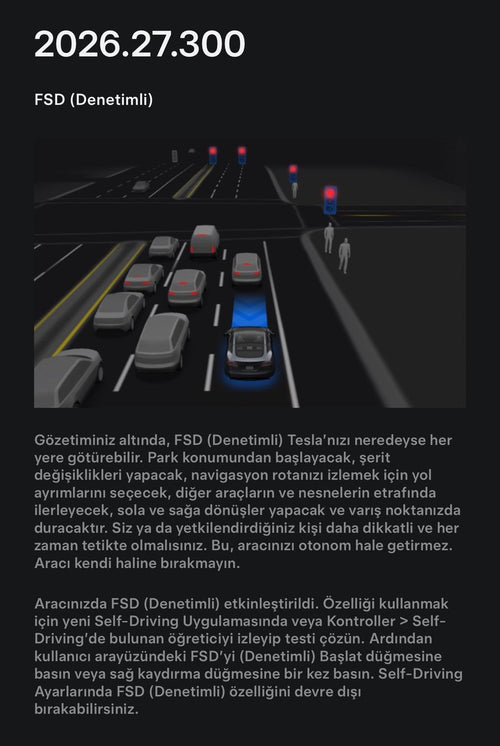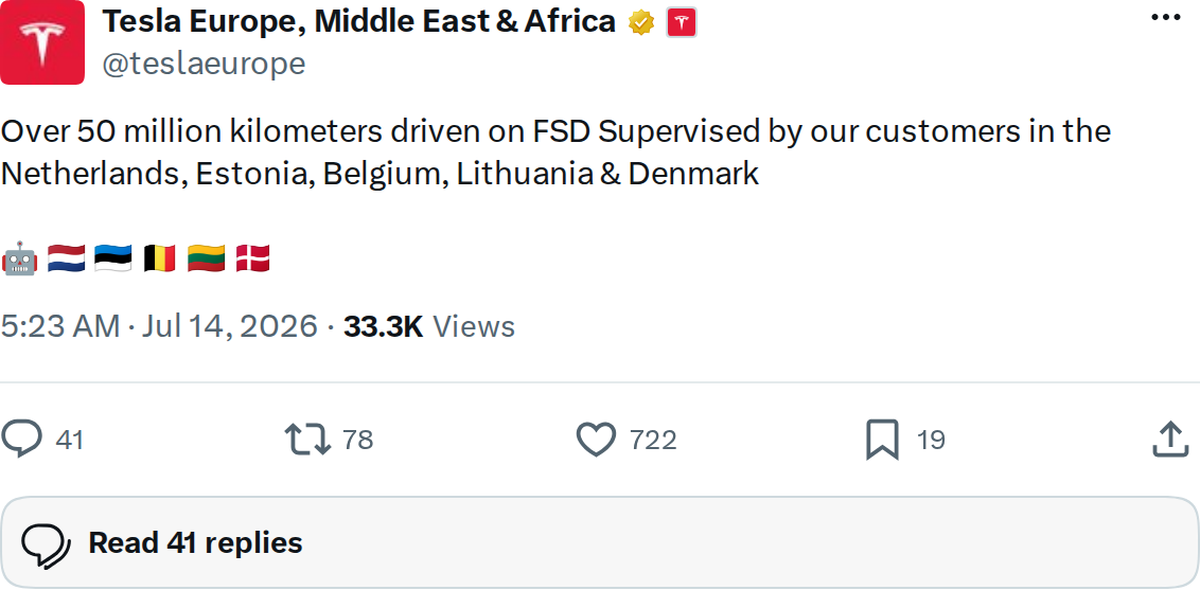
Tesla's Full Self-Driving (Supervised) system has crossed 50 million kilometers driven in Europe — a figure that would have seemed ambitious just weeks ago. The milestone, announced officially by Tesla Europe on July 14, covers five countries where FSD (Supervised) has received regulatory approval: the Netherlands, Estonia, Belgium, Lithuania, and Denmark. What makes the number striking isn't the total itself, but the pace at which it arrived.

How Fast Is the Accumulation Rate?
The 50 million kilometer mark is significant not just as a round number, but as a signal of exponential fleet engagement. According to analyst Sawyer Merritt, Tesla users in Europe hit 20 million kilometers approximately 7.5 weeks ago. That means the fleet added 30 million kilometers in roughly 52 days — a rate of nearly 580,000 kilometers per day across the five-country footprint.
For context, the earlier trajectory was already rapid. Background data shows the fleet crossed 15 million kilometers just under three days before reaching 20 million — adding 5 million kilometers in less than 72 hours at that stage. The acceleration from 20 million to 50 million suggests the active user base has grown substantially as approvals in Belgium, Estonia, and Denmark came through in the weeks that followed.

The Regulatory Timeline Behind the Numbers
The five-country footprint didn't happen overnight. The Netherlands was the anchor, receiving the first European type approval for FSD (Supervised) from the Dutch vehicle authority RDW on April 10, 2026. From there, the EU's mutual recognition framework allowed other countries to move faster: Lithuania followed on May 20, Estonia on May 29, and Denmark provisionally on June 9. Belgium completed its mandatory 5,000 kilometers of public road testing by early June and was formally among the approved group by June 23, according to verified sources.
That compressed timeline — from first approval to five countries in roughly 10 weeks — is what's enabling the kilometer accumulation to compound. Each new country adds a fresh pool of eligible owners who can subscribe and start driving.
| Country | Approval Date | Route to Approval |
|---|---|---|
| Netherlands | April 10, 2026 | RDW type approval (first in Europe) |
| Lithuania | May 20, 2026 | EU mutual recognition |
| Estonia | May 29, 2026 | EU mutual recognition |
| Denmark | June 9, 2026 | Provisional approval |
| Belgium | June 23, 2026 | Post mandatory 5,000 km public road testing |
What the Milestone Actually Measures
It's worth being precise about what these kilometers represent. FSD (Supervised) is classified as a Level 2 advanced driver-assistance system in Europe, meaning a human driver must remain attentive and ready to intervene at all times. The 50 million kilometers is not autonomous operation — it's supervised miles where the system was actively engaged. That distinction matters for regulatory conversations, but it doesn't diminish the data value: every kilometer is real-world training signal on European road conditions, signage conventions, and driving behavior that differs meaningfully from the US dataset.
For owners in these markets, FSD (Supervised) is available at €99 per month, with a discounted rate of €49 per month for those who previously purchased Enhanced Autopilot, according to verified pricing data.

Editor's View
The more consequential number here isn't 50 million — it's the rate. Going from 20 million to 50 million in under eight weeks, with only five relatively small countries in the pool, suggests the per-owner engagement is high. If Tesla secures approvals in larger European markets — Germany, France, and the UK are the obvious targets — the accumulation curve could steepen dramatically. The Netherlands proving the regulatory pathway through EU mutual recognition was the strategic unlock; the question now is how quickly larger markets follow the same route.
Related Gear
Gear up your Tesla with tested, custom-fit BASENOR accessories — shop Tesla accessories →
Sources & reporting notes
The links below identify the material source records used for this report.
- @SawyerMerritt on X (2026-07-14T05:33:52.000Z) — Direct source
- @wholemars on X (2026-07-14T05:52:10.000Z) — Direct source
- @teslaeurope on X (2026-07-14T05:23:33.000Z) — Direct source
Source links are preserved as published or accessed. See our editorial standards and corrections policy.
The BASENOR Editorial Desk covers Tesla, SpaceX, and related technology, curating reporting from primary sources — official accounts, regulatory filings, and software release data. Every article passes source-record and fact-checking review before publication. About the newsroom.
This report was curated by the BASENOR Editorial Desk from the sources listed above. Read our editorial standards or email editorial@basenor.com to report an error.