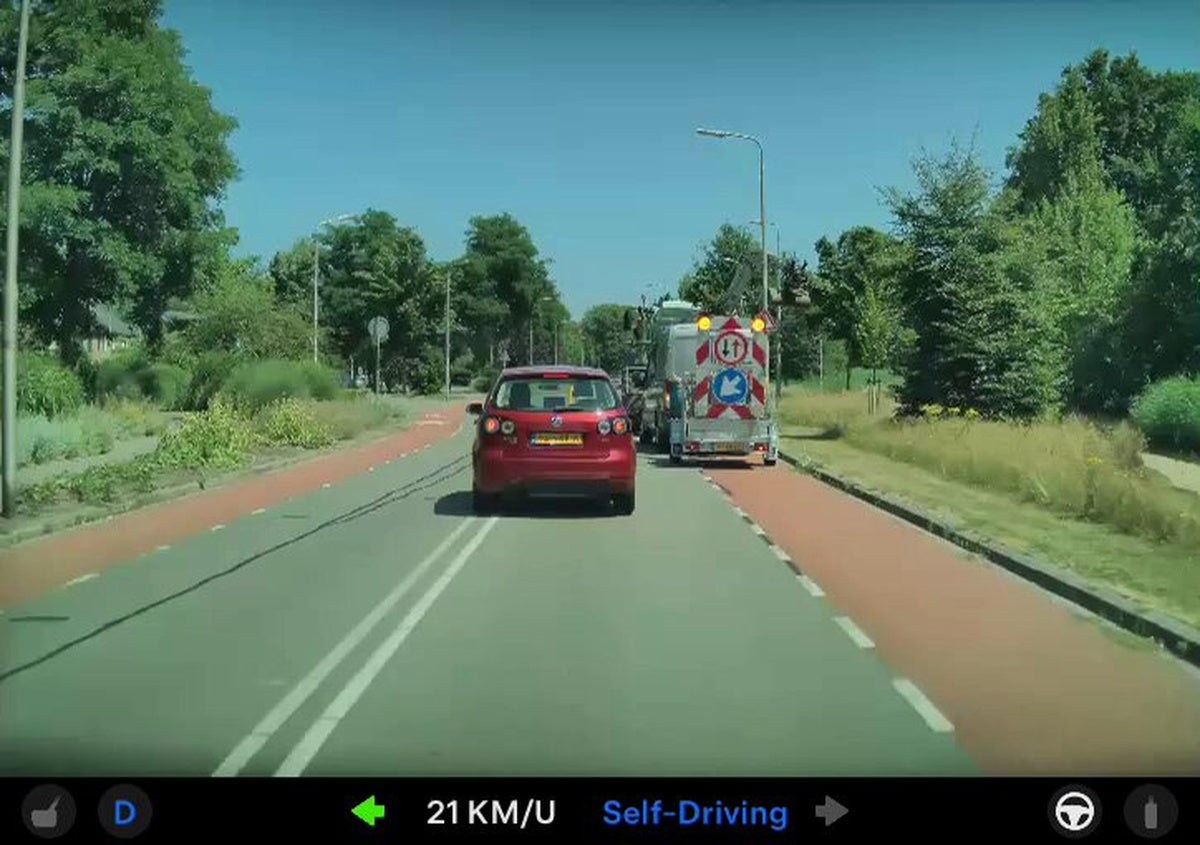
Tesla has shared footage of FSD Supervised handling one of the more demanding real-world scenarios it has encountered in Europe: a construction blockage on a narrow Dutch road that required the system to briefly cross into the opposite lane, yield to oncoming traffic and cyclists, then merge back — all without driver intervention on the steering wheel. The clip, posted by Tesla's official account, offers the clearest public demonstration yet of how the system adapts to infrastructure that simply doesn't exist in North America.

Why the Netherlands Is a Meaningful Test Case
Dutch roads are, by design, one of the harder environments for any autonomous driving system to master. Narrow two-way streets, dense cyclist infrastructure, mixed traffic including tractors and construction equipment, and road markings that frequently give way to temporary signage — it's a fundamentally different challenge from the wide suburban grids that shaped FSD's early training data.
Tesla received official type approval from the Dutch vehicle authority (RDW) on April 10, 2026 — the first regulatory clearance for FSD Supervised anywhere in Europe. The RDW's sign-off came after more than 18 months of testing, over 1.6 million kilometers of European road data, and more than 1,000 structured test runs, according to verified reporting. The regulator was explicit that FSD Supervised remains a driver-assistance system: the driver is responsible and must stay in control at all times.
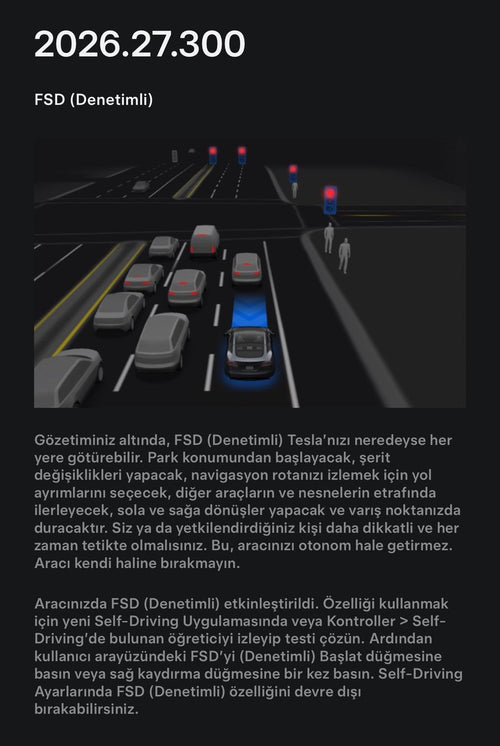
The initial software rollout to eligible Dutch owners began the following day, April 11, with update 2026.3.6 carrying FSD Supervised v14.2.2.5. By May 4 — less than a month later — Dutch owners had collectively driven 10 million kilometers on the system. As of July 10, 2026, firmware 2026.21.100 with FSD Supervised v14.2.2.6 had begun downloading to an initial cohort of Dutch owners. That version is the same neural-network generation currently active in North America, meaning Dutch owners are no longer running a localized fork — they're on Tesla's main stack.
What the Footage Actually Shows
The scenario in the video is not a controlled demonstration. It's a live construction zone on a public road: stationary vehicles blocking the right lane, a cyclist ahead, and oncoming traffic approaching from the opposite direction. FSD Supervised's response is methodical — it checks the opposing lane, waits for a gap, crosses the center line, passes the obstruction, yields as a cyclist and oncoming car clear the path, then pulls back into its lane.
Earlier footage from April documented similar behavior: FSD navigating around a wide tractor by briefly using an adjacent bike path, and separately, handling a temporary narrow bridge at a roadworks site by driving onto the opposite carriageway. The July clip is consistent with those earlier examples but notable because it involves simultaneous variables — construction vehicles, a cyclist, and oncoming traffic — resolved in a single continuous maneuver.
This kind of behavior requires the system to model the intent of multiple road users at once and time its actions against gaps that are measured in seconds. It's the type of edge case that has historically required a human driver to take over.
The Broader European Picture
Tesla's decision to share this clip publicly is deliberate. FSD Supervised's European expansion beyond the Netherlands depends in part on demonstrating to other national regulators that the system can handle local road conditions competently. The Netherlands was the proof-of-concept market; the footage is effectively part of that argument.
For Dutch owners currently on the system, FSD Supervised was priced at €99/month at launch, with Enhanced Autopilot subscribers eligible for a reduced €49/month rate. A one-time purchase option of €7,500 was available until May 15, 2026, after which the Netherlands shifted to a subscription-only model.
The question now is whether the 10 million kilometers of Dutch driving data — and demonstrations like this one — accelerate regulatory conversations in Germany, France, or the UK. Each market carries its own approval process, but the RDW's framework and Tesla's documented European dataset give those discussions a concrete starting point. How quickly that translates into additional approvals will be one of the more important FSD storylines of the next 12 months.
Related Gear
Gear up your Tesla with tested, custom-fit BASENOR accessories — shop Tesla accessories →
📋 Tracking Tesla software? See every firmware, FSD and app version in one place in our Tesla Software Update Tracker.
Sources & reporting notes
The links below identify the material source records used for this report.
- @Tesla on X (2026-07-14T03:38:23.000Z) — Direct source
Source links are preserved as published or accessed. See our editorial standards and corrections policy.
The BASENOR Editorial Desk covers Tesla, SpaceX, and related technology, curating reporting from primary sources — official accounts, regulatory filings, and software release data. Every article passes source-record and fact-checking review before publication. About the newsroom.
This report was curated by the BASENOR Editorial Desk from the sources listed above. Read our editorial standards or email editorial@basenor.com to report an error.