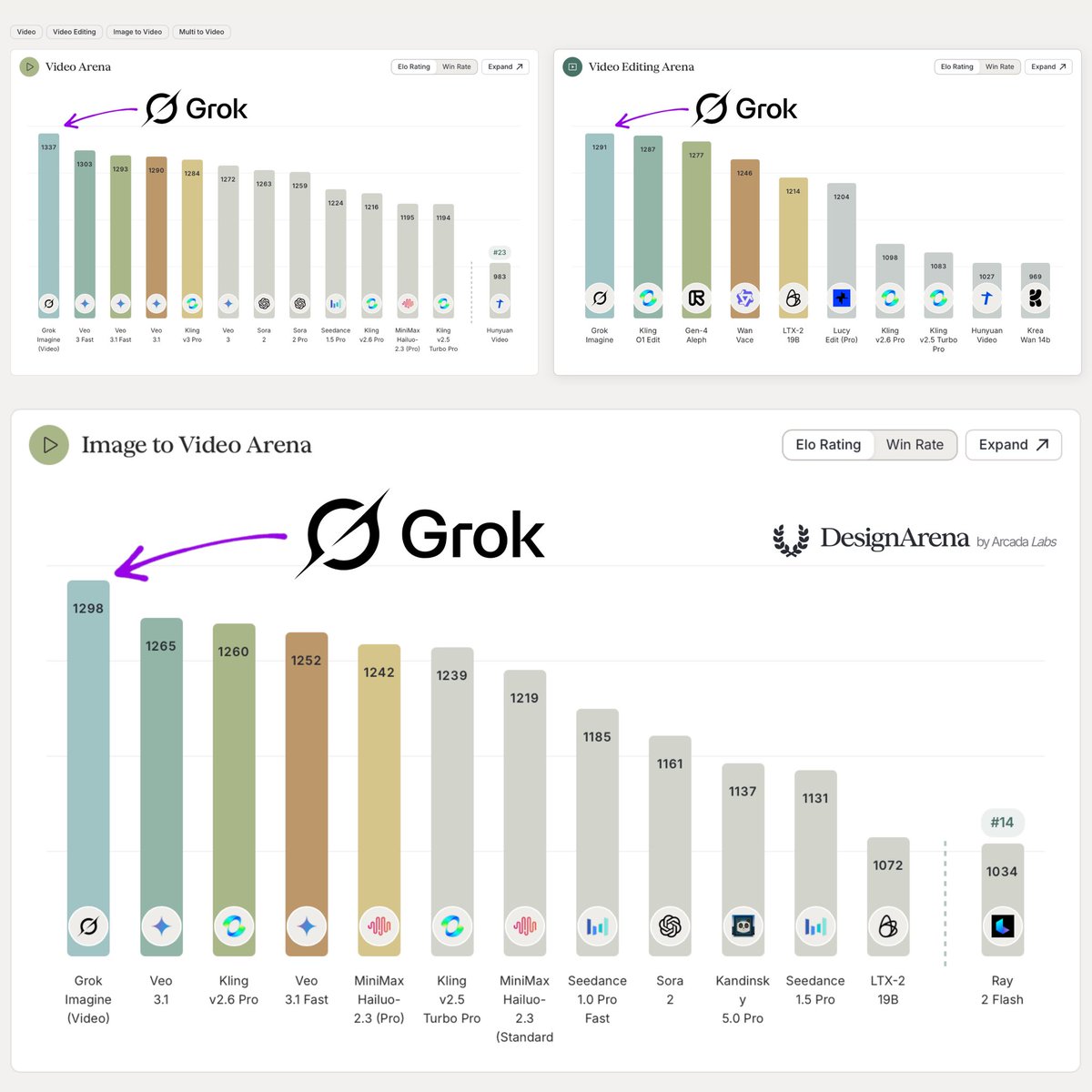
The News: Elon Musk posted three gold medal emojis alongside 'Grok Imagine triple gold,' signaling a major performance milestone for xAI's AI image and video generation platform.
Why It Matters: Grok is increasingly integrated into Tesla's AI ecosystem — advances in its reasoning and generative capabilities have direct implications for how Tesla's AI stack evolves.
Source: @elonmusk on X
Grok Hits 'Triple Gold': What xAI's Image Generation Milestone Means for the AI Race
Elon Musk doesn't post three gold medals without a reason. On March 16, 2026, the xAI founder dropped a cryptic but unmistakably triumphant message: 'Grok Imagine triple gold 🥇🥇🥇' — and the AI community immediately started decoding it.

While xAI has not yet published an official breakdown of what 'triple gold' refers to, the phrasing — and the specific callout of Grok Imagine — points to a benchmark sweep in AI-generated image or video quality evaluations. Three gold medals typically signals first-place finishes across three separate competitive categories or leaderboards. Given Grok Imagine's recent trajectory, that's not a stretch.
📊 Where Grok Imagine Stands Right Now
To understand why this matters, it helps to know how aggressively xAI has been developing Grok Imagine over the past few months:
| Milestone | Detail | Date |
|---|---|---|
| Extend from Frame | Chain video clips up to 15 seconds per clip | March 2, 2026 |
| Folders Feature | Organize generated content in-platform | March 4, 2026 |
| Videos Generated | 1.245 billion videos in January 2026 alone | Jan 2026 |
| API Pricing | $0.05 per second for 720p video with audio | Current |
Over 1.245 billion videos generated in a single month is a scale that few AI platforms have matched. That kind of usage volume also generates the training signal needed to rapidly improve model quality — which is likely part of the story behind today's announcement.
🔭 The BASENOR Take
Timeline: Announcement March 16, 2026. Official benchmark details not yet published by xAI.
Impact Level: Medium-High — significant for xAI's competitive positioning; indirect but meaningful for Tesla's AI roadmap.
Confidence: High that a real milestone was achieved. Low on the specific benchmarks until xAI publishes details.
Here's the context that matters: Grok and Tesla's AI ambitions are not separate universes. Elon Musk has consistently described xAI and Tesla as deeply intertwined — sharing compute infrastructure, talent, and long-term vision around autonomous intelligence. When Grok's generative capabilities leap forward, that capability eventually finds its way into Tesla's ecosystem, whether through in-car interfaces, the Tesla app, or the underlying AI research that feeds into FSD and Optimus.
The specific callout of Grok Imagine — not Grok's language reasoning or coding ability — is also telling. Image and video generation is the battleground where OpenAI's Sora, Google's Veo, and Meta's Movie Gen are all competing aggressively. A 'triple gold' sweep in this category, if confirmed across recognized benchmarks, would represent a genuine competitive statement.
Meanwhile, Grok 4.20 (launched in beta in February 2026) is already posting Arena Elo scores of approximately 1490–1500 on the Chatbot Arena leaderboard, and Grok 5 is currently in training on xAI's Colossus supercluster — running on over 200,000 NVIDIA GB200 GPUs with plans to scale toward 1 million. The infrastructure being built here is not incremental. It's a bet on a fundamentally different scale of AI compute than most competitors are running.
What This Means for Tesla Owners
The honest answer right now: this is a signal, not a product update. Tesla owners won't wake up tomorrow to a new in-car feature because of today's tweet. But the trajectory matters. xAI's rapid capability gains in image and video generation are the same foundational research that underpins how AI systems understand the visual world — which is precisely what FSD relies on.
As Grok's models become more capable at interpreting and generating visual information, that research cross-pollinates with Tesla's own perception stack. Musk has been explicit that Tesla and xAI share resources and that Tesla benefits from xAI's AI advances. So while 'triple gold' in image generation doesn't directly translate to a better FSD experience today, it's a data point in a larger story about xAI pulling ahead in the AI capability race.
Watch for xAI to publish a formal benchmark breakdown in the coming days. When they do, the specific leaderboards referenced will clarify exactly how significant this milestone is — and whether it represents a genuine state-of-the-art claim or a more narrowly scoped win.
📰 Deep Dive
Musk's choice of the word 'triple' is deliberate. In competitive AI benchmarking, sweeping three categories simultaneously — typically image quality, video coherence, and prompt adherence, or similar triads — is rare enough to be noteworthy. The fact that he specifically named 'Grok Imagine' rather than Grok broadly suggests the achievement is tied to the generative media side of the platform, not the language model's reasoning scores.
The timing is also significant. xAI is in an active arms race with well-funded competitors across every dimension of AI capability. Announcing a triple benchmark win — even cryptically — is a recruiting signal, an investor signal, and a competitive signal all at once. It tells the market that Grok Imagine isn't a secondary feature; it's a flagship product that xAI believes can compete at the top of its category.
For Tesla owners tracking the broader AI picture, the key number to watch is Grok 5's training progress on Colossus. The scale of compute being deployed — 200,000+ GB200 GPUs — is unprecedented for a model still in training. If Grok 5 delivers on the reasoning and agency improvements xAI has described, the downstream effects on Tesla's autonomous driving and robotics programs could be substantial. Today's 'triple gold' is a milestone on that road.
Sources & reporting notes
The links below identify the material source records used for this report.
- @elonmusk on X (2026-03-16T07:19:11.000Z) — Direct source
Source links are preserved as published or accessed. See our editorial standards and corrections policy.
The BASENOR Editorial Desk covers Tesla, SpaceX, and related technology, curating reporting from primary sources — official accounts, regulatory filings, and software release data. Every article passes source-record and fact-checking review before publication. About the newsroom.
This report was curated by the BASENOR Editorial Desk from the sources listed above. Read our editorial standards or email editorial@basenor.com to report an error.