xAI dropped Grok Voice Think Fast 2.0 on July 29, 2026 — a meaningful step up from its predecessor with faster response times, sharper transcription in noisy environments, and a new price point for API users. Here's everything developers and curious owners need to know about what changed and what to do before the automatic migration deadline.

What exactly is Grok Voice Think Fast 2.0?
It's xAI's next-generation voice model, built specifically for voice agents operating in real-world conditions. According to xAI, the model improves on three fronts simultaneously: intelligence (better reasoning through complex workflows), transcription accuracy, and conversational naturalness. Think of it as the engine powering voice-based AI applications — customer support bots, voice assistants, telephony systems — rather than a consumer-facing product you interact with directly.
How much faster and more accurate is it compared to the previous version?
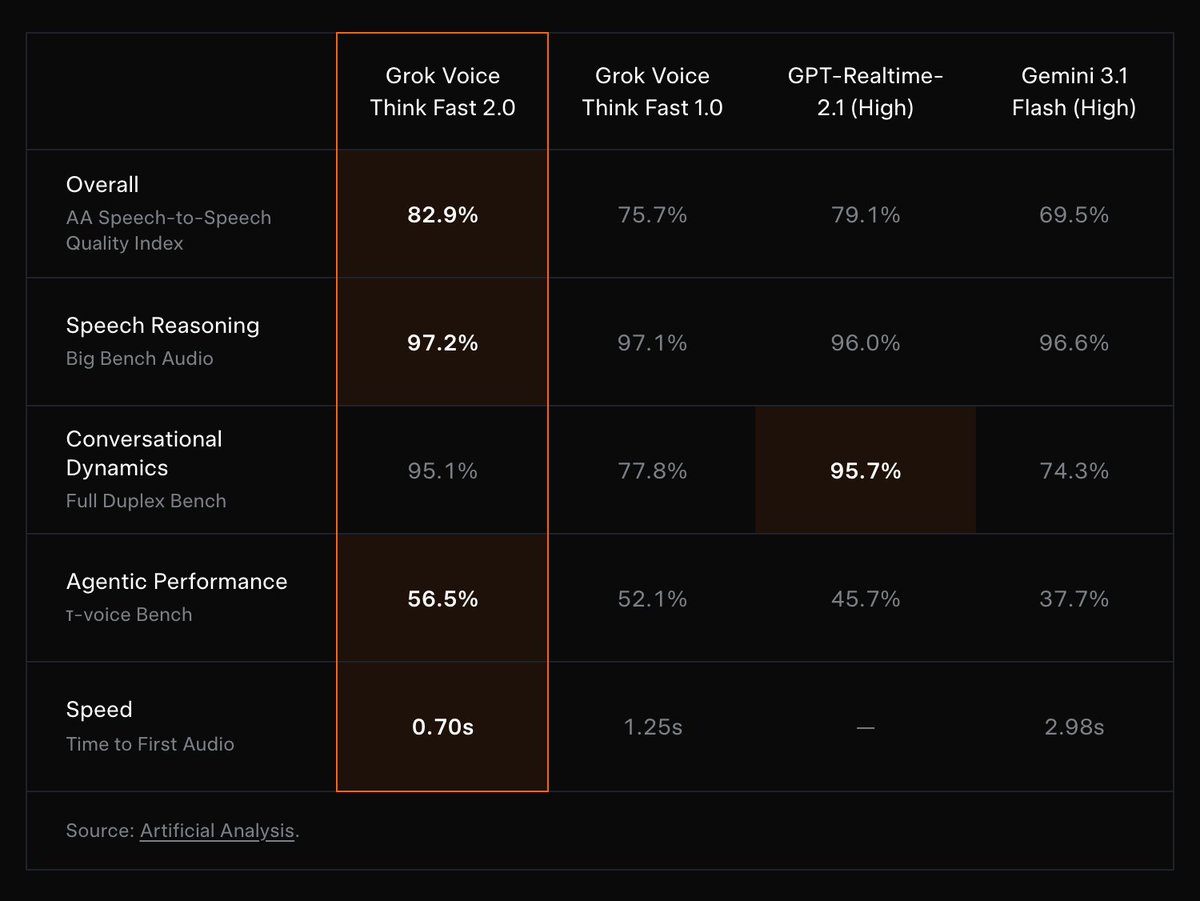
According to xAI, the numbers are notable. Time to First Audio dropped from 1.25 seconds on version 1.0 to 0.70 seconds on 2.0 — a nearly 44% improvement in perceived responsiveness. On transcription accuracy, xAI reports a 1.4x improvement over Grok Voice Think Fast 1.0, and a 1.5–2.0x improvement relative to Deepgram Nova 3 and ElevenLabs Scribe v2. That gap widens dramatically in noisy settings — approximately 10x better transcription accuracy than those competitors when audio conditions degrade, which is exactly the environment most real-world voice agents encounter.

Has it been tested in any real deployments?
Yes — and the results are concrete. According to xAI, A/B testing conducted on Starlink's platform showed a significant increase in both sales conversion rate and support containment rate when using Grok Voice Think Fast 2.0 versus the prior version. That's a meaningful real-world signal: it's not just benchmark performance, but measurable business impact in a live, high-volume environment.
How much does it cost, and where is it available?
Grok Voice Think Fast 2.0 is priced at $0.08 per minute of audio — up from $0.05/min for version 1.0. It's available now through the xAI API and the Voice Agent Builder. The price increase reflects the capability jump, and for applications where transcription accuracy in noisy conditions is critical, the delta is likely justified.

Is there anything developers need to do before August 5?
Yes — this is the most action-critical detail. On August 5, 2026, the grok-voice-latest endpoint will automatically upgrade from version 1.0 to version 2.0. If you're currently using that endpoint and want to stay on 1.0 — whether for cost reasons or to avoid any behavioral changes in your application — you need to explicitly pin grok-voice-think-fast-1.0 before that date. If you do nothing, you'll be on 2.0 automatically, at the new $0.08/min rate.
What does this mean for Tesla owners specifically?
Grok Voice Think Fast 2.0 isn't a Tesla OTA update — it won't appear in your car's software version. But it's the infrastructure layer that powers xAI's voice capabilities, and as Grok continues to deepen its integration with Tesla vehicles and the broader xAI ecosystem, improvements here eventually surface in the in-car experience. The Starlink deployment results are a useful preview: faster, more accurate voice understanding in noisy environments is exactly what you'd want from an in-car assistant navigating road noise and wind.

The August 5 auto-migration is the hard deadline here. Developers on grok-voice-latest have less than a week to decide whether to pin the old version or let the upgrade roll through. For most use cases, the accuracy and speed gains likely make 2.0 the right call — but the cost jump from $0.05 to $0.08/min is worth modeling against your usage volume before the switch happens automatically.
Sources & reporting notes
The links below identify the material source records used for this report.
- @SpaceXAI on X (2026-07-29T18:10:46.000Z) — Direct source
- @SpaceXAI on X (2026-07-29T18:10:46.000Z) — Direct source
- @SpaceXAI on X (2026-07-29T18:10:47.000Z) — Direct source
- @elonmusk on X (2026-07-29T19:14:06.000Z) — Direct source
Source links are preserved as published or accessed. See our editorial standards and corrections policy.
The BASENOR Editorial Desk covers Tesla, SpaceX, and related technology, curating reporting from primary sources — official accounts, regulatory filings, and software release data. Every article passes source-record and fact-checking review before publication. About the newsroom.
This report was curated by the BASENOR Editorial Desk from the sources listed above. Read our editorial standards or email editorial@basenor.com to report an error.