Tesla North America posted a video this week showing FSD Supervised doing something most drivers would find genuinely tricky: detecting and steering around an empty flatbed truck whose bed was hanging out over the curb line. It's a low-speed, tight-clearance scenario — exactly the kind of edge case that used to trip up camera-based autonomy systems. The clip is worth watching, and the questions it raises are worth answering.

What exactly happened in the video?
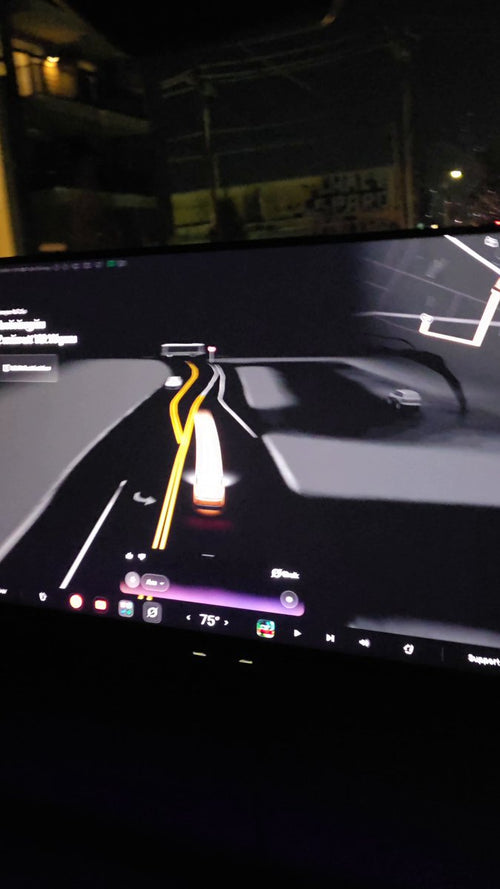
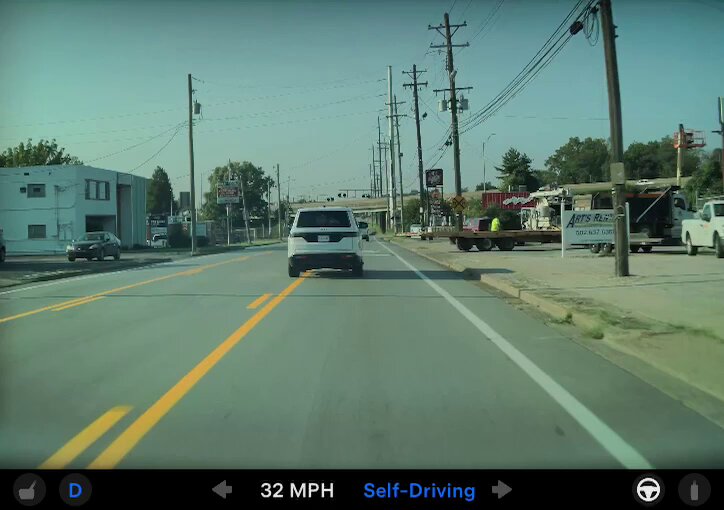
The clip shows a Tesla running FSD Supervised approaching a parked flatbed truck whose empty bed extends past the rear of the vehicle and over the curb, narrowing the usable lane width. Rather than continuing straight or hesitating, FSD detects the overhang, adjusts its lateral position, and passes cleanly. The car doesn't brake hard or wait for a human override — it reads the geometry and moves through.
Why is a hanging flatbed particularly hard to detect?
A flatbed with its bed raised or extended doesn't have the rectangular silhouette of a normal parked vehicle. The overhang sits at an unusual height, partially over the road surface, partially over the curb. Camera-based systems have to distinguish that object from the road edge, the curb, and the vehicle body itself — all in the same frame. Earlier FSD versions sometimes treated stationary overhangs as background clutter. The fact that the system here proactively adjusts its path, rather than reacting at the last moment, suggests the neural network is classifying the object correctly and planning around it with margin to spare.
Which version of FSD is running here?
Tesla North America didn't specify a version in the post. Based on the rollout timeline, the current production release is FSD (Supervised) v14.3.7, shipping as part of software version 2026.21.6, which began reaching vehicles around August 18–22, 2026. According to autopilotreview.com, v14.3.7 includes an upgraded reinforcement learning stage and an enhanced neural network vision encoder aimed specifically at improving performance in rare and low-visibility conditions — which a partially obscured flatbed overhang qualifies as.
What's actually improved in recent FSD versions that makes this possible?
A few things compound here. According to background research, FSD v14.3.7 delivers a reported 20% faster reaction time through a rewritten AI compiler and runtime using MLIR. The higher-resolution vision encoder — first introduced in v14.2 and refined through v14.2.2 — gives the system better awareness of objects that don't fit standard vehicle templates: emergency vehicles, road debris, and unusual load configurations like this flatbed. Earlier in 2026, FSD v14 was also captured detecting an approaching truck that was nearly invisible to human eyes, suggesting the 360° camera array is being used more aggressively for peripheral threat assessment. For more on how these updates have evolved, see our FSD coverage.
Does this mean FSD can handle any obstacle without driver input?
No — and that distinction matters. FSD (Supervised) still requires a fully attentive driver ready to take control at any moment. Tesla's own naming makes this explicit. What clips like this demonstrate is that the system's detection envelope is widening: it's catching more unusual hazards earlier and responding with smoother, more confident path adjustments. But edge cases still exist, and driver supervision remains the safety layer the system is designed around. A single clean pass on a parked flatbed is a data point, not a guarantee.
Which vehicles can run the version shown here?
FSD (Supervised) v14.3.7 is available to Model 3, Model Y, and Cybertruck owners in the U.S., Puerto Rico, Mexico, and Canada who are running software version 14.2 or later. According to Tesla's eligibility information, owners who haven't purchased FSD outright may be eligible for a complimentary trial of the latest v14 features. Existing Model S and Model X owners also continue to receive FSD updates normally.
Clips like this one serve a dual purpose for Tesla: they document real-world capability for owners who are deciding whether to engage FSD in tighter urban environments, and they function as implicit training data feedback loops — the more unusual scenarios the system handles cleanly on public roads, the richer the edge-case library becomes. Whether you find the flatbed avoidance impressive or simply expected at this stage of v14, the underlying trend is clear: the system is getting better at the scenarios that used to require a human hand on the wheel.
Related Gear
Gear up your Tesla with tested, custom-fit BASENOR accessories — shop Tesla accessories →
Sources & reporting notes
The links below identify the material source records used for this report.
- @tesla_na on X (2026-08-25T21:13:48.000Z) — Direct source
Source links are preserved as published or accessed. See our editorial standards and corrections policy.
The BASENOR Editorial Desk covers Tesla, SpaceX, and related technology, curating reporting from primary sources — official accounts, regulatory filings, and software release data. Every article passes source-record and fact-checking review before publication. About the newsroom.
This report was curated by the BASENOR Editorial Desk from the sources listed above. Read our editorial standards or email editorial@basenor.com to report an error.