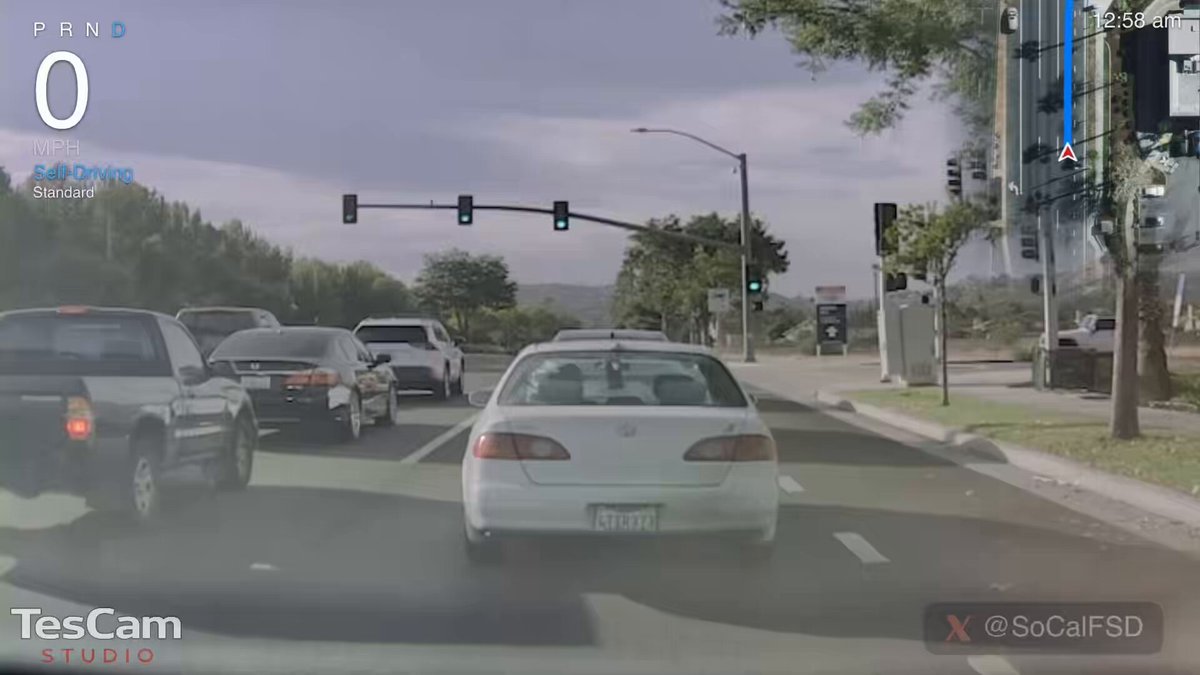
Tesla is drawing attention to one of FSD Supervised's quieter but meaningful capabilities: detecting and safely navigating around cyclists. In a post shared August 27, the company highlighted how its self-driving system contributes to safer road conditions for one of the most vulnerable groups in traffic — and the underlying technology behind that claim has grown substantially more capable over the past year.

What FSD Actually Does Around Cyclists
FSD Supervised v14 runs on a neural network that is reportedly 10 times larger than previous generations. Rather than processing each camera feed in isolation, the system ingests input from all cameras simultaneously to build a continuous real-time 3D model of the vehicle's surroundings. That architecture matters for cyclists specifically, because it allows FSD to detect a partially obscured rider — someone emerging from behind a parked van, for instance, or filtering up the side of slow traffic — before they are fully visible in any single camera view.
The most recent version, FSD Supervised v14.3.8, began rolling out on August 26, 2026 as part of software update 2026.26.6.5 for Hardware 4 (HW4) vehicles. According to verified release information, v14.3.7 introduced a 20% faster reaction time through a rewritten AI compiler and runtime, an upgraded Reinforcement Learning stage, and an improved neural network vision encoder tuned for rare and low-visibility scenarios — exactly the conditions where cyclist interactions tend to go wrong.
What Owners Should Do Right Now
If you want FSD to perform at its best around cyclists and other vulnerable road users, there are a few concrete steps worth taking today.
- Check your software version. Go to Controls → Software on your touchscreen. If you are on HW4 hardware and not yet on 2026.26.6.5 or later, tap Check for Updates. If the update is available, install it — v14.3.8 contains the perception and reaction-time improvements described above.
- Confirm FSD is set to the right profile. Go to Autopilot → FSD Profile and make sure it reflects how you actually drive. A profile set too aggressively can reduce the buffer FSD maintains around cyclists. Most owners find the default or a slightly more cautious profile works well in urban environments with heavy bike traffic.
- Enable automatic lane changes with care in bike lanes. In cities with dedicated cycling infrastructure, review your Auto Lane Change setting under Autopilot. FSD tracks lane markings and vulnerable road users, but staying attentive during any lane change near a bike lane remains your responsibility as the supervised driver.
- Stay engaged — this is still Supervised. FSD Supervised requires the driver to remain alert and ready to intervene at all times. Improved cyclist detection does not mean the system is infallible. If FSD behaves unexpectedly near a cyclist, take control immediately and submit a bug report via the voice command "Report an issue" or through the in-car feedback button.
- Submit feedback after relevant encounters. Tesla's neural network improves through real-world data. When FSD handles a cyclist interaction particularly well — or poorly — use the thumbs-up/thumbs-down control on the FSD visualization screen. That feedback directly informs future training runs.
Why This Matters Beyond the Clip
Cyclist fatalities remain a persistent problem in urban traffic. Regulatory bodies in multiple jurisdictions have begun scrutinizing how automated driving systems handle vulnerable road users, making this capability increasingly important not just for safety but for the long-term regulatory trajectory of FSD. Tesla highlighting this use case publicly suggests the company is confident enough in the system's current performance to invite that scrutiny — a meaningful signal given how carefully the company has managed FSD's public narrative over the years.
For owners who regularly drive in cities or suburbs with active cycling infrastructure, keeping FSD updated and staying engaged behind the wheel is the most practical contribution you can make to that safety picture. For more on FSD's evolving capabilities, see our FSD coverage.
Related Gear
Gear up your Tesla with tested, custom-fit BASENOR accessories — shop Tesla accessories →
Sources & reporting notes
The links below identify the material source records used for this report.
- @Tesla on X (2026-08-27T21:32:38.000Z) — Direct source
Source links are preserved as published or accessed. See our editorial standards and corrections policy.
The BASENOR Editorial Desk covers Tesla, SpaceX, and related technology, curating reporting from primary sources — official accounts, regulatory filings, and software release data. Every article passes source-record and fact-checking review before publication. About the newsroom.
This report was curated by the BASENOR Editorial Desk from the sources listed above. Read our editorial standards or email editorial@basenor.com to report an error.