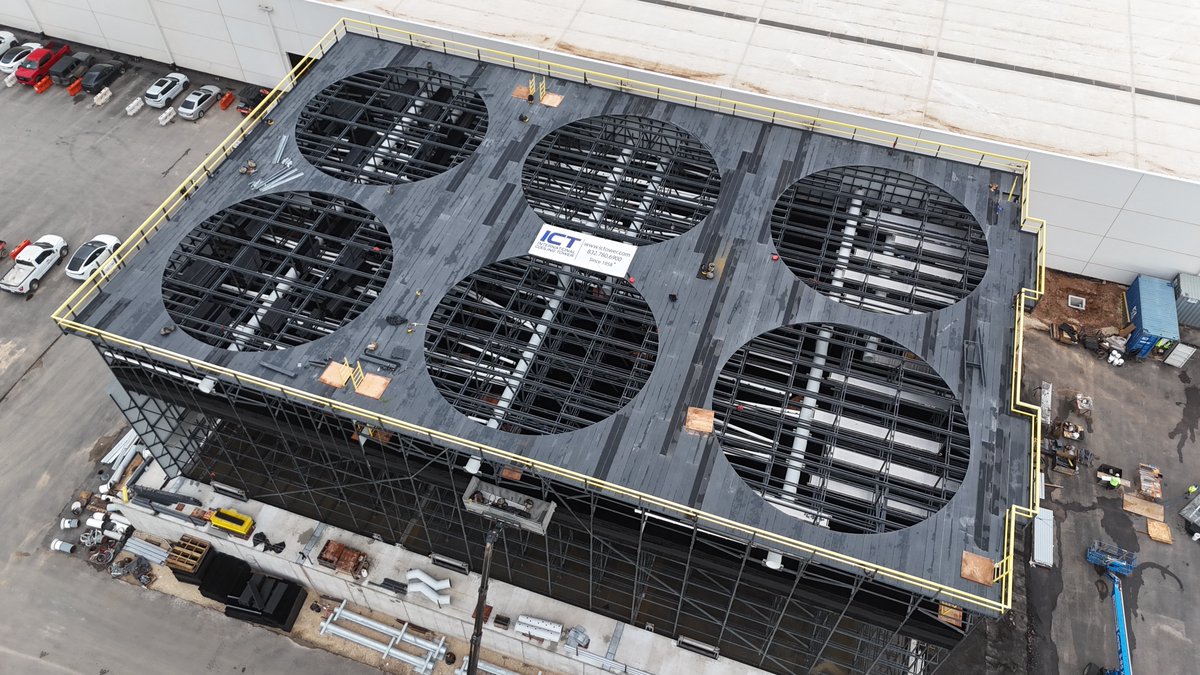
Aerial observer Joe Tegtmeyer is back over Giga Texas, and his latest footage offers a rare ground-level look at the cooling infrastructure keeping Tesla's Cortex AI data centers operational. The systems running underneath those towers aren't just keeping servers comfortable — they're the backbone of everything Tesla is building toward with Full Self-Driving and the Optimus humanoid robot.

What Cortex Actually Is
Tesla's Cortex 1 and Cortex 2 are AI training superclusters located at Giga Texas, purpose-built for one job: processing the enormous volumes of video data needed to train FSD's neural networks and Optimus's vision AI systems. At full combined capacity, the two clusters are expected to house approximately 100,000 Nvidia H100 and H200 GPUs — a compute footprint that rivals the largest AI infrastructure deployments anywhere in the world.
Cortex 1 launched with roughly 50,000 GPUs installed and, according to previous reports, is projected to deliver around 10x the training compute Tesla had before. Cortex 2 is designed to push that further — potentially adding 20x training compute for FSD and Optimus vision AI when fully operational. The first 250 MW phase of Cortex 2 was targeted to activate in April 2026, with full 500 MW capacity expected by mid-2026.
Why Cooling Is the Real Story
Running 100,000 high-performance GPUs generates heat at a scale that makes conventional air cooling impractical. Tesla's solution, according to reports citing Supermicro's involvement, is liquid cooling technology claimed to reduce electricity costs for cooling infrastructure by up to 89% compared to traditional air-cooled setups. That's not a marginal efficiency gain — at the power draw these clusters require, it translates to tens of millions of dollars in annual operating savings.
The numbers behind the power requirements are striking. The first stage of Cortex was estimated to require 130 megawatts of cooling and power at launch. The combined Cortex supercluster is projected to scale to 500 MW by 2026 — roughly equivalent to the output of a small power plant dedicated entirely to AI training.
Tegtmeyer's footage specifically highlights the Part 2 cooling tower for Cortex 2, where a large maintenance cart is visible on top of the structure — a sign that active commissioning work is underway, not just construction. The cooling infrastructure for Cortex 1 also relies on reclaimed rainwater stored in underground tanks, with most of that water recycled through the system. Tegtmeyer himself has previously pushed back on inflated estimates of daily water consumption that circulated online, noting the actual figures are considerably lower than some reports suggested.
What This Means for FSD and Optimus Development
Training compute is the rate-limiting factor in AI capability improvement. More GPUs running more efficiently means Tesla can iterate on FSD models faster, process more edge-case driving scenarios, and refine Optimus's physical AI capabilities at a pace that wouldn't be possible with smaller infrastructure. Every efficiency gain in the cooling system translates directly into more training cycles per dollar — and ultimately, faster improvement in the AI systems Tesla owners interact with every day.
The scale of what's being built at Giga Texas is easy to underestimate from a distance. Tegtmeyer's consistent aerial documentation has been one of the clearest windows into how seriously Tesla is investing in the physical infrastructure behind its AI ambitions. With Cortex 2 commissioning now visibly active, the next milestone to watch is whether the first 250 MW phase comes online close to its reported April 2026 target — and what that means for the pace of FSD updates in the months that follow.

Sarah focuses on Tesla Energy, SpaceX missions, and the broader Musk AI portfolio. Former data analyst in clean energy. Based in San Francisco.
Sources verified at publish time. Spotted an inaccuracy? Email editorial@basenor.com.