30-Second Brief
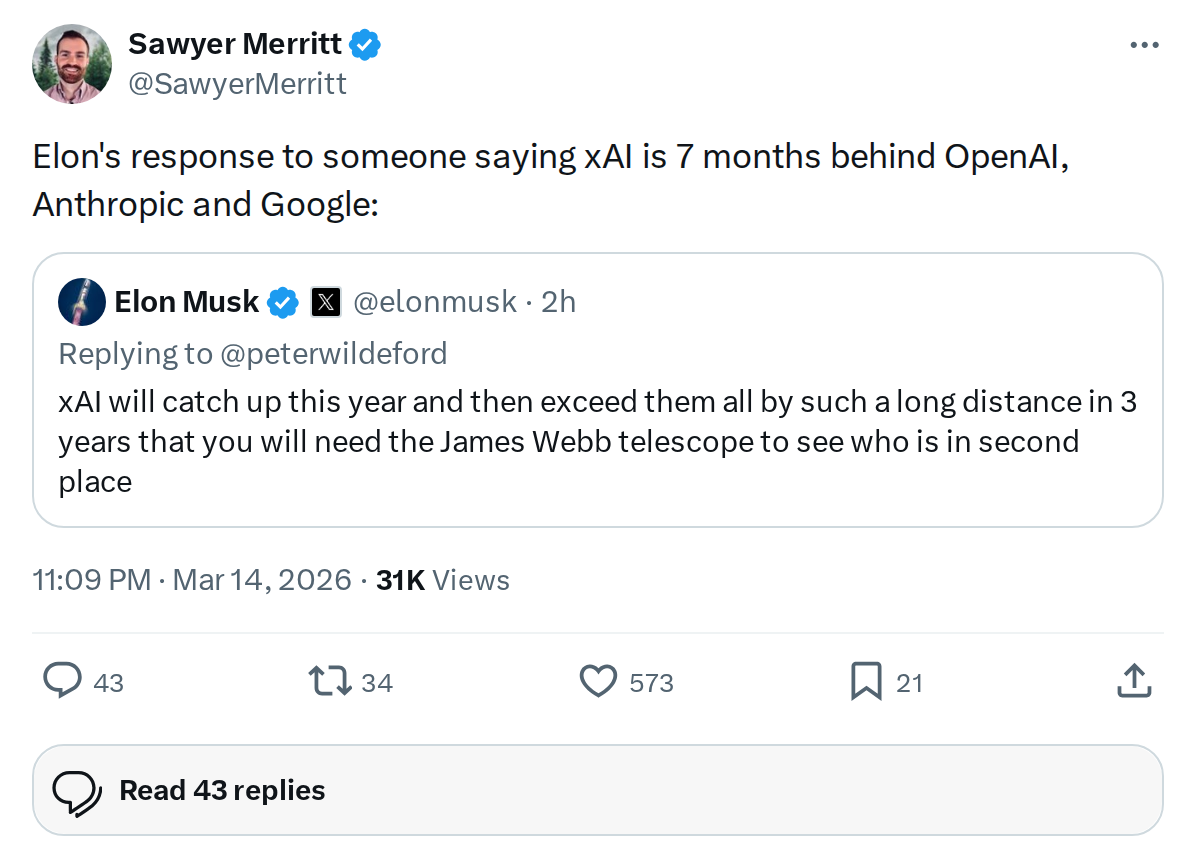
The News: Elon Musk has publicly responded to claims that xAI is 7 months behind OpenAI, Anthropic, and Google — and the full picture of xAI's current state is more complicated than a simple gap metric suggests.
Why It Matters: xAI's trajectory directly affects Tesla owners: Grok powers Tesla's in-car AI assistant, and the forthcoming "Digital Optimus" project is a Tesla-xAI collaboration. How fast xAI closes the gap determines how quickly your Tesla gets smarter.
Source: @SawyerMerritt on X
Is xAI Really 7 Months Behind Its Rivals? Musk Responds — And the Reality Is More Nuanced
The AI race is brutal, and xAI is not pretending otherwise. When a user publicly claimed that xAI sits 7 months behind OpenAI, Anthropic, and Google, Elon Musk didn't dismiss it — he engaged. That response, captured by Tesla tracker @SawyerMerritt, has reignited debate about where Grok actually stands in the competitive AI landscape and what xAI's path forward looks like for the millions of Tesla owners whose vehicles depend on it.

📊 Key Figures
| Metric | Value | Context |
|---|---|---|
| xAI Valuation (post-SpaceX merger) | $250B | Part of $1.25T combined entity |
| Series E Funding Raised | $20B | Upsized round, closed recently |
| GPU Compute (Colossus I & II) | 1M+ H100 equivalents | As of end of 2025 |
| Grok 5 Parameter Count | 6 trillion | Currently in training |
| Musk's AGI probability estimate (Grok 5) | 10% | Per Musk's own statement |
| Target IPO Date (SpaceX/xAI) | June 2026 | Combined entity public offering |
| Digital Optimus ETA | ~6 months | From March 13, 2026 per Musk |
The Gap Is Real — But So Is the Rebuild
Musk himself has acknowledged that Grok currently trails competitors, particularly in coding performance — an area where OpenAI's o3 and Anthropic's Claude 3.7 Sonnet have set a high bar. What's more significant is what Musk said on March 13: xAI "was not built right first time around" and is undergoing a complete architectural rebuild from its foundations.
That's a remarkable admission from a founder. It also explains why 10 of the 12 original xAI co-founders have departed. To plug the gap, xAI has brought in Andrew Milich and Jason Ginsberg — two senior executives from AI coding startup Cursor — who report directly to Musk. Their mandate is clear: fix the coding weakness that has been xAI's most visible competitive liability.
The target for closing the competitive gap is mid-2026, which aligns with Grok 5's training timeline. At 6 trillion parameters, Grok 5 would be a significant architectural leap. Musk has placed a 10% probability on Grok 5 achieving AGI — a number that sounds small until you consider that no serious AI researcher was putting any probability on AGI this decade just two years ago.
What xAI Is Building Right Now
While the headline debate is about competitive ranking, xAI has been shipping. Grok 4.20 Beta launched in the Enterprise API on March 11, including multi-agent capabilities. The Grok Imagine platform — xAI's video and image generation tool — received an API launch in January 2026 at $0.05 per second, with features like "Extend from Frame" (continuous clip chaining up to 15 seconds) added in early March.
On the infrastructure side, xAI ended 2025 with over one million NVIDIA H100 GPU equivalents across its Colossus I and II supercomputers, with plans to scale toward a facility housing 100,000+ GPUs dedicated to training future models. The $20 billion Series E gives xAI the runway to execute — the question is whether the architectural rebuild can be completed fast enough to matter.
🔭 The BASENOR Take
The 7-month gap claim is a snapshot, not a verdict. AI model generations are measured in months, not years. The more important signal here is that Musk is engaging with the criticism rather than dismissing it — which suggests xAI's internal assessment of its own standing is honest, even if uncomfortable.
For Tesla owners, the stakes are direct. Grok is already integrated into Tesla's voice and AI experience, and "Digital Optimus" — the collaborative Tesla-xAI AI project — is reportedly just six months away from user availability. If xAI's rebuild succeeds on schedule, Tesla vehicles could see a step-change improvement in AI capability by late 2026. If it slips, that timeline shifts too.
The compute advantage is real: one million H100 equivalents is a serious infrastructure position. The talent additions from Cursor are targeted and credible. The wildcard is whether a full architectural rebuild — while simultaneously shipping products and integrating with SpaceX post-merger — can be executed without further leadership instability. The June 2026 IPO target adds another forcing function. Musk has set a lot of clocks running at once.
📰 Deep Dive
The framing of "7 months behind" reflects how quickly the AI landscape moves. A 7-month gap in a field where major model releases happen every quarter is significant — but it's also closeable. The more structurally interesting question is whether xAI's rebuild addresses the right problems. Musk's acknowledgment that the original architecture was flawed is rare candor in an industry where founders typically spin setbacks as pivots.
The departure of 10 of 12 original co-founders is the detail that deserves more attention. Co-founder departures at that scale typically signal either a fundamental disagreement about direction or a culture that makes it difficult for strong technical leaders to operate. The Cursor hires — Milich and Ginsberg — suggest Musk is betting on a smaller, more focused leadership structure reporting directly to him, rather than rebuilding a broad founding team.
What this means for the competitive race: xAI's path to relevance likely runs through Grok 5. If the 6-trillion-parameter model delivers on coding benchmarks and general capability, the 7-month gap narrative collapses quickly. If Grok 5 underdelivers or arrives late, the combined SpaceX-xAI entity faces its IPO window with a weaker AI story than investors are expecting. That pressure — not just competitive pride — is probably the real driver behind Musk's public engagement with the criticism.
Tesla owners watching this should track two milestones: the Grok 5 release (currently in training, projected for 2026) and the first public demonstration of Digital Optimus. Those two events will tell us far more about xAI's actual competitive position than any benchmark comparison published today.
🤖 Tracking Tesla's humanoid robot? See every Optimus production milestone and appearance in our Tesla Optimus Tracker.
Related Gear
Gear up your Tesla with tested, custom-fit BASENOR accessories — shop Tesla accessories →
Sources & reporting notes
The links below identify the material source records used for this report.
- @SawyerMerritt on X (2026-03-14T15:09:44.000Z) — Direct source
Source links are preserved as published or accessed. See our editorial standards and corrections policy.
The BASENOR Editorial Desk covers Tesla, SpaceX, and related technology, curating reporting from primary sources — official accounts, regulatory filings, and software release data. Every article passes source-record and fact-checking review before publication. About the newsroom.
This report was curated by the BASENOR Editorial Desk from the sources listed above. Read our editorial standards or email editorial@basenor.com to report an error.