Lufthansa Group has confirmed it will begin rolling out SpaceX's Starlink Wi-Fi service across its partner airlines next week, with the first equipped commercial flight scheduled for August 19, 2026. The deployment covers more than 850 aircraft across ten airlines in the group, and Lufthansa is targeting full fleet coverage by 2029 — one of the largest single Starlink Aviation commitments to date.
The announcement, flagged by Sawyer Merritt on X, marks a significant escalation in Starlink's push into commercial aviation, following earlier deployments with United Airlines, Qatar Airways, and Hawaiian Airlines.

What Lufthansa Confirmed
The inaugural Starlink-equipped flight will operate on August 19, 2026, aboard a Lufthansa Airbus A320neo registered as D-AINM, according to reporting from Simple Flying and Airways Magazine. From there, installations will expand across the group's fleet on a rolling basis.
The rollout will cover Lufthansa, SWISS, Austrian Airlines, Brussels Airlines, Eurowings, Discover Airlines, Air Dolomiti, Edelweiss, Lufthansa CityLine, and ITA Airways — effectively the entire mainline and regional network under the group's umbrella. Lufthansa Group initially telegraphed the plan in January 2026, but this week's confirmation puts firm dates and aircraft counts behind it.
Key Figures
| Metric | Value |
|---|---|
| First equipped flight | August 19, 2026 |
| First aircraft | Airbus A320neo (D-AINM) |
| Total aircraft in scope | 850+ |
| Airlines covered | 10 |
| Fleet-wide completion target | 2029 |
| Passenger cost | Free (with Travel ID) |
What Passengers Get
The most consumer-relevant detail: Lufthansa will offer the service free of charge to all Miles & More loyalty members and Travel ID account holders across every travel class, according to the group's official announcement. Passengers without status will simply need to create a free Travel ID account to connect — meaning there's effectively no paywall for the Wi-Fi itself.
That's a meaningful shift from the tiered, often-expensive satellite Wi-Fi pricing that European carriers have historically charged. It also aligns Lufthansa with the model United Airlines is pursuing on its Starlink deployment, where connectivity is bundled with the flight rather than sold à la carte.
Lufthansa states the service will support video streaming, cloud-based work, and other bandwidth-heavy applications, with gate-to-gate coverage. The group notes that onboard bandwidth will, in many cases, exceed typical home or office broadband — a claim Starlink Aviation has consistently backed up in the field, thanks to the low-Earth-orbit constellation's low latency compared with legacy geostationary satellite Wi-Fi providers.
Why This Matters for SpaceX
Starlink Aviation has been building steadily but the Lufthansa Group deal is a category shift. At 850+ aircraft, it dwarfs most previous single-group commitments and gives SpaceX a foothold across Europe's largest airline family — one that had, until recently, standardized on legacy Ku-band providers like Viasat and Inmarsat.
The competitive implications extend well beyond a single carrier. Lufthansa Group operates significant transatlantic and Asian long-haul routes through SWISS, Austrian, and Lufthansa mainline, meaning Starlink terminals will now be visible to millions of premium business travelers every month. Historically, that demographic has been the hardest to win over on inflight connectivity, because they compare it directly against ground broadband — the exact benchmark Lufthansa is now claiming Starlink can meet or beat.
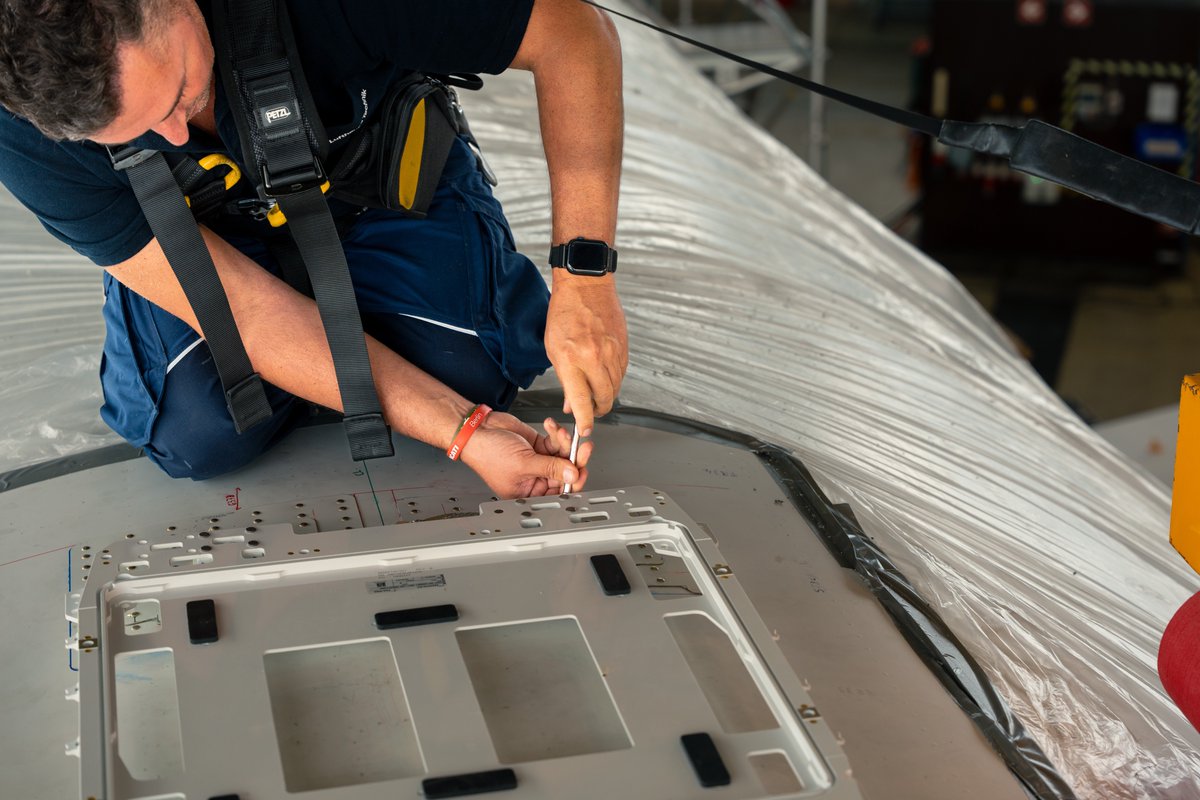
The 2029 completion target also implies a sustained installation cadence. Retrofitting 850 aircraft over roughly three years works out to roughly 280 aircraft per year, or more than five installations per week across the group's maintenance bases. That's a non-trivial logistics operation for both Lufthansa Technik and SpaceX's aviation hardware supply chain.
What to Watch Next
Several signals worth tracking in the coming months:
- Aug 19 launch performance: Real-world speed and latency reports from the first D-AINM flights will set the tone for how quickly other European carriers follow.
- Installation cadence: Watch for updates from Lufthansa Technik on how many aircraft complete retrofit per month — the pace will determine whether the 2029 target is realistic.
- Competitor responses: Air France-KLM, IAG (British Airways/Iberia), and the Middle Eastern majors haven't yet made comparable fleet-wide LEO commitments. Expect movement.
- Long-haul rollout: The A320neo is a short/medium-haul aircraft. When Lufthansa's 747-8s, A350s, and 787s get equipped will be the more consequential milestone for transatlantic business travel.
For now, the practical takeaway is straightforward: starting next week, at least one Lufthansa A320neo will offer free, high-speed, low-latency Wi-Fi from gate to gate — a first for the group, and a substantial win for SpaceX's aviation business.
Related Gear
Gear up your Tesla with tested, custom-fit BASENOR accessories — shop Tesla accessories →
Sources & reporting notes
The links below identify the material source records used for this report.
- @SawyerMerritt on X (2026-08-10T15:52:57.000Z) — Direct source
Source links are preserved as published or accessed. See our editorial standards and corrections policy.
The BASENOR Editorial Desk covers Tesla, SpaceX, and related technology, curating reporting from primary sources — official accounts, regulatory filings, and software release data. Every article passes source-record and fact-checking review before publication. About the newsroom.
This report was curated by the BASENOR Editorial Desk from the sources listed above. Read our editorial standards or email editorial@basenor.com to report an error.