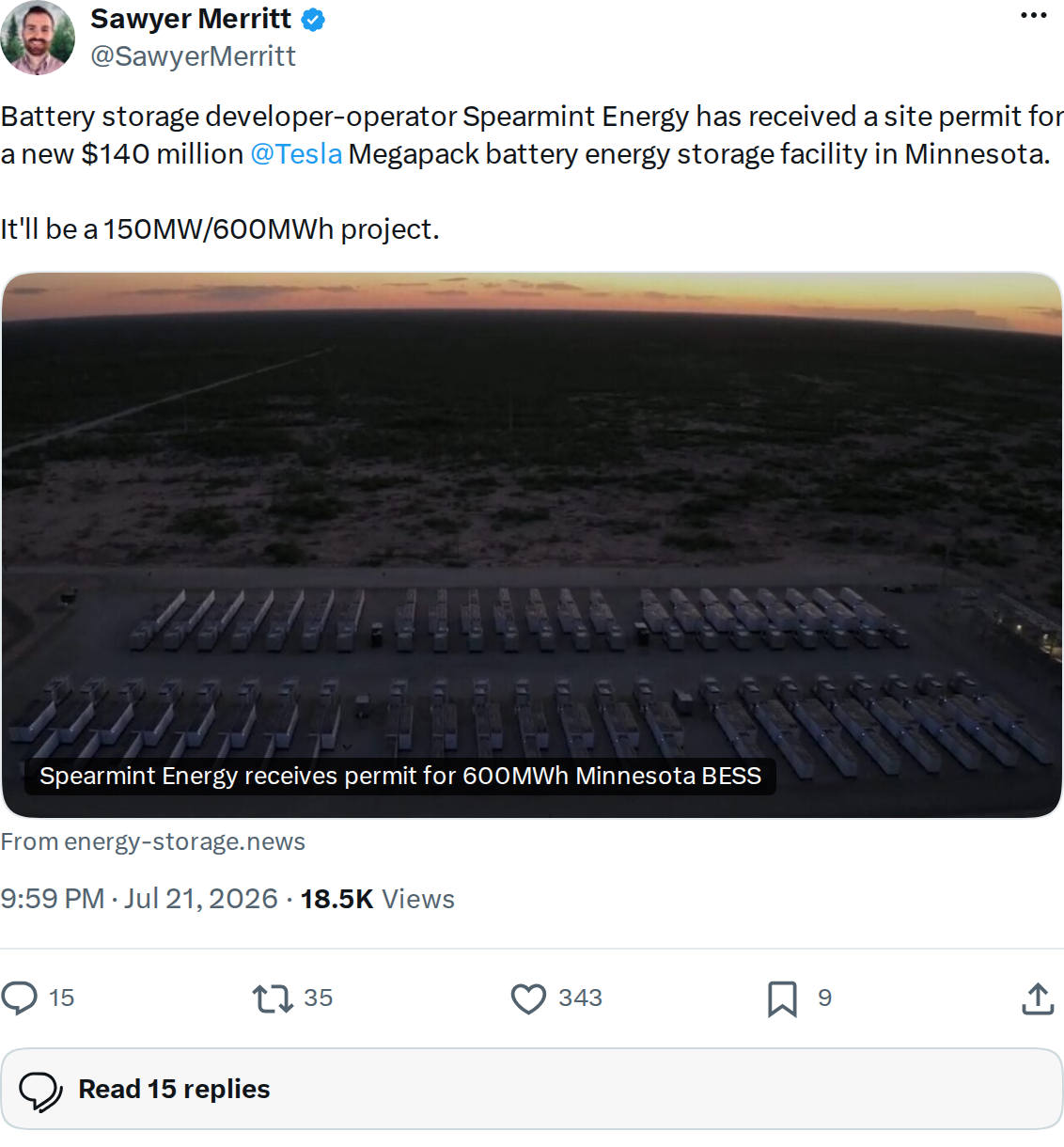
Spearmint Energy has cleared a major regulatory hurdle for a large-scale Tesla Megapack installation in Freeborn County, Minnesota. The Minnesota Public Utilities Commission approved the site permit on July 16, 2026, paving the way for what will become one of the more substantial standalone battery storage projects in the MISO grid region. Here's what the project actually involves.

1. The Project Is Called Midwater, and It Has a Specific Address
The facility's official name is the Midwater Energy Storage Project. It will sit on 10 to 20 acres of privately owned land adjacent to the Glenworth Substation off Minnesota Highway 65 in Freeborn County. Connecting directly to an existing substation is standard practice for grid-scale storage — it minimizes transmission losses and speeds up interconnection approvals. The site footprint is modest for the capacity it will deliver.
2. 150 MW / 600 MWh Means Four Hours of Full-Power Discharge
The system is rated at 150 megawatts of power output and 600 megawatt-hours of total energy capacity. In practical terms, that means the facility can push 150 MW onto the grid continuously for roughly four hours before needing to recharge. For context, 150 MW is enough to power approximately 120,000 average U.S. homes simultaneously. That four-hour discharge window is the current industry standard for projects targeting evening peak demand after solar generation drops off.
3. Tesla Megapack 2XL Is the Baseline Design — But Megapack 3 May Arrive in Time
According to project documentation, the preliminary design is built around Tesla's Megapack 2XL lithium iron phosphate (LFP) battery solution in a modular layout. LFP chemistry is the preferred choice for stationary storage: it runs cooler, degrades more slowly over thousands of charge cycles, and carries lower fire risk than other lithium chemistries. Notably, Tesla's next-generation Megapack 3 and Megablock units are anticipated to begin shipping in the second half of 2026 — meaning the final procurement decision could shift to newer hardware before construction begins.
4. The True Price Tag Is $457 Million, Not $140 Million
The $140 million figure cited in initial reports refers to the estimated capital cost of the battery storage system itself. According to project filings, the total installed capital cost for the full facility — including civil works, electrical infrastructure, grid interconnection, and commissioning — comes to approximately $457 million. Lifetime operating costs, covering labor and materials over the project's lifespan, add another estimated $246 million. The $140M number is real, but it represents only the equipment slice of a significantly larger investment.
5. This Is Spearmint's Second Minnesota Win, and It Targets the MISO Grid
Midwater is not Spearmint Energy's first project through Minnesota's state permitting process. The company previously advanced the Snowshoe Energy Storage Project in Olmsted County through the same MPUC pathway. Both projects feed into the Midcontinent Independent System Operator (MISO) grid, which covers a 15-state footprint from Manitoba to Louisiana. MISO has been actively pushing for additional storage capacity to support the region's renewable integration targets and manage grid reliability as older thermal generation retires. A permitted, shovel-ready project of this scale strengthens that buildout meaningfully.
With the site permit secured, Spearmint's next steps will involve finalizing interconnection agreements with MISO and locking in equipment procurement — the point at which the Megapack 2XL vs. Megapack 3 question gets answered. Construction timelines for projects of this scale typically run 18 to 24 months from financial close, so grid operators in the region should be watching for an operational date sometime in 2027 or 2028.
Related Gear
Gear up your Tesla with tested, custom-fit BASENOR accessories — shop Tesla accessories →
Sources & reporting notes
The links below identify the material source records used for this report.
- @SawyerMerritt on X (2026-07-21T21:59:38.000Z) — Direct source
Source links are preserved as published or accessed. See our editorial standards and corrections policy.
The BASENOR Editorial Desk covers Tesla, SpaceX, and related technology, curating reporting from primary sources — official accounts, regulatory filings, and software release data. Every article passes source-record and fact-checking review before publication. About the newsroom.
This report was curated by the BASENOR Editorial Desk from the sources listed above. Read our editorial standards or email editorial@basenor.com to report an error.