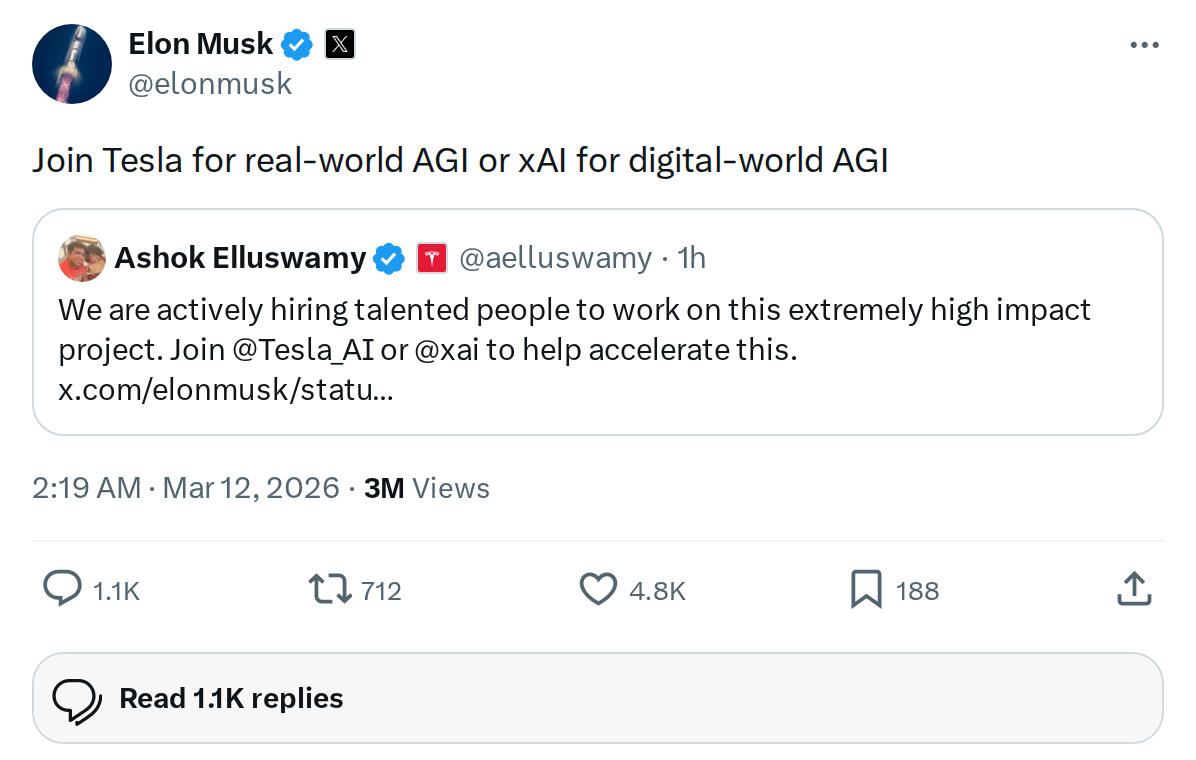
The News: Elon Musk is openly recruiting engineers for AGI development — directing candidates to Tesla for 'real-world AGI' and xAI for 'digital-world AGI.'
Why It Matters: This is the clearest public articulation yet of how Musk divides AGI responsibilities across his companies — and it has direct implications for Optimus, FSD, and the Grok AI powering your future Tesla.
Source: @elonmusk on X

In a single sentence posted to X, Elon Musk drew the clearest map yet of his AGI empire: Tesla owns the physical world, xAI owns the digital one. The post — which pulled over 2.5 million views within hours — is also a direct recruiting call, signaling that both companies are actively staffing up for what Musk believes is the defining technology race of this decade.
For Tesla owners, this isn't abstract tech news. The 'real-world AGI' Musk references at Tesla is the intelligence layer being built into Optimus, FSD, and every future product that interacts with atoms rather than pixels. Understanding how these two AGI tracks are structured tells you a lot about where your car — and Tesla's roadmap — is heading.
📊 Key Figures
| Metric | Value | Context |
|---|---|---|
| Tesla 2026 CapEx | >$20B | Up from $8.5B in 2025 |
| xAI Series E Raise | $20B | Closed Jan 6, 2026 |
| xAI Colossus GPUs | ~200,000 | Target: 1 million |
| FSD Real-World Miles | 8.4B+ | As of March 1, 2026 |
| Tesla–xAI Investment | $2B | Tesla investment in xAI |
| Optimus Production Target | 1M units/yr | Initial annual target |
Two AGI Tracks, One Musk Vision
Musk's framing is deliberate and precise. 'Real-world AGI' at Tesla means intelligence that manipulates the physical environment — robots that pick up objects, vehicles that navigate complex roads, and systems that interact with matter. The primary vehicle for this is the Optimus humanoid robot, which Musk declared on March 4, 2026, will make Tesla 'probably the first to achieve AGI in humanoid/atom-shaping form.'
'Digital-world AGI' at xAI is a different beast entirely — intelligence that processes information, writes code, reasons through problems, and generates language. That's the domain of Grok, xAI's flagship model, which is being developed at the Colossus compute cluster currently running approximately 200,000 GPUs with ambitions to scale to 1 million.
What makes today's tweet particularly significant is the announcement of 'Digital Optimus' (also referred to internally as 'Macrohard') — a joint xAI-Tesla project that uses Grok to power a computer-controlling AI agent. This is the bridge between the two tracks: xAI's digital reasoning capabilities plugged directly into Tesla's physical execution layer, funded in part by Tesla's $2 billion investment in xAI.
What This Means for Your Tesla
The talent recruitment call matters beyond the headline. When Musk publicly posts a job call with 2.5 million views, it accelerates pipeline. The engineers who respond to this tweet are the ones who will build the next generation of FSD, train the neural networks that process 8.4 billion miles of real-world driving data, and design the Optimus Gen 3 expected to be announced in Q1 2026.
For FSD specifically, the real-world AGI framing is a direct statement of intent. Tesla's neural network isn't just a driver-assistance tool in Musk's view — it's the sensory and decision-making layer of a physical AGI system. Every mile your Tesla drives contributes to that dataset. The 8.4 billion cumulative miles logged as of March 1, 2026, is the training corpus that no competitor can replicate from scratch.
On the hardware side, Tesla is in active discussions with Samsung Electronics to expand its AI6 chip supply, targeting approximately 40,000 wafers per month on Samsung's 2-nanometer process. That chip investment is the substrate on which real-world AGI runs — both in Optimus and in future Tesla vehicles.
🔭 The BASENOR Take
Timeline: AGI recruitment active now — March 2026. Digital Optimus project announced same day. Optimus Gen 3 expected Q1 2026.
Impact Level: 🔴 High — This shapes Tesla's product roadmap for the next 3–5 years.
Confidence: ⬛⬛⬛⬛⬜ — Musk's public statements are directionally reliable, though timelines historically slip.
The split AGI strategy is smart organizational design. By keeping Tesla focused on physical-world intelligence and xAI on digital intelligence, Musk avoids the internal competition and resource conflicts that would arise from a single unified AGI lab. Instead, the two entities are designed to be complementary — xAI's Grok provides the reasoning engine, Tesla provides the body and the real-world training data.
The $2 billion Tesla investment in xAI, combined with the Digital Optimus project, means these two tracks are not independent — they're converging. For Tesla owners, the practical outcome is a vehicle and robotics ecosystem where the AI layer gets significantly smarter, faster, because it's drawing on both physical driving data and digital reasoning capabilities simultaneously.
The recruitment call also signals urgency. Musk has stated xAI could achieve AGI as early as 2026. Whether or not that timeline holds, the competitive pressure it creates — both internally and against other AI labs — means the pace of development at Tesla is accelerating. That translates to more frequent FSD updates, faster Optimus iteration, and a Tesla that becomes meaningfully more capable with each passing quarter. For owners who've been tracking our FSD coverage, this is the strategic backdrop behind every incremental improvement you're already seeing.
🤖 Tracking Tesla's humanoid robot? See every Optimus production milestone and appearance in our Tesla Optimus Tracker.
Related Gear
Gear up your Tesla with tested, custom-fit BASENOR accessories — shop Tesla accessories →
Sources & reporting notes
The links below identify the material source records used for this report.
- @elonmusk on X (2026-03-11T18:19:01.000Z) — Direct source
Source links are preserved as published or accessed. See our editorial standards and corrections policy.
The BASENOR Editorial Desk covers Tesla, SpaceX, and related technology, curating reporting from primary sources — official accounts, regulatory filings, and software release data. Every article passes source-record and fact-checking review before publication. About the newsroom.
This report was curated by the BASENOR Editorial Desk from the sources listed above. Read our editorial standards or email editorial@basenor.com to report an error.