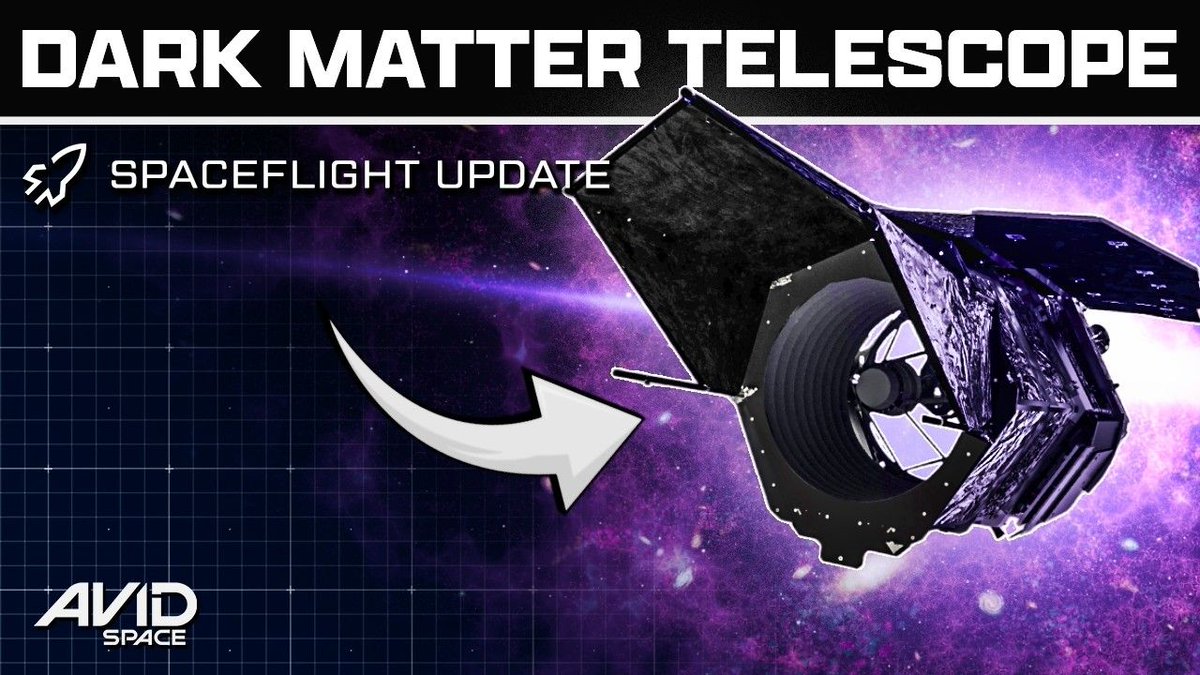
Three days after liftoff, the space industry is still processing what just happened at Kennedy Space Center. NASA's Nancy Grace Roman Space Telescope — one of the agency's most ambitious astrophysics missions in years — launched aboard a SpaceX Falcon Heavy on August 30, 2026, and is now quietly making its way to one of the most scientifically productive addresses in the solar system. Avid Space's weekly industry update, posted by @LabPadre on September 2, puts the mission in context alongside other active Falcon 9 activity and Artemis program developments.

The Launch, by the Numbers
| Detail | Value |
|---|---|
| Launch date | August 30, 2026 — 7:26 a.m. EDT |
| Vehicle | SpaceX Falcon Heavy |
| Launch site | Launch Complex 39A, Kennedy Space Center, Florida |
| Destination | Sun-Earth Lagrange Point 2 (L2) |
| Transit distance | ~1.5 million km (930,000 miles) |
| Transit duration | Approximately three months |
| NASA Falcon Heavy missions to date | 4th primary mission |
| Falcon Heavy total engines | 27 Merlin engines across three reusable Falcon 9 cores |
Why L2 — and Why Falcon Heavy
L2 is the same gravitational sweet spot that hosts the James Webb Space Telescope. Sitting roughly 1.5 million kilometers beyond Earth on the Sun-Earth line, it offers an unobstructed, thermally stable vantage point ideal for infrared observation — exactly what Roman needs to survey wide swaths of sky for dark energy signatures, exoplanet atmospheres, and infrared transients.
Getting a payload to L2 requires meaningful delta-v, which is why NASA turned to Falcon Heavy rather than a standard Falcon 9. The rocket's three-core architecture — essentially three Falcon 9 first stages strapped together — delivers the lift margin that a mission of Roman's mass demands. According to NASA, this marks the fourth time the agency has used Falcon Heavy as its primary launch vehicle, a pattern that reflects both the rocket's proven reliability and the cost pressure NASA operates under for flagship science missions.
Falcon 9 Activity and the Broader Context
The Avid Space update doesn't treat Roman in isolation. The weekly roundup also covers ongoing Falcon 9 cadence and Artemis program developments — a reminder that SpaceX is simultaneously supporting commercial satellite launches, ISS crew and cargo rotations, and NASA's deep-space human exploration program. That operational tempo across multiple vehicle types and customer classes is what makes SpaceX's launch manifest unlike anything else currently flying.
For the Roman mission specifically, the Falcon Heavy's side boosters are designed for recovery and reuse, continuing SpaceX's standard approach of landing boosters for reflight. The center core trajectory for a high-energy L2 insertion typically precludes recovery of that stage — the energy budget simply doesn't leave enough propellant for a return burn — though SpaceX has not publicly detailed the exact recovery plan for this particular flight.
What Roman Will Actually Do
Named after Nancy Grace Roman, NASA's first Chief of Astronomy, the telescope carries a 2.4-meter primary mirror — the same aperture as Hubble — but with a field of view roughly 100 times larger. Its primary science goals include mapping the large-scale structure of the universe to probe dark energy, conducting a statistical census of exoplanets via gravitational microlensing, and enabling a broad general observer program similar to Hubble's community-driven model.
The three-month cruise to L2 is a commissioning period as much as a transit. Engineers will use that time to verify instrument health, calibrate detectors, and prepare for first light observations. Science operations are expected to begin once the telescope reaches its operational orbit around L2 and completes its checkout sequence.
With Roman now en route and the Falcon Heavy's role in NASA's science portfolio expanding, the coming months will test whether the telescope's ambitious survey program delivers on years of development — and whether SpaceX's heavy-lift workhorse continues to anchor the agency's most demanding missions. Follow our SpaceX coverage for updates as Roman approaches L2 and begins commissioning.
Sources & reporting notes
The links below identify the material source records used for this report.
- @LabPadre on X (2026-09-02T17:30:55.000Z) — Direct source
Source links are preserved as published or accessed. See our editorial standards and corrections policy.
The BASENOR Editorial Desk covers Tesla, SpaceX, and related technology, curating reporting from primary sources — official accounts, regulatory filings, and software release data. Every article passes source-record and fact-checking review before publication. About the newsroom.
This report was curated by the BASENOR Editorial Desk from the sources listed above. Read our editorial standards or email editorial@basenor.com to report an error.