SpaceX's Starship program is moving again. A new Temporary Flight Restriction filed over Starbase, Texas confirms that Ship 42 — the next Starship upper-stage prototype — has entered cryo proof testing, one of the last major structural hurdles before a vehicle is cleared for static fire and eventual flight. Here's what the TFR and the testing process actually tell us.

1. A New TFR Replaced the Old One — and It Runs Until September 12
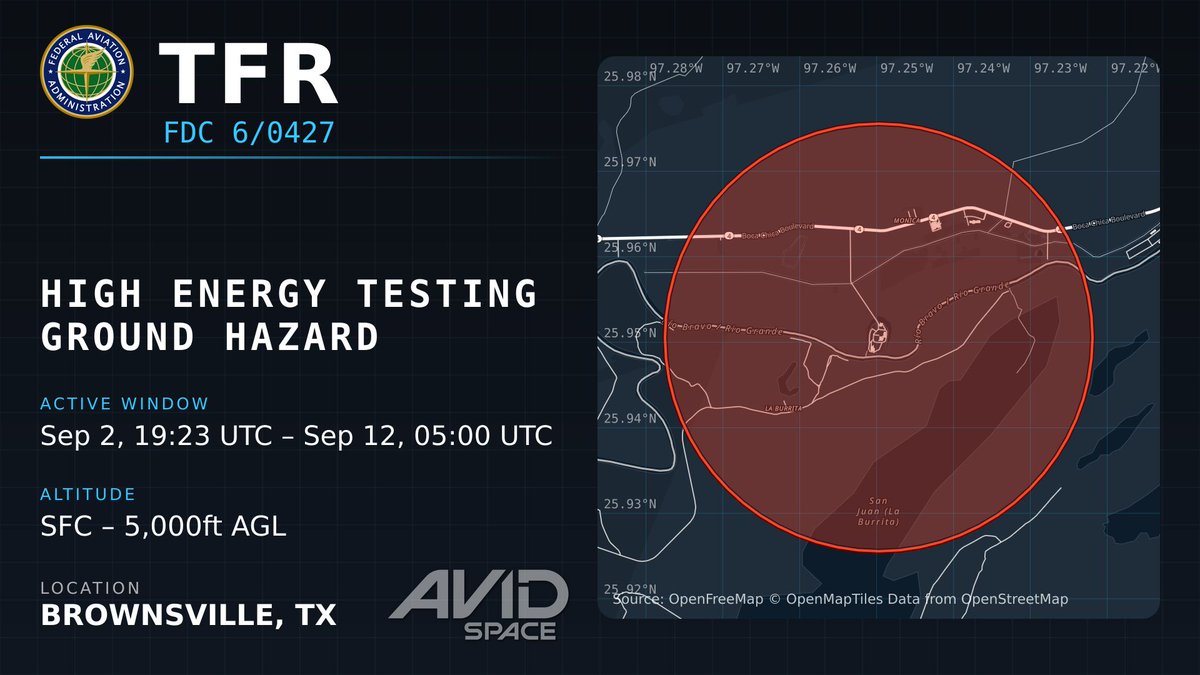
The previous TFR over Massey's test stand at Starbase expired, and a replacement was filed almost immediately. According to Starbase observer account @LabPadre (Avid Space), the new restriction — TFR 6/0427 — covers the Brownsville, TX area from the surface up to 5,000 feet AGL. It runs from September 2 at 19:23 UTC through September 12 at 05:00 UTC. A ten-day window is consistent with a multi-session cryo proof campaign, where engineers typically run several pressurization cycles rather than a single test.
2. Cryo Proofing Is a Structural Stress Test, Not a Fueling Drill
The term sounds routine, but cryo proofing is one of the more demanding tests a Starship prototype faces before flight. Engineers load the vehicle's propellant tanks with liquid cryogens — liquid nitrogen is commonly used as a non-flammable stand-in — then pressurize the tanks beyond operational limits to verify structural integrity under the extreme cold and stress the vehicle will experience during actual propellant loading. A vehicle that passes cryo proof has demonstrated its welds, domes, and tank walls can handle the real thing. Failure at this stage has grounded previous prototypes.
3. The Test Stand Is Massey's — Not the Orbital Launch Mount
The TFR is centered on Massey's, a dedicated test structure at Starbase separate from the orbital launch site. SpaceX uses Massey's specifically for pressure and cryo tests on Ship upper stages before they are moved to the launch pad. The fact that Ship 42 is at Massey's — not already stacked on the booster — means it is still working through its qualification sequence. Passing here is a prerequisite for the next steps: static fire testing and eventual stacking with a Super Heavy booster.
4. Ship 42 Follows a Rapidly Accelerating Production Cadence
Ship 42's arrival at the test stand reflects how quickly SpaceX has been turning over Starship hardware. Each successive Ship prototype has moved through production and testing faster than the last as the Starbase factory scales up. While SpaceX has not issued an official statement on Ship 42's test schedule, the cadence of TFR filings and observer reports from Starbase has consistently been the earliest public signal of an imminent test campaign — and this one is no different.
5. What Comes Next After a Successful Cryo Proof
If Ship 42 clears the cryo proof campaign within this TFR window, the likely sequence is a spin prime test of its Raptor engines at Massey's, followed by transport to the orbital launch site for stacking. From there, a full static fire with the integrated stack would precede any flight attempt. The September 12 TFR end date gives SpaceX roughly ten days to complete pressurization cycles — a timeline that, if met, could keep Ship 42 on track for a late 2026 flight assignment. For the latest on SpaceX's Starship program, follow our SpaceX coverage.
🚀 Following the Starship program? See every test flight, official outcome and the next launch window in our SpaceX Starship Tracker.
Sources & reporting notes
The links below identify the material source records used for this report.
- @LabPadre on X (2026-09-02T18:14:28.000Z) — Direct source
Source links are preserved as published or accessed. See our editorial standards and corrections policy.
The BASENOR Editorial Desk covers Tesla, SpaceX, and related technology, curating reporting from primary sources — official accounts, regulatory filings, and software release data. Every article passes source-record and fact-checking review before publication. About the newsroom.
This report was curated by the BASENOR Editorial Desk from the sources listed above. Read our editorial standards or email editorial@basenor.com to report an error.