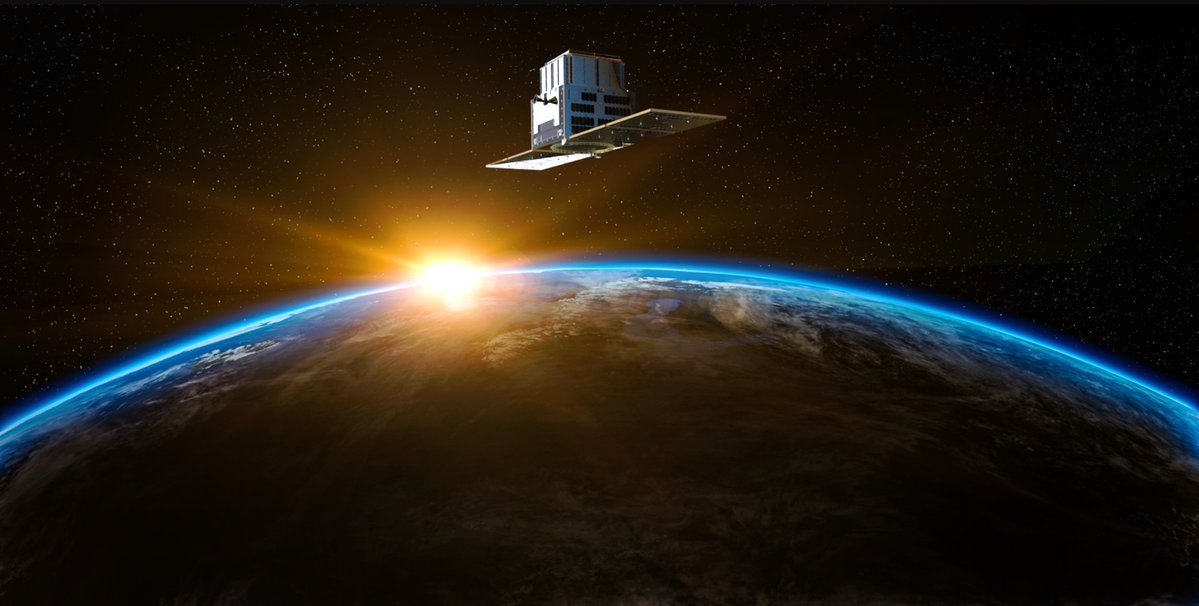
NASA has officially tapped SpaceX to launch its StarBurst satellite aboard a Falcon 9 Bandwagon rideshare mission, with liftoff scheduled no earlier than 2028. The smallsat is built to crack open one of astrophysics' most violent open questions: what actually happens when neutron stars collide. Here are the five details worth knowing.

1. The Science Target: Neutron Star Mergers and Short Gamma-Ray Bursts
StarBurst is a NASA Astrophysics Pioneers Program mission with a specific mandate — study the origins of short gamma-ray bursts (SGRBs), the ultra-energetic flashes believed to originate when two neutron stars spiral into each other and merge. These events last less than two seconds but release more energy than the Sun will emit in its entire lifetime. Despite decades of observation, the precise mechanics of how neutron star mergers produce SGRBs remain poorly understood. StarBurst is designed to gather the data needed to close that gap.
2. The Instrument: 12 Detectors with 500% More Effective Area Than Fermi
The satellite's core instrument consists of 12 cesium iodide (CsI(Tl)) scintillation detectors, sensitive to gamma-rays in the 30–1,000 keV energy range. According to NASA, the instrument covers an 8 steradian unocculted sky view — meaning it can monitor a vast swath of the sky simultaneously. Critically, it offers over 500% the effective area of the Fermi Gamma-ray Burst Monitor (GBM), currently one of the primary tools for detecting gamma-ray bursts. That is not an incremental improvement; it is a generational leap in detection capability for this class of event.
3. The Hardware: A ~250 kg SmallSat Heading to Low Earth Orbit
StarBurst is classified as a smallsat, with a mass of approximately 250 kg. It will operate in low Earth orbit (LEO) on a nominal one-year mission, with an option for extension depending on spacecraft health and scientific yield. The relatively compact size is part of what makes a rideshare slot viable — and keeps mission costs within the bounds of NASA's Pioneers Program, which is specifically structured to fund smaller-scale, high-science-value astrophysics missions that would otherwise struggle to secure a dedicated launch.
4. The Launch: Falcon 9 Bandwagon Rideshare from Cape Canaveral
StarBurst will lift off from Space Launch Complex 40 (SLC-40) at Cape Canaveral Space Force Station in Florida, riding as a secondary payload on one of SpaceX's Bandwagon rideshare missions. Bandwagon flights are designed for mid-inclination orbits and have become a reliable, cost-efficient pathway for smallsats that don't require a dedicated rocket. The launch is confirmed for no earlier than 2028, though a specific date has not been announced. The contract is structured as a firm-fixed-price task order under NASA's Venture-Class Acquisition of Dedicated and Rideshare (VADR) launch services contract, which carries a maximum total value of $1 billion across all task orders over a ten-year ordering period.
5. The Broader Picture: SpaceX's Expanding Role in NASA Science Missions
StarBurst is one more data point in a clear trend: NASA's science division is increasingly routing smallsat and medium-class missions through SpaceX's commercial launch infrastructure rather than reserving slots on larger, more expensive dedicated vehicles. The VADR contract framework is built precisely to enable this — giving NASA the flexibility to assign missions to commercial rideshare slots as they become available, rather than waiting years for a bespoke launch. For SpaceX, each Bandwagon mission that carries a high-profile NASA payload reinforces Falcon 9's position as the default workhorse for government science payloads in LEO.
The 2028 launch window gives the StarBurst team roughly two years to finalize integration and testing. If the instrument performs as designed, it could meaningfully reshape how astronomers catalog and characterize short gamma-ray bursts — and potentially provide new observational constraints on the neutron star merger models that underpin both gravitational wave astronomy and heavy element formation theories. Follow our SpaceX coverage for updates as the mission progresses toward its launch date.
Sources & reporting notes
The links below identify the material source records used for this report.
- @SpaceX on X (2026-09-18T01:49:11.000Z) — Direct source
Source links are preserved as published or accessed. See our editorial standards and corrections policy.
The BASENOR Editorial Desk covers Tesla, SpaceX, and related technology, curating reporting from primary sources — official accounts, regulatory filings, and software release data. Every article passes source-record and fact-checking review before publication. About the newsroom.
This report was curated by the BASENOR Editorial Desk from the sources listed above. Read our editorial standards or email editorial@basenor.com to report an error.