New Zealand's grid just got a significant upgrade. Tesla's first utility-scale Megapack deployment in the country — Contact Energy's Glenbrook-Ohurua Battery 1 — is now fully operational, commissioned ahead of schedule and under budget. Here are the six details worth knowing.

1. 56 Megapack 2XL Units — a New Zealand First
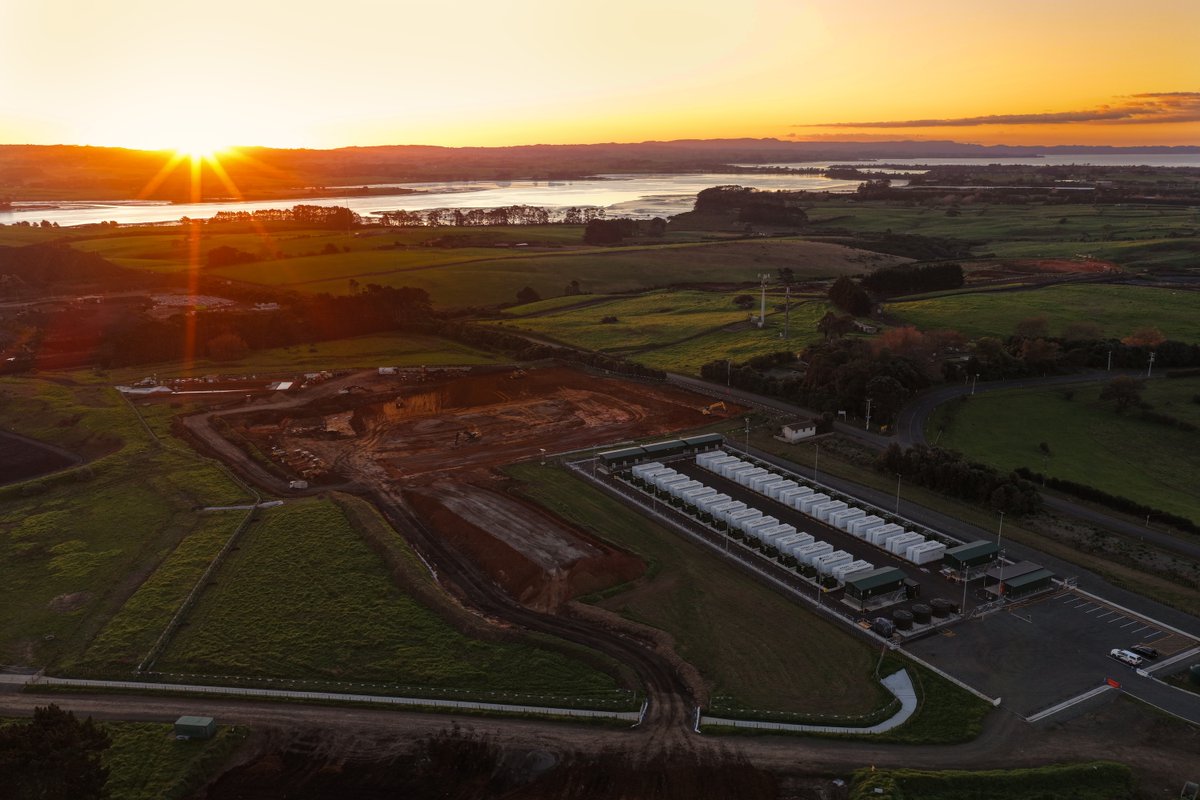
The site uses 56 Tesla Megapack 2XL units, marking the first deployment of that specific hardware in New Zealand. The 2XL is Tesla's highest-density Megapack variant, and stacking 56 of them at a single South Auckland site — on land owned by New Zealand Steel at Glenbrook — delivers the 100 MW / 200 MWh capacity Contact Energy needed to participate meaningfully in the country's frequency-keeping and energy markets.
2. 0.2-Second Grid Response
Speed is the core value proposition of grid-scale batteries over gas peakers, and this installation delivers. According to Contact Energy, the system can respond to grid signals in 0.2 seconds. That near-instant reaction time allows it to stabilize frequency fluctuations before they cascade — something a thermal plant spinning up over minutes simply cannot do. The practical effect is a more resilient grid during demand spikes and unexpected generation drops.
3. Enough Capacity to Power 44,000 Homes for Two Hours
The 200 MWh storage capacity translates to a concrete real-world figure: the system can supply electricity equivalent to the peak demand of roughly 44,000 New Zealand households for approximately two hours. That's the Glenbrook and wider South Auckland catchment covered through the critical morning and evening peaks when the grid is most stressed. Two hours of storage is the design target — enough for the battery to bridge generation shortfalls without requiring backup thermal generation to fire up.
4. NZD 163 Million Investment, Delivered Under Budget
Contact Energy's total investment in Glenbrook-Ohurua Battery 1 came to NZD 163 million (approximately USD 99.4 million at current rates). The project broke ground in July 2024, began trading on April 1, 2026, and was formally opened by Prime Minister Christopher Luxon on May 21, 2026 — all while coming in under budget. In an infrastructure sector where cost overruns are the norm, that execution record is notable. Tesla was responsible for supply, commissioning, and will provide long-term maintenance services on the units.
5. A Large Partner Stack Built the Site
This wasn't a two-party deal. Alongside Contact Energy and Tesla, the project involved New Zealand Steel (land host), Transpower (grid operator), and contractors Omexom, ABB, Entec, Obertech Group, Worley, and ElectroNet Group. That breadth of local and international partners reflects the complexity of integrating a 100 MW asset into an existing industrial site and national grid infrastructure — and suggests the execution model Contact Energy will likely replicate for Battery 2.
6. Battery 2 Is Already in Development — at Double the Size
The announcement from @Tesla_Megapack confirmed that Battery 2 is already underway at the same Glenbrook location. According to Contact Energy, that second installation will be rated at 200 MW / 400 MWh — exactly double Battery 1 — and is targeted to be operational by the first quarter of 2028. Contact Energy has also secured an option to expand the Glenbrook site to 130 MW on the Battery 1 footprint if needed. Taken together, the two projects would give a single South Auckland site up to 330 MW of dispatchable battery storage, making it one of the more significant grid-scale energy storage concentrations in the Southern Hemisphere.
With Battery 2 already in motion and an expansion option secured on the existing site, Contact Energy's Glenbrook complex looks less like a one-off project and more like a long-term platform. Whether New Zealand's grid operators lean into that model — and whether Tesla's Megapack pipeline can keep pace with the demand — will be worth watching as the country pushes toward its renewable energy targets.
Related Gear
Gear up your Tesla with tested, custom-fit BASENOR accessories — shop Tesla accessories →
Sources & reporting notes
The links below identify the material source records used for this report.
- @Tesla_Megapack on X (2026-07-27T22:24:35.000Z) — Direct source
Source links are preserved as published or accessed. See our editorial standards and corrections policy.
The BASENOR Editorial Desk covers Tesla, SpaceX, and related technology, curating reporting from primary sources — official accounts, regulatory filings, and software release data. Every article passes source-record and fact-checking review before publication. About the newsroom.
This report was curated by the BASENOR Editorial Desk from the sources listed above. Read our editorial standards or email editorial@basenor.com to report an error.