
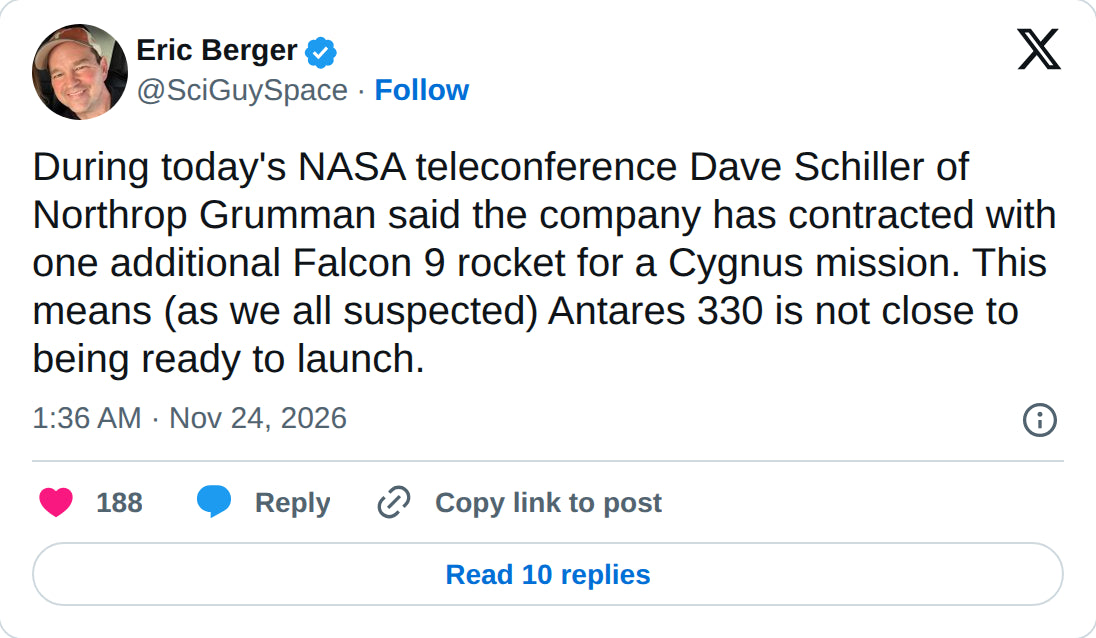
Northrop Grumman has contracted an additional SpaceX Falcon 9 rocket to carry a Cygnus cargo spacecraft to the International Space Station, a disclosure made on November 23 during a NASA teleconference. The announcement, attributed to Northrop Grumman's Dave Schiller, effectively confirms what the space industry had long suspected: the company's next-generation Antares 330 rocket is nowhere near ready to fly.

How Falcon 9 Became Cygnus's Default Ride
The backstory here starts with the 2022 Russian invasion of Ukraine. Antares 230+, the rocket Northrop Grumman had used for years to launch Cygnus, relied on Russian-built RD-181 engines and a Ukrainian-built first stage — a supply chain that collapsed overnight when the war began. With no viable path to fly Antares 230+, Northrop Grumman turned to SpaceX.
The NG-20 mission marked the first time a Cygnus spacecraft ever launched on a Falcon 9. Since then, the partnership has become routine. NG-21 lifted off on August 4, 2024, delivering more than 8,200 pounds of cargo to the ISS aboard booster B1080 on its tenth flight. NG-23 followed on September 14, 2025, debuting the larger Cygnus XL configuration with 5,000 kilograms of payload. CRS-24 launched on April 11, 2026 — the fourth consecutive Northrop Grumman ISS mission to ride a Falcon 9. The newly contracted rocket will extend that streak further.
Antares 330: The Rocket That Keeps Slipping
Northrop Grumman has been developing Antares 330 as a clean-sheet replacement for the grounded Antares 230+, designed around domestic engines to eliminate the geopolitical vulnerability that sidelined its predecessor. The program was originally projected to be flight-ready by 2025. That date slipped to 2027, according to reporting from spacepolicyonline.com, and the new Falcon 9 contract signals the 2027 target is itself uncertain.
Schiller's comment at the NASA teleconference — that the company has signed for one more Falcon 9 — is the clearest public acknowledgment yet that Antares 330 will not be available in time to cover the next Cygnus mission slot. The phrasing matters: contracting a rocket takes months of coordination, and Northrop Grumman would not be spending that money if there were a realistic near-term alternative.
What This Means for the ISS Supply Chain
For NASA, the practical impact is continuity. Cygnus missions carry pressurized cargo — science experiments, crew supplies, hardware — that the ISS depends on. Keeping that pipeline flowing on Falcon 9 is a known, proven arrangement at this point, and the reliability record Falcon 9 has built over hundreds of consecutive successful missions makes it a low-risk choice for a cargo customer in Northrop Grumman's position.
The broader picture, though, is one of growing concentration. SpaceX is now the launch vehicle for both NASA's Commercial Crew program (Crew Dragon) and an expanding share of Commercial Resupply Services missions — roles originally designed to spread work across multiple providers. That was always a structural tension in the CRS framework, and the Antares delays are making it more pronounced.
Whether Antares 330 eventually reclaims Cygnus missions or Northrop Grumman continues rolling over Falcon 9 contracts indefinitely will depend on how the development program proceeds from here. For now, the answer from the teleconference is unambiguous: one more Falcon 9, and no firm timeline for anything else.
Related coverage
Sources & reporting notes
The links below identify the material source records used for this report.
- @SciGuySpace on X (2026-11-23T17:36:37.000Z) — Direct source
Source links are preserved as published or accessed. See our editorial standards and corrections policy.
The BASENOR Editorial Desk covers Tesla, SpaceX, and related technology, curating reporting from primary sources — official accounts, regulatory filings, and software release data. Every article passes source-record and fact-checking review before publication. About the newsroom.
This report was curated by the BASENOR Editorial Desk from the sources listed above. Read our editorial standards or email editorial@basenor.com to report an error.