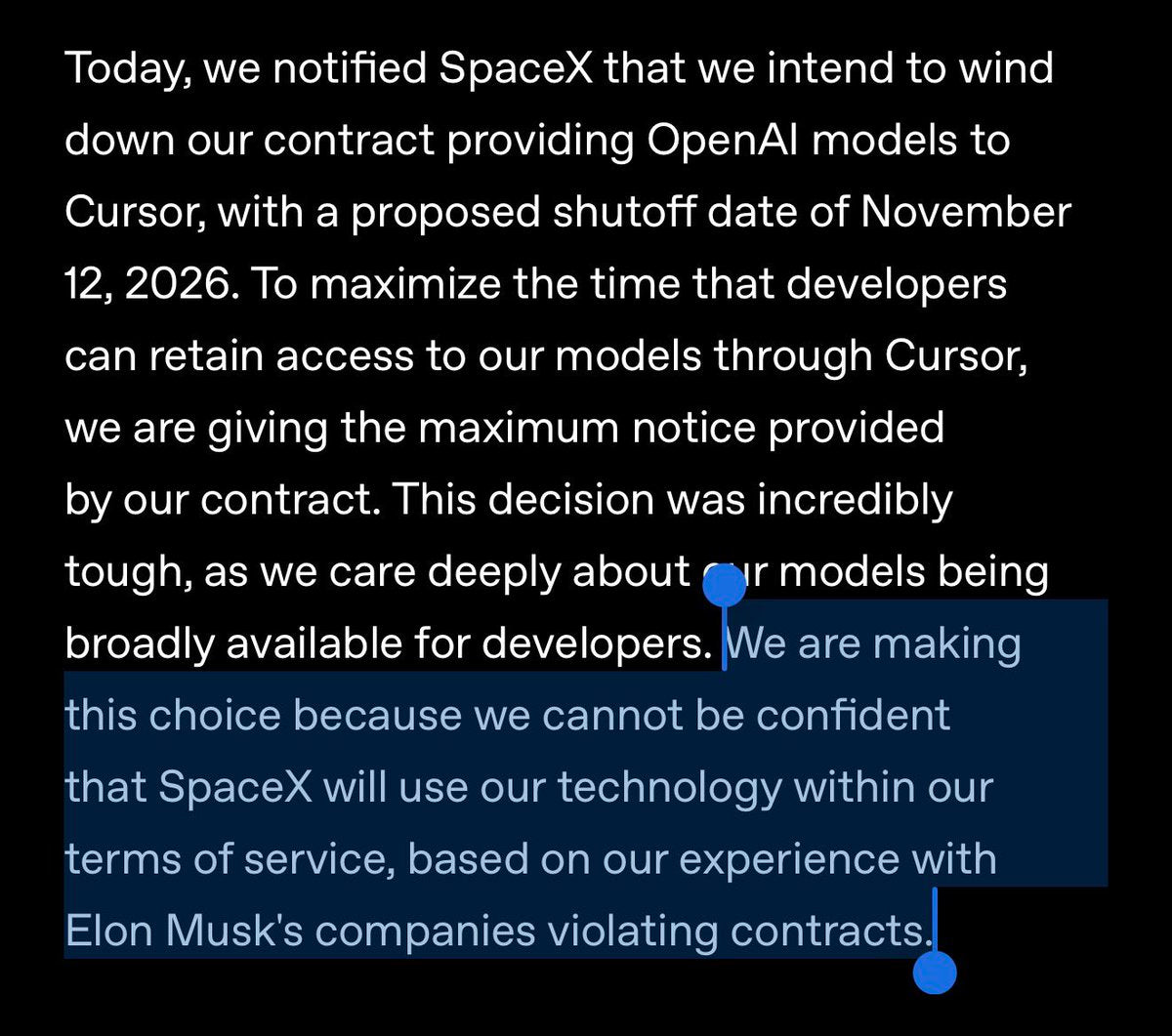
OpenAI announced late Friday that it is ending its partnership with Cursor, the AI coding assistant, following Cursor's acquisition by SpaceX. In its statement, OpenAI said it 'cannot be confident that SpaceX will use our technology within our terms of service' — a rare, publicly explicit rebuke that severs one of the most commercially significant relationships in the AI developer-tools space.
The news lands as a Friday-night surprise, but the underlying corporate maneuvering has been in motion for months. SpaceX's AI arm now owns one of the fastest-growing enterprise software products in history, and one of Elon Musk's oldest rivals has just pulled the plug on model access.

How We Got Here
SpaceX acquired Anysphere — Cursor's parent company — in a $60 billion all-stock deal, according to Wikipedia and Crunchbase records of the transaction. The option agreement was first disclosed on April 21, 2026, formally announced on June 16, and closed on August 14. Cursor is now a wholly owned subsidiary of SpaceXAI, the AI division that absorbed xAI in February 2026 before being rebranded in July.
The price tag reflects Cursor's extraordinary growth curve. According to reporting from Business Insider and industry trackers, Cursor's annualized revenue reached roughly $3 billion by late April 2026, with internal projections pointing to more than $6 billion by year-end — including approximately $2.6 billion from enterprise B2B contracts. Few software products in history have scaled that quickly, and the acquisition gives SpaceXAI immediate distribution inside developer teams at thousands of companies.
Why OpenAI Is Walking Away
OpenAI's statement pointed to terms-of-service concerns, and the subtext is not subtle. According to OpenAI's own communications and prior public disputes, the company has previously accused other Musk-controlled entities — including X (formerly Twitter) and xAI — of violating contractual commitments around data use and model handling. With Cursor now sitting inside the SpaceXAI umbrella, OpenAI's leadership evidently concluded that continuing to supply frontier models to a Musk-owned coding platform was untenable.
OpenAI also referenced heightened accountability requirements around Astra, its upcoming model. Providing that class of system to a direct competitor's subsidiary would create obvious commercial and safety exposure.
The proposed shutoff date is November 12, 2026, giving Cursor roughly ten weeks to migrate workloads. That is a compressed but workable timeline for an enterprise-scale platform.
Key Figures
| Metric | Value |
|---|---|
| Acquisition value | $60 billion (all-stock) |
| Deal announced | June 16, 2026 |
| Deal closed | August 14, 2026 |
| Cursor ARR (April 2026) | ~$3 billion |
| Projected 2026 ARR | ~$6 billion |
| OpenAI model shutoff | November 12, 2026 |
What It Means Strategically
Cursor's product has historically leaned heavily on OpenAI's models — GPT-class systems handled a substantial share of the code generation, refactoring, and agentic workflows that made the app sticky with enterprise customers. Losing that access forces a migration to alternative back-ends, and the obvious candidate is Grok, SpaceXAI's in-house model family.
That is almost certainly the point. SpaceX did not spend $60 billion to keep paying OpenAI. The acquisition gives SpaceXAI a captive, revenue-generating distribution channel for Grok's coding capabilities and a data flywheel — millions of developer interactions per day — that xAI on its own would have struggled to build organically. Combined with SpaceX's GPU infrastructure, the vertical integration story is now complete: chips, models, product, and paying enterprise customers under one roof.
For OpenAI, the calculation is defensive. Continuing to power a Musk-owned platform would have subsidized a direct competitor's growth while creating legal exposure over data handling. Cutting the cord now — before Astra ships — is the cleaner move.
What Tesla and SpaceX Watchers Should Track
The Cursor deal is not a Tesla story on its face, but the ripple effects reach into Musk's broader AI stack. SpaceXAI now controls the model layer (Grok), a top-tier developer product (Cursor), and — through Tesla — one of the largest real-world AI training pipelines in existence via FSD fleet data. Whether any of that cross-pollinates into Tesla's software workflows, Optimus development, or Robotaxi backend infrastructure is the question worth watching.
A few concrete signals to watch over the next quarter:
- Cursor's model back-end after November 12. Does the product transition entirely to Grok, or does SpaceXAI license from Anthropic or Google as a bridge?
- Enterprise churn. Some Cursor customers signed contracts specifically because of the OpenAI relationship. Retention numbers over Q4 2026 will tell the real story.
- OpenAI's Astra launch. If Astra ships with materially better coding performance than Grok, Cursor's competitive position weakens regardless of ownership.
- Any Tesla-side integration. Grok is already embedded in Tesla vehicles. A Cursor-flavored developer experience for Tesla's internal engineering teams — or for third-party app developers building on Tesla's platform — would be a logical next step.
The Bigger Picture
Friday's announcement crystallizes a split that has been forming for two years. The AI industry is no longer a loose coalition of labs sharing infrastructure; it is a set of competing vertical stacks. OpenAI, backed by Microsoft, is one. Anthropic and Google form another. SpaceXAI — with Grok, Cursor, xAI's original team, and SpaceX's compute — is now unambiguously a third.
For developers currently using Cursor, the practical impact should be minimal in the near term. The product will keep working, the migration will be managed, and Grok's coding capabilities have improved substantially over the past year. For the industry, the message is louder: the era of AI companies quietly powering each other's products is closing fast.
Related Gear
Gear up your Tesla with tested, custom-fit BASENOR accessories — shop Tesla accessories →
Sources & reporting notes
The links below identify the material source records used for this report.
- @SawyerMerritt on X (2026-08-29T02:41:22.000Z) — Direct source
Source links are preserved as published or accessed. See our editorial standards and corrections policy.
The BASENOR Editorial Desk covers Tesla, SpaceX, and related technology, curating reporting from primary sources — official accounts, regulatory filings, and software release data. Every article passes source-record and fact-checking review before publication. About the newsroom.
This report was curated by the BASENOR Editorial Desk from the sources listed above. Read our editorial standards or email editorial@basenor.com to report an error.