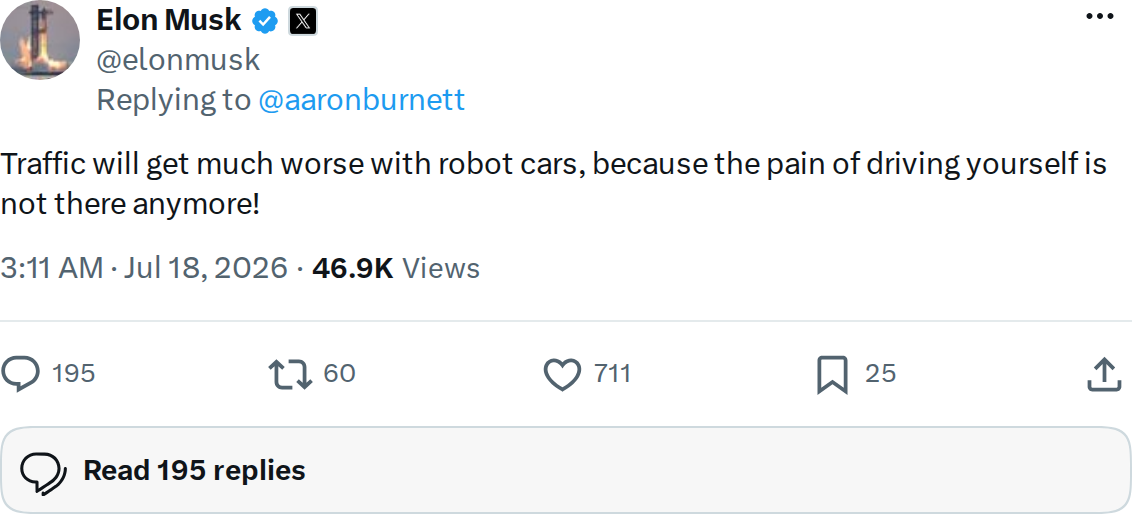
Elon Musk made a blunt admission this week: robotaxis will probably make traffic congestion worse, not better. His reasoning is simple — remove the pain of driving yourself and more people will use cars more often. It's an honest take from the CEO building one of the world's largest autonomous vehicle networks, and it deserves unpacking.

Tesla's robotaxi service is already operating in Austin, Dallas, Houston, and Miami. Volume production of the purpose-built Cybercab is planned to begin in mid-2026, and Musk has previously stated he expects a widespread driverless network across the U.S. by end of year. The scale is coming fast. Here's what that actually means for the roads you drive on every day.
1. The "Pain Tax" on Driving Is Real — and It Suppresses Demand
Traffic engineers have known for decades that the friction of driving — finding parking, sitting in gridlock, paying attention for an hour — discourages discretionary trips. You skip the errand, combine stops, or take the train because driving is a hassle. Autonomous vehicles eliminate most of that friction entirely. When a robotaxi drops you off at the door and you never once touched a steering wheel, the calculus changes. Musk is acknowledging what urban planners have warned about for years: induced demand is real, and removing the cost of effort induces a lot of it.
2. Empty Miles Are the Hidden Multiplier
A personal car sits parked roughly 95% of its life. A robotaxi doesn't — it repositions between rides, cruises to charging, and deadheads back to high-demand zones. Every mile a robotaxi travels without a passenger still occupies road space. Studies from the pre-robotaxi era estimated that ride-hail vehicles in dense cities already generate significant empty-mile traffic. Scale that to hundreds of thousands of autonomous vehicles and the congestion math gets uncomfortable quickly, even before you account for increased rider demand.
3. Tesla's Own Expansion Timeline Makes This Urgent
This isn't a theoretical concern for 2035. Musk stated in January 2026 that Tesla expects a widespread driverless robotaxi network in the U.S. by the end of this year. He has also projected hundreds of thousands — potentially over a million — Teslas operating in self-driving mode across the country. The Tesla robotaxi service already covers four major metro areas using Model Y vehicles. The Cybercab, a purpose-built two-seater with no steering wheel, is designed to scale that fleet further. City infrastructure planning cycles run in decades; the robotaxi rollout is running in months.
4. Regulatory Scrutiny Is Already Mounting
The NHTSA opened an investigation into Tesla's robotaxi service following early incidents documented by riders — wrong-side-of-road driving, phantom braking, and drop-offs in intersections. In July 2026, the agency issued a broader call to action for all autonomous vehicle makers to address vehicles interfering with emergency scenes. Regulators are reacting to safety issues now; congestion management frameworks don't yet exist at the federal level. That gap between deployment speed and policy readiness is where the traffic problem will grow fastest.
5. Musk's Candor Here Is Worth Taking Seriously
It would be easy — and commercially convenient — for Musk to claim robotaxis will solve traffic. He's not doing that. Admitting the opposite, publicly, while actively scaling the service that will cause the problem, is an unusual move. It suggests Tesla's internal modeling already accounts for congestion as a downstream consequence rather than a marketing talking point to be managed. For owners and city planners alike, that's a signal worth heeding: the question isn't whether robotaxi adoption will stress urban road networks, but how quickly cities will respond with congestion pricing, dedicated lanes, or demand management tools to compensate.
The robotaxi era isn't arriving with a traffic solution pre-packaged. Musk is building the network anyway — and being unusually straightforward about the tradeoff. Whether cities are ready for that tradeoff is a different question entirely, and one that won't be answered in a single X reply.
🚕 Following the Robotaxi rollout? See every operating city, launch date and announced market in our Tesla Robotaxi Tracker.
Related Gear
Gear up your Tesla with tested, custom-fit BASENOR accessories — shop Tesla accessories →
Sources & reporting notes
The links below identify the material source records used for this report.
- @elonmusk on X (2026-07-18T03:11:02.000Z) — Direct source
Source links are preserved as published or accessed. See our editorial standards and corrections policy.
The BASENOR Editorial Desk covers Tesla, SpaceX, and related technology, curating reporting from primary sources — official accounts, regulatory filings, and software release data. Every article passes source-record and fact-checking review before publication. About the newsroom.
This report was curated by the BASENOR Editorial Desk from the sources listed above. Read our editorial standards or email editorial@basenor.com to report an error.