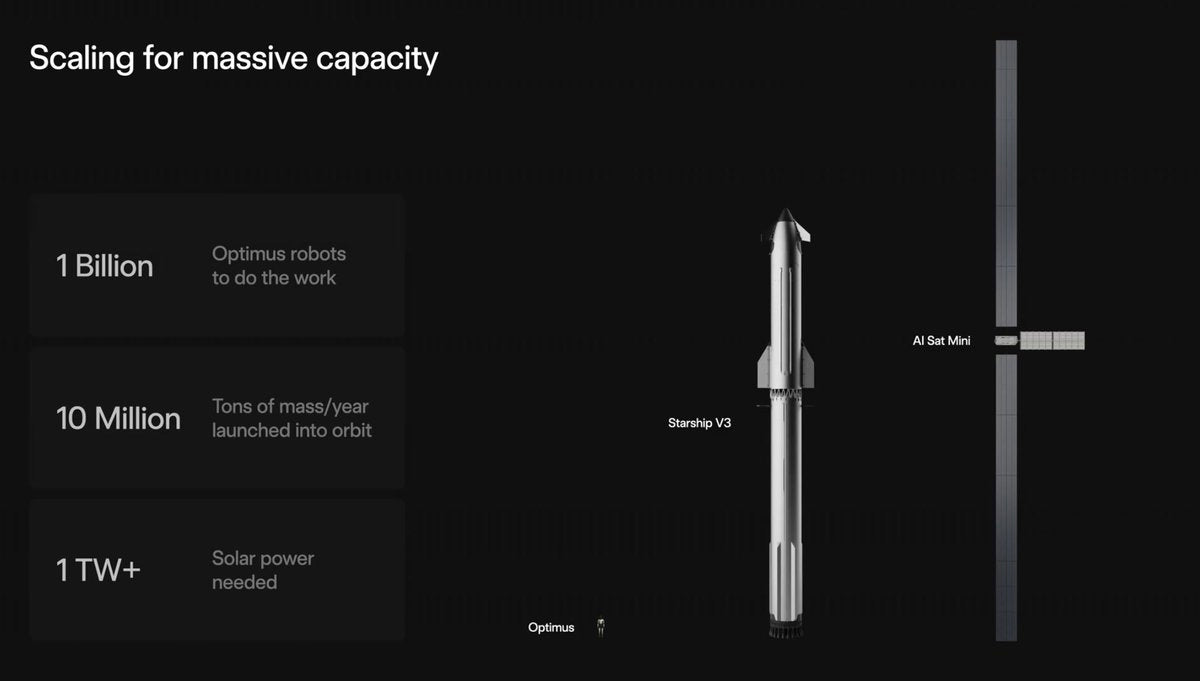
The News: SpaceX's new 'AI Sat Mini' satellite stretches over 170 meters when deployed — roughly 50% longer than a Starship V3 — and is designed to generate approximately 100 kW of solar power per unit, with future iterations targeting the Megawatt range.
Why It Matters: This isn't just a bigger satellite. It's a flying data center — and it's being built by the same company that makes your car's AI and your home internet. The Tesla/SpaceX/xAI ecosystem just got a major new piece.
Source: @TeslaNewswire on X
SpaceX AI Sat Mini: Bigger Than Starship, Generating 100kW in Orbit — Here's the Full Picture
When SpaceX filed paperwork with the FCC in January 2026 seeking approval for a constellation of up to one million next-generation satellites, most people glossed over the technical specs. They shouldn't have. The 'AI Sat Mini' — as it's being called — is one of the most ambitious pieces of hardware the company has ever described, and it sits at the center of a converging strategy involving Tesla, xAI, and orbital AI computing.

📊 Key Figures
| Metric | Value | Context |
|---|---|---|
| Deployed Length | 170+ meters | ~50% longer than Starship V3 (124.4m) |
| Solar Power Per Satellite | ~100 kW | Dedicated to onboard AI processors |
| Future Power Target | Megawatt range | 10x+ increase over current design |
| FCC Constellation Size | Up to 1,000,000 | Filed January 2026 |
| Annual AI Compute Target | 100 GW added/year | Path to 1 TW total AI compute capacity |
| SpaceX-xAI Merger | February 2026 | Enables vertically integrated AI stack |
What Is the AI Sat Mini, Exactly?
Think of it as a data center that SpaceX launches into orbit on its own rockets, powers with abundant unfiltered sunlight, and eventually uses to run AI workloads at a scale that's simply not possible on the ground. The name 'Mini' is relative — at over 170 meters deployed, this satellite is longer than a 50-story building laid on its side, and dwarfs Starship V3's already-staggering 124.4 meters.
The key design insight is power. Ground-based AI data centers face hard constraints: electricity costs, cooling infrastructure, land availability, and grid capacity. In orbit, you get uninterrupted solar exposure and the vacuum of space handles a significant portion of your thermal management problem. SpaceX's filing describes a path to generating 100 kW of compute-dedicated solar power per satellite — and that's just the starting point.
The Scale of the Ambition
The numbers SpaceX is working with are almost difficult to parse. According to background research tied to the FCC filing, the long-term goal is to add 100 gigawatts of AI compute capacity annually — achieved by launching a million tons of satellites per year, each generating 100 kW of compute power per ton. Future satellite iterations are expected to reach the Megawatt range in power generation, a 10x leap over the current design.
The stated macro-target: 1 Terawatt per year of AI compute capacity from Earth orbit. For context, that's roughly the entire current electricity generating capacity of the United States — dedicated entirely to AI processing, running in space.
Where Tesla and xAI Fit In
This isn't a SpaceX-only project. According to verified reporting, SpaceX acquired xAI in February 2026, creating what the company describes as a vertically integrated innovation engine spanning AI, rockets, and space-based internet. The chips that will power these orbital data centers are expected to come from Terafab — a chip fabrication facility that is a joint venture between Tesla, SpaceX, and xAI.
In other words: Tesla designs the chips (via Dojo and xAI expertise), SpaceX launches the satellites, and Starlink provides the connectivity layer. The AI Sat Mini is the physical manifestation of that three-way convergence. For Tesla owners, this matters because the same AI infrastructure powering your FSD system is being scaled into orbit — which has long-term implications for the compute resources available to train and improve autonomous driving models.
🔭 The BASENOR Take
Timeline: FCC filing January 2026 → xAI acquisition February 2026 → Public specs emerging March 2026. Deployment expected in phases, starting small to validate models before scaling.
Impact Level: 🔴 High — This reshapes the competitive landscape for AI compute infrastructure, and directly connects to Tesla's autonomous driving roadmap via the Terafab chip venture.
Confidence: ⭐⭐⭐⭐ High — Core specs are drawn from FCC filings and verified reporting. The Megawatt-range future targets are stated ambitions, not confirmed hardware.
The real story here isn't the satellite size. It's that SpaceX is attempting to solve AI's biggest bottleneck — compute infrastructure — by moving it off-planet entirely. If even a fraction of the stated capacity materializes, it represents a structural shift in who controls AI compute at scale. And with Tesla's chip manufacturing tied directly into this ecosystem via Terafab, your car is more connected to this orbital ambition than it might appear.
📰 Deep Dive
The framing of 'AI Sat Mini' as merely a communications satellite undersells what SpaceX is actually proposing. Traditional satellites — including existing Starlink units — are designed to relay data. The AI Sat Mini is designed to process data. That's a fundamental architectural shift, and it explains why the power requirements are so dramatically higher than anything currently in orbit.
The 100 kW figure per satellite is striking when you consider that the International Space Station — the largest structure ever assembled in orbit — generates approximately 120 kW of solar power to run an entire crewed research facility. SpaceX is proposing to match that output per AI satellite, at a scale of potentially millions of units. The engineering challenges involved in deploying, maintaining, and deorbiting structures over 170 meters long in large numbers are immense, which is precisely why the company has signaled a phased approach: launch a smaller initial constellation, monitor actual orbital effects, and validate models before scaling.
For the broader Tesla ecosystem, the Terafab connection is the thread worth watching. If Tesla, SpaceX, and xAI are jointly manufacturing chips optimized for these orbital data centers, the same silicon architecture could inform future generations of Tesla's in-vehicle AI hardware — creating a feedback loop between space-based training infrastructure and ground-based inference in your car. That's speculative extrapolation from current facts, but it's the logical direction of a vertically integrated AI-rocket-internet company. Follow our SpaceX coverage as deployment details emerge.
🚀 Following the Starship program? See every test flight, official outcome and the next launch window in our SpaceX Starship Tracker.
Sources & reporting notes
The links below identify the material source records used for this report.
- @TeslaNewswire on X (2026-03-22T18:30:20.000Z) — Direct source
Source links are preserved as published or accessed. See our editorial standards and corrections policy.
The BASENOR Editorial Desk covers Tesla, SpaceX, and related technology, curating reporting from primary sources — official accounts, regulatory filings, and software release data. Every article passes source-record and fact-checking review before publication. About the newsroom.
This report was curated by the BASENOR Editorial Desk from the sources listed above. Read our editorial standards or email editorial@basenor.com to report an error.