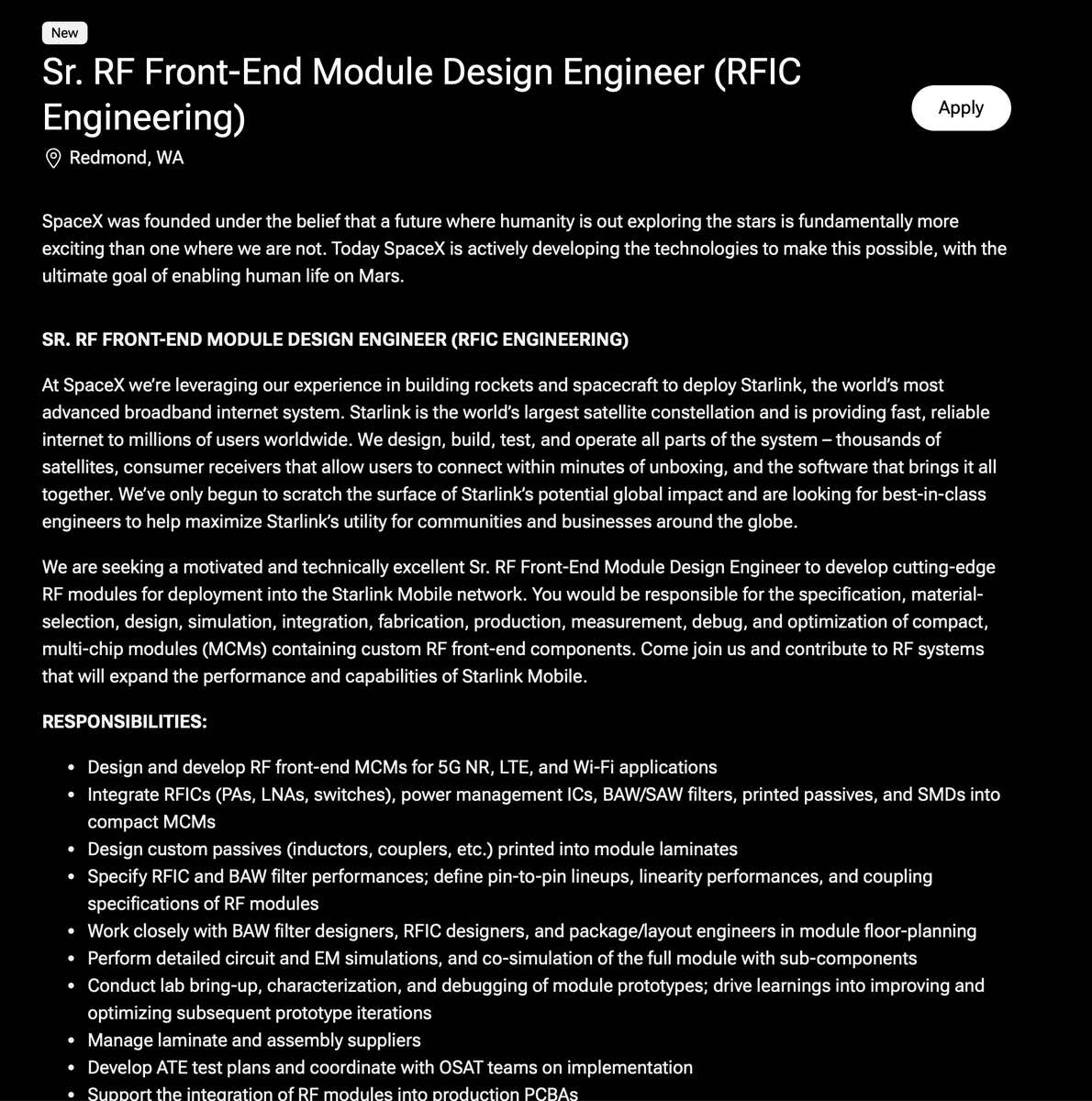
The News: SpaceX is developing compact multi-chip modules to handle radio frequencies for Starlink Mobile, as revealed by a new job posting seeking an RF/chip engineer.
Why It Matters: Custom silicon is the fastest path to smaller, cheaper, and more capable Starlink hardware — the kind that could eventually land in vehicles, phones, and wearables.
Source: @SawyerMerritt on X
SpaceX Is Building Its Own Chips for Starlink Mobile — Here's Why That's a Big Deal
SpaceX has quietly signaled a significant hardware ambition: developing its own custom multi-chip modules specifically designed to manage radio frequencies for Starlink Mobile. The hint comes not from a press release or an Elon tweet — but from a job posting, which is often where the most honest engineering roadmaps live.

The posting calls for an engineer to work on compact multi-chip modules — specialized assemblies that pack multiple semiconductor dies into a single, tightly integrated package. In the context of Starlink Mobile, that means shrinking the radio frequency hardware needed to connect directly to satellites into something far more compact than what exists today.
📊 Why Custom Silicon Changes Everything
When a company moves from off-the-shelf components to custom chip modules, it's not just an engineering preference — it's a strategic statement. Here's what the shift typically unlocks:
- Size reduction: Multi-chip modules consolidate what would otherwise require multiple discrete components onto a single substrate. Smaller hardware means Starlink Mobile can reach form factors that weren't previously possible — think embedded vehicle antennas, compact portable terminals, or eventually smartphone integration.
- Power efficiency: Custom RF modules can be tuned precisely to the frequency bands and protocols Starlink uses, cutting wasted power draw versus general-purpose components.
- Cost at scale: Once the module design is locked in and production ramps, unit economics improve dramatically. This is how SpaceX has driven down the cost of Starlink dishes over time — vertical integration.
- Performance ceiling: Off-the-shelf RF chips are designed for broad compatibility. A purpose-built module can be optimized entirely for Starlink's satellite constellation geometry, orbital parameters, and frequency allocation.
🔭 The BASENOR Take
Timeline: Job posting stage — hardware likely 18–36 months from production deployment
Impact Level: 🟠 High — signals SpaceX is serious about miniaturizing Starlink Mobile beyond current hardware constraints
Confidence: Medium — job postings reveal intent, not guaranteed execution. But SpaceX has a strong track record of following through on internal hardware programs.
SpaceX has been on a quiet but consistent path of vertical integration. The company already designs its own Starlink user terminals, builds its own satellites, and operates its own launch vehicles. Adding custom RF chip modules to that stack is the logical next move — and it mirrors exactly what Tesla did with its own custom AI inference chips (the FSD computer) to gain performance and cost advantages over suppliers.
The specific focus on Starlink Mobile is the detail worth watching. This isn't about upgrading the dish on your roof. Mobile connectivity — meaning direct-to-device or vehicle-embedded Starlink — requires hardware that operates under very different constraints: vibration, power budgets, antenna form factors, and regulatory approvals across dozens of markets. A custom multi-chip module purpose-built for those conditions is a meaningful step toward making Starlink Mobile a mainstream, embedded technology rather than a niche add-on.
For Tesla owners specifically, this matters because Tesla vehicles already support Starlink-based connectivity in some markets for in-car Wi-Fi. As SpaceX miniaturizes and optimizes the underlying RF hardware, the path toward tighter, more capable Tesla-Starlink integration becomes clearer. Whether that means better in-car streaming, more reliable connectivity in remote areas, or eventually a fully embedded antenna solution — the foundation is being built now, at the chip level. You can follow our SpaceX coverage for updates as this program develops.
📰 Deep Dive
Job postings are one of the most reliable leading indicators in the tech industry. Companies don't hire specialized RF chip engineers unless they have a concrete program underway — the skill set is too narrow and too expensive to recruit speculatively. The fact that SpaceX is specifically calling out multi-chip module development for Starlink Mobile suggests this is an active engineering program, not a research exercise.
Multi-chip modules (MCMs) are a mature but highly specialized packaging technology. They allow multiple semiconductor dies — in this case, likely RF front-end components, baseband processors, and power management circuits — to be co-packaged with extremely short interconnects. That proximity reduces signal loss and latency at radio frequencies, which is critical when you're trying to maintain a link with a satellite moving at 17,000 mph. The engineering challenge isn't just making it work — it's making it work reliably at scale, across temperature extremes, and in a package small enough to embed in a vehicle or handheld device.
SpaceX's timing here also aligns with the broader maturation of the Starlink Mobile service. Direct-to-cell capabilities have been expanding, carrier partnerships are growing, and regulatory approvals are accumulating in more markets. The service layer is coming together — and now SpaceX appears to be investing in the hardware layer to match. Custom silicon is how you go from a promising service to a dominant platform.
The parallel to Tesla's own chip strategy is hard to ignore. When Tesla replaced NVIDIA hardware with its own FSD computer, it unlocked performance improvements and cost reductions that wouldn't have been possible with off-the-shelf silicon. SpaceX appears to be making the same calculated bet on Starlink Mobile — and if the execution follows the same playbook, the results could be equally transformative for what mobile satellite connectivity can actually deliver.
Sources & reporting notes
The links below identify the material source records used for this report.
- @SawyerMerritt on X (2026-04-11T13:11:12.000Z) — Direct source
Source links are preserved as published or accessed. See our editorial standards and corrections policy.
The BASENOR Editorial Desk covers Tesla, SpaceX, and related technology, curating reporting from primary sources — official accounts, regulatory filings, and software release data. Every article passes source-record and fact-checking review before publication. About the newsroom.
This report was curated by the BASENOR Editorial Desk from the sources listed above. Read our editorial standards or email editorial@basenor.com to report an error.