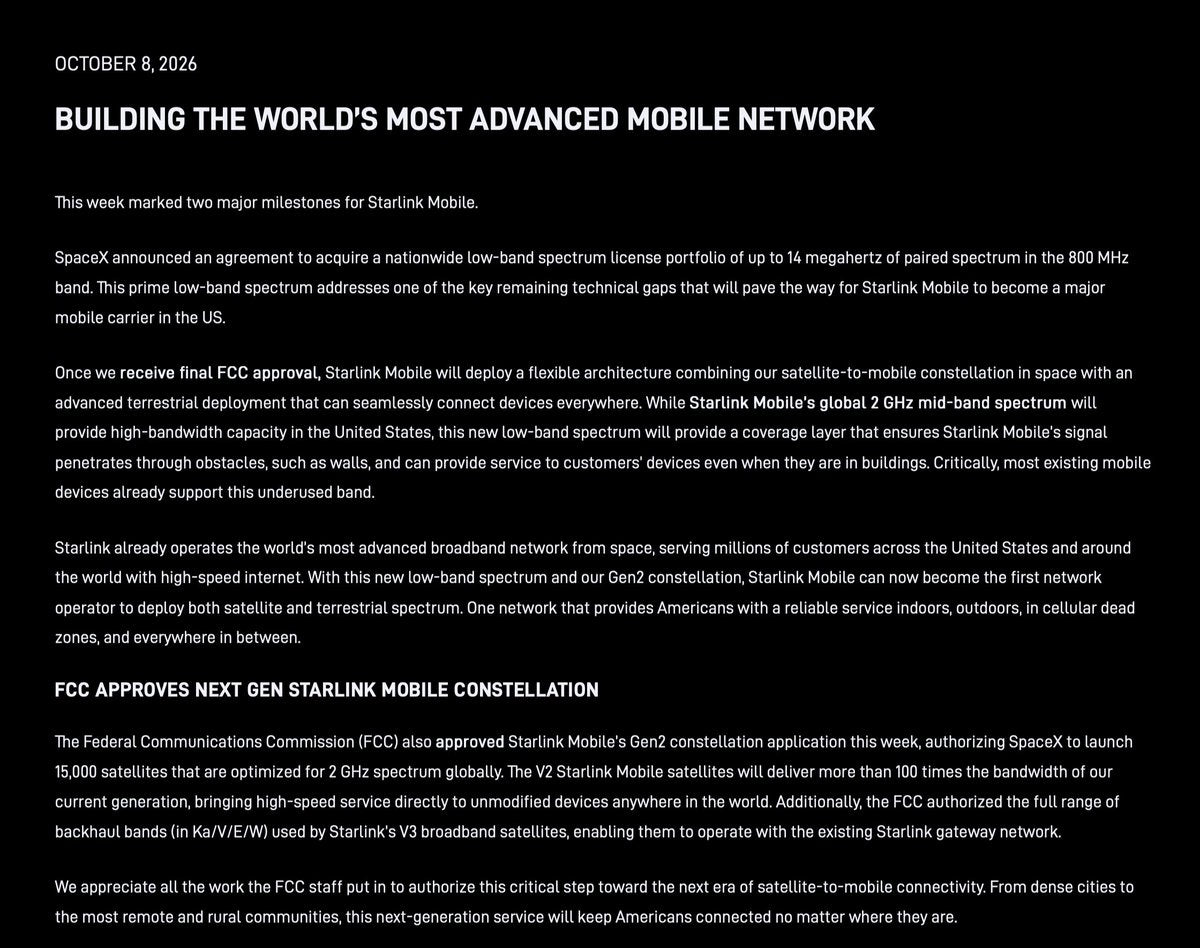
SpaceX has struck a deal to acquire a nationwide 800 MHz spectrum portfolio, a move Elon Musk is calling the 'last critical piece' needed for Starlink Mobile to provide complete phone coverage across America. The announcement, made public on October 8, 2026, sent shares of Verizon, AT&T, and T-Mobile tumbling roughly 7% in after-hours trading as investors absorbed the implications of a satellite-native carrier entering the U.S. mobile market with the frequencies required to punch signals through building walls.
The deal pairs with the FCC's approval just two days earlier of Starlink's Gen2 constellation, authorizing up to 15,000 next-generation satellites. Together, the two developments transform Starlink Mobile from a text-only emergency backup into a credible competitive threat to the entrenched U.S. carrier trio.
The Spectrum Deal
According to a SpaceX statement reported by StreetInsider and PR Newswire, SpaceX has agreed to acquire 100% of Grain Management's nationwide 800 MHz spectrum portfolio, picking up as much as 14 megahertz of paired low-band frequencies. The transaction remains subject to Federal Communications Commission approval and customary closing conditions.

Low-band spectrum is the piece Starlink Mobile has been missing. Higher frequencies deliver more bandwidth but struggle with obstacles — trees, drywall, concrete. The 800 MHz band is the opposite: it propagates further and penetrates buildings, which is why terrestrial carriers have guarded their low-band holdings for decades.
Musk's 'Last Critical Piece'
Musk framed the acquisition in blunt terms on X: 'This is the last critical piece of the spectrum puzzle needed for SpaceX to provide complete phone coverage in America.' He followed up moments later with a two-word verdict: 'Very big deal.'

The timing of his statement matters. AT&T CEO John Stankey had previously argued publicly that Starlink Mobile would not be able to penetrate walls — a technical limitation that would relegate the service to outdoor or edge-of-network use cases. The 800 MHz acquisition is SpaceX's direct answer to that critique. With low-band in hand, Starlink Mobile can now theoretically deliver signal to a phone sitting on a kitchen counter inside a suburban home.
Key Figures
| Item | Detail |
|---|---|
| Spectrum acquired | Up to 14 MHz paired, 800 MHz band, nationwide |
| Seller | Grain Management, LLC |
| Carrier stock reaction | VZ, T, TMUS down ~7% after-hours |
| Prior EchoStar deal | 65 MHz mid-band, $17B, approved May 2026 |
| Gen2 constellation | 15,000 satellites, FCC approved Oct 6, 2026 |
| Target service date | Late 2027 into early 2028 (per prior SpaceX guidance) |
How We Got Here
The 800 MHz deal is the capstone of a roughly 13-month spectrum accumulation. In September 2025, SpaceX announced the acquisition of 65 megahertz of mid-band spectrum from EchoStar in a transaction valued at $17 billion — $8.5 billion cash plus $8.5 billion in SpaceX equity, according to prior reporting. The FCC approved the transfer in May 2026.
That mid-band spectrum handles bulk throughput — the data pipe that lets a Starlink Mobile phone stream video or hold a video call. But mid-band alone cannot solve the indoor-coverage problem. The 800 MHz acquisition fills that gap. Meanwhile, the FCC's October 6 approval of the Gen2 constellation authorizes the V2 satellites optimized to transmit on these frequencies — satellites that, according to SpaceX filings, are expected to deliver substantially more bandwidth than the current generation.

Why the Market Panicked
The after-hours stock reaction tells the story. For years, the big three U.S. carriers have operated as a de facto oligopoly, with high barriers to entry defined almost entirely by capex: towers, fiber backhaul, and spectrum licenses. Starlink Mobile sidesteps the first two by routing signals through satellites already in orbit, and the EchoStar and Grain acquisitions now check the third box.
Texting via Starlink is already live through a partnership with T-Mobile as of late 2024. Direct-to-device voice and data for standard, unmodified smartphones is targeted for late 2027, with broader rollout extending into early 2028 per SpaceX's prior guidance. If that timeline holds, by 2028 a Verizon customer with marginal rural coverage will have a credible alternative that works in the places the terrestrial networks never reached.
What to Watch Next
Three signals will determine how quickly this threat materializes:
- FCC approval timing. The Grain transaction is pending regulatory sign-off. The EchoStar deal took roughly eight months from announcement to FCC approval; a similar window would clear this by mid-2027.
- Gen2 launch cadence. SpaceX is authorized for 15,000 satellites but needs to actually launch and activate them. Watch Starship cadence and payload manifests.
- Carrier counter-moves. Expect lobbying pressure at the FCC, potential spectrum deals of their own, and marketing pivots emphasizing 5G terrestrial advantages. T-Mobile's existing partnership with Starlink makes its position uniquely awkward.
Editor's View
The AT&T CEO's 'won't penetrate walls' line is going to age poorly. For over a year, the standard carrier defense against Starlink Mobile was that satellite physics couldn't deliver real indoor coverage without low-band spectrum. SpaceX just bought the low-band. The playing field didn't level overnight — regulatory approval, satellite deployment, and device compatibility all still have to be worked through — but the strategic question has shifted from 'can they?' to 'when?' That's a very different conversation.
Sources & reporting notes
The links below identify the material source records used for this report.
- @SawyerMerritt on X (2026-10-08T20:19:17.000Z) — Direct source
- @SawyerMerritt on X (2026-10-08T20:31:58.000Z) — Direct source
- @elonmusk on X (2026-10-08T20:39:11.000Z) — Direct source
- @elonmusk on X (2026-10-08T20:41:03.000Z) — Direct source
- @SawyerMerritt on X (2026-10-08T20:50:30.000Z) — Direct source
Source links are preserved as published or accessed. See our editorial standards and corrections policy.
The BASENOR Editorial Desk covers Tesla, SpaceX, and related technology, curating reporting from primary sources — official accounts, regulatory filings, and software release data. Every article passes source-record and fact-checking review before publication. About the newsroom.
This report was curated by the BASENOR Editorial Desk from the sources listed above. Read our editorial standards or email editorial@basenor.com to report an error.