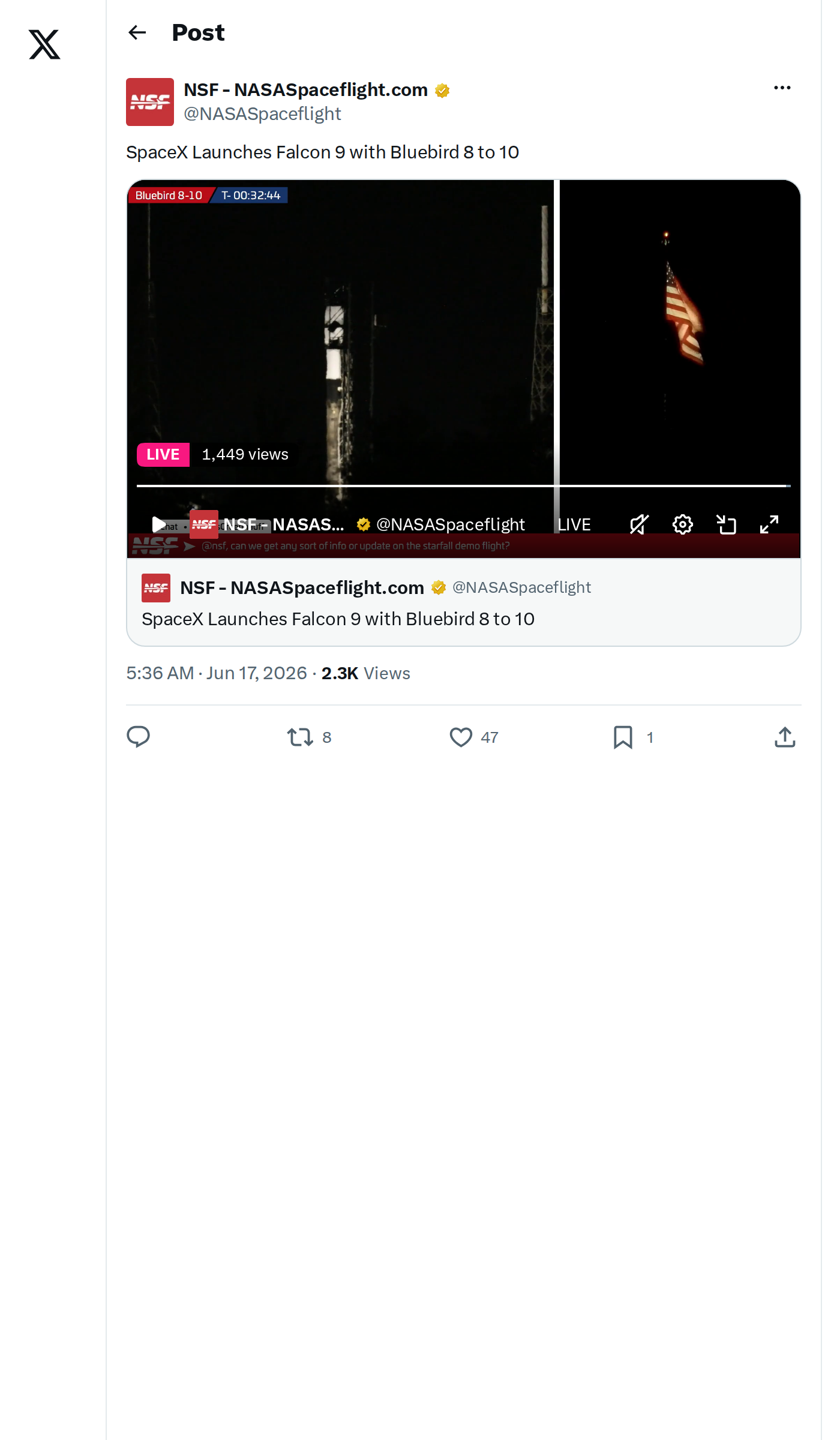
SpaceX successfully launched three AST SpaceMobile BlueBird Block 2 satellites — BlueBird 8, 9, and 10 — aboard a Falcon 9 rocket from Space Launch Complex 40 at Cape Canaveral Space Force Station early Wednesday morning. The launch window opened at 2:39 a.m. EDT on June 17, 2026, marking another step forward in AST SpaceMobile's push toward continuous global cellular broadband coverage directly to standard smartphones.

The booster supporting this mission, B1077, completed its 29th flight before landing on the "A Shortfall of Gravitas" droneship in the Atlantic Ocean — a routine recovery that continues to underline how reliably SpaceX turns around its Falcon 9 fleet. The BlueBird Block 2 satellites themselves are anything but routine: each features a communications array up to 2,400 square feet in size, making them the largest commercially deployed satellites in Low Earth Orbit. According to AST SpaceMobile, they deliver up to 10 times the bandwidth of the Block 1 generation and support peak data speeds of up to 120 Mbps.
The mission's significance extends beyond the hardware specs. AST SpaceMobile's network is designed to connect directly to unmodified smartphones — no special hardware, no satellite dish — supporting voice, data, and video over standard cellular bands. Scott Wisniewski, President of AST SpaceMobile, noted ahead of the launch that "each BlueBird satellite launched expands our ability to support seamless space-based broadband mobile connectivity directly to everyday smartphones." With BlueBird 8 through 10 now in orbit, the company moves closer to the constellation density needed for continuous global coverage. For more on SpaceX's ongoing launch cadence, see our SpaceX coverage.
Sources & reporting notes
The links below identify the material source records used for this report.
- @NASASpaceflight on X (2026-06-17T05:36:17.000Z) — Direct source
Source links are preserved as published or accessed. See our editorial standards and corrections policy.
The BASENOR Editorial Desk covers Tesla, SpaceX, and related technology, curating reporting from primary sources — official accounts, regulatory filings, and software release data. Every article passes source-record and fact-checking review before publication. About the newsroom.
This report was curated by the BASENOR Editorial Desk from the sources listed above. Read our editorial standards or email editorial@basenor.com to report an error.