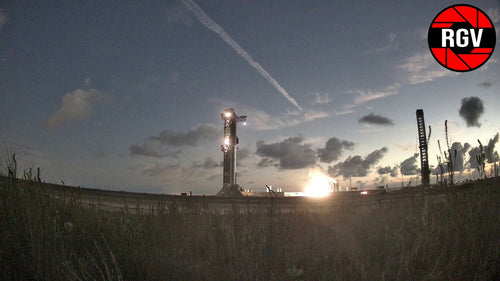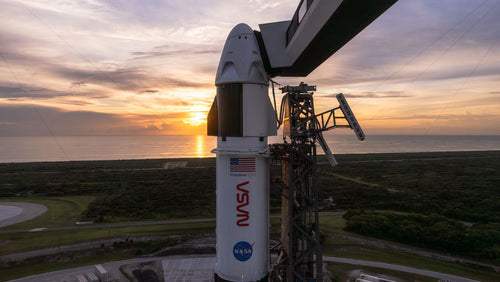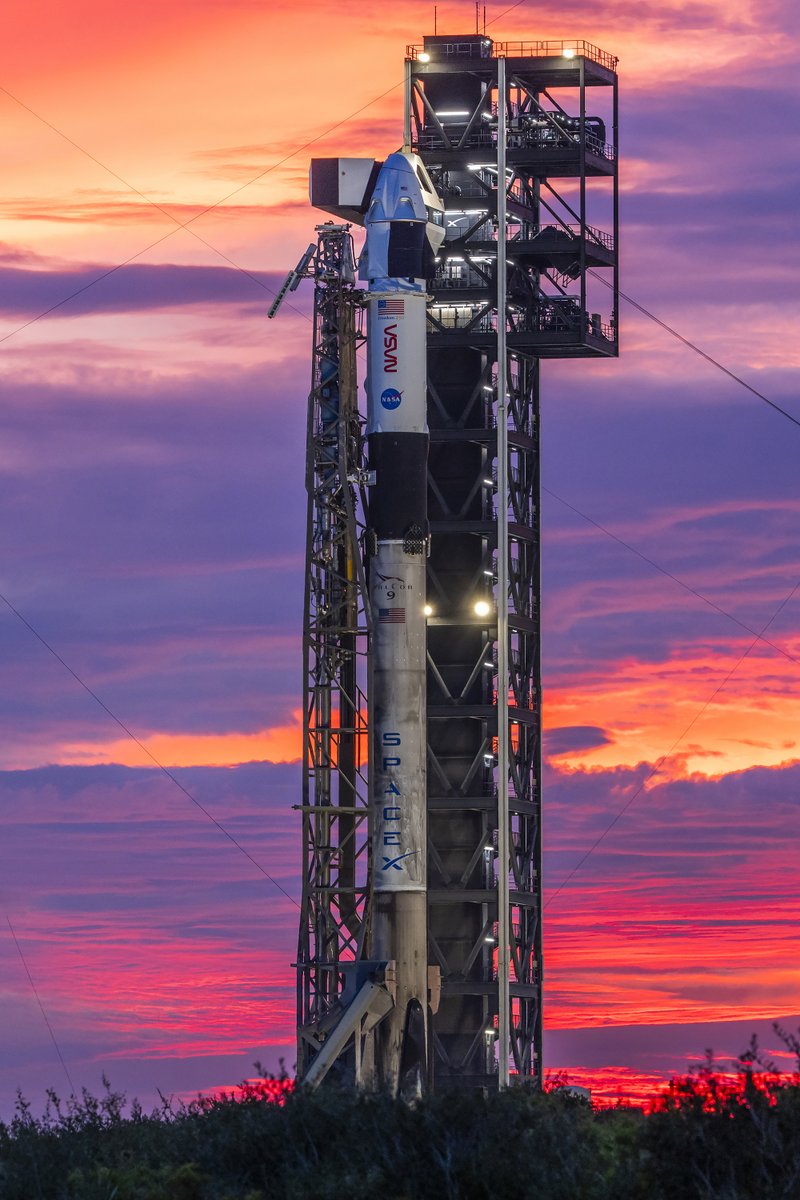
On October 1, 2026, SpaceX is attempting something it has done only once before: three separate orbital missions within a single 13-hour window. A Falcon 9 carrying astronauts to the International Space Station, a Falcon 9 loaded with 103 rideshare payloads, and a Falcon Heavy hauling a classified national security satellite are all standing vertical at pads in Florida and California simultaneously — a logistical display that underscores just how industrialized orbital launch has become.

Three Pads, Three Missions
The day's schedule spans both coasts and covers crewed spaceflight, commercial rideshare, and national security — three distinct customer segments served inside a single calendar day.
| Mission | Vehicle | Launch Time | Pad | Weather |
|---|---|---|---|---|
| Crew-13 / Dragon Grace | Falcon 9 (B1101, flight 3) | 11:10 a.m. ET | SLC-40, Cape Canaveral | 40% favorable |
| Transporter-18 (103 payloads) | Falcon 9 | 11:18 a.m. PT | SLC-4E, Vandenberg | Favorable |
| NROL-97 (NRO / USSF) | Falcon Heavy | 11:53 p.m. ET | LC-39A, Kennedy | 60% favorable |
Crew-13: Four Astronauts, One Weather Concern
The day's highest-stakes launch comes first. Dragon Grace will carry NASA astronauts Jessica Watkins and Luke Delaney, Canadian Space Agency astronaut Joshua Kutryk, and Roscosmos cosmonaut Sergey Teteryatnikov to the ISS. Booster B1101 is on its third flight and is expected to return to Landing Zone 40 at Cape Canaveral roughly eight minutes after liftoff. The 40% go weather forecast is the only real variable — a backup opportunity exists on October 2 at 10:47 a.m. EDT if conditions don't cooperate.

Transporter-18: 103 Payloads, One Rocket
While Florida manages a crewed launch, SpaceX's Vandenberg pad will be busy with the 18th iteration of its Transporter rideshare program. One hundred and three payloads — a mix of commercial smallsats, government experiments, and hosted payloads — will share a single Falcon 9 to a sun-synchronous orbit. Weather at Vandenberg is fully favorable, and the West Coast launch is timed to follow the Florida crew launch by just over two hours (local time). The Transporter series has become the backbone of the smallsat launch market, offering predictable, affordable access to orbit on a recurring schedule.
NROL-97: Falcon Heavy Closes Out the Day
After nightfall, the heaviest rocket in SpaceX's active fleet takes the stage. Falcon Heavy will lift off from historic pad 39A at Kennedy Space Center carrying the NROL-97 mission for the National Reconnaissance Office and U.S. Space Force. Details about the payload are classified, as is standard for NRO missions. Weather sits at 60% favorable for the 11:53 p.m. ET liftoff. Both side boosters are expected to return to landing zones in Florida with the characteristic double sonic boom that has become a familiar sound along the Space Coast.

What This Day Actually Represents
The operational picture here goes beyond the spectacle of three rockets standing vertical at once. According to background reporting, this is only the second time SpaceX has attempted three orbital missions within a 13-hour span. Each mission uses a different vehicle configuration (Falcon 9 expendable-profile crewed, Falcon 9 rideshare, Falcon Heavy) and serves a completely different customer category. That breadth — ISS partnership, commercial smallsat market, classified government — reflects a launch business that no longer needs to specialize.
Booster recovery is scheduled across both coasts: the Crew-13 first stage returns to LZ-40 in Florida, the Transporter-18 booster lands at Vandenberg, and the Falcon Heavy side cores come back to the Florida landing zones. Eight minutes from liftoff to touchdown, three times over, in three different time zones. The sonic booms are almost a footnote at this point — routine punctuation on an increasingly routine operation.
Whether all three missions launch on schedule will depend on weather, particularly the marginal 40% forecast hanging over Crew-13. But the fact that SpaceX can queue three orbital missions on a single calendar day — across two states, three vehicle configurations, and three customer types — is the real story. The infrastructure to sustain that cadence didn't exist five years ago. Today it's just a Thursday.
Sources & reporting notes
The links below identify the material source records used for this report.
- @SpaceX on X (2026-10-01T09:51:52.000Z) — Direct source
- @SpaceX on X (2026-10-01T09:54:59.000Z) — Direct source
- @SpaceX on X (2026-10-01T09:56:01.000Z) — Direct source
- @SpaceX on X (2026-10-01T09:57:30.000Z) — Direct source
- @SpaceX on X (2026-10-01T09:58:32.000Z) — Direct source
Source links are preserved as published or accessed. See our editorial standards and corrections policy.
The BASENOR Editorial Desk covers Tesla, SpaceX, and related technology, curating reporting from primary sources — official accounts, regulatory filings, and software release data. Every article passes source-record and fact-checking review before publication. About the newsroom.
This report was curated by the BASENOR Editorial Desk from the sources listed above. Read our editorial standards or email editorial@basenor.com to report an error.