📌 UPDATE — August 4, 2026
SpaceX's newly filed 10-Q reveals the company purchased $295 million worth of Tesla Megapacks in Q2 2026 alone to power its datacenters. That brings SpaceX's cumulative Megapack spending to over $800 million since last year, making it one of Tesla Energy's largest known customers. The disclosure adds a notable related-party dimension to SpaceX's Q2 financials, given Elon Musk's leadership role at both companies.
@SawyerMerritt · Aug 4, 2026
"SpaceX says that it purchased $295 million of @Tesla Megapacks in Q2 2026, according to a new 10-Q filing. This means that the company has now spent over $800 million on Megapacks for its datacenters since last year."
📌 UPDATE — August 4, 2026
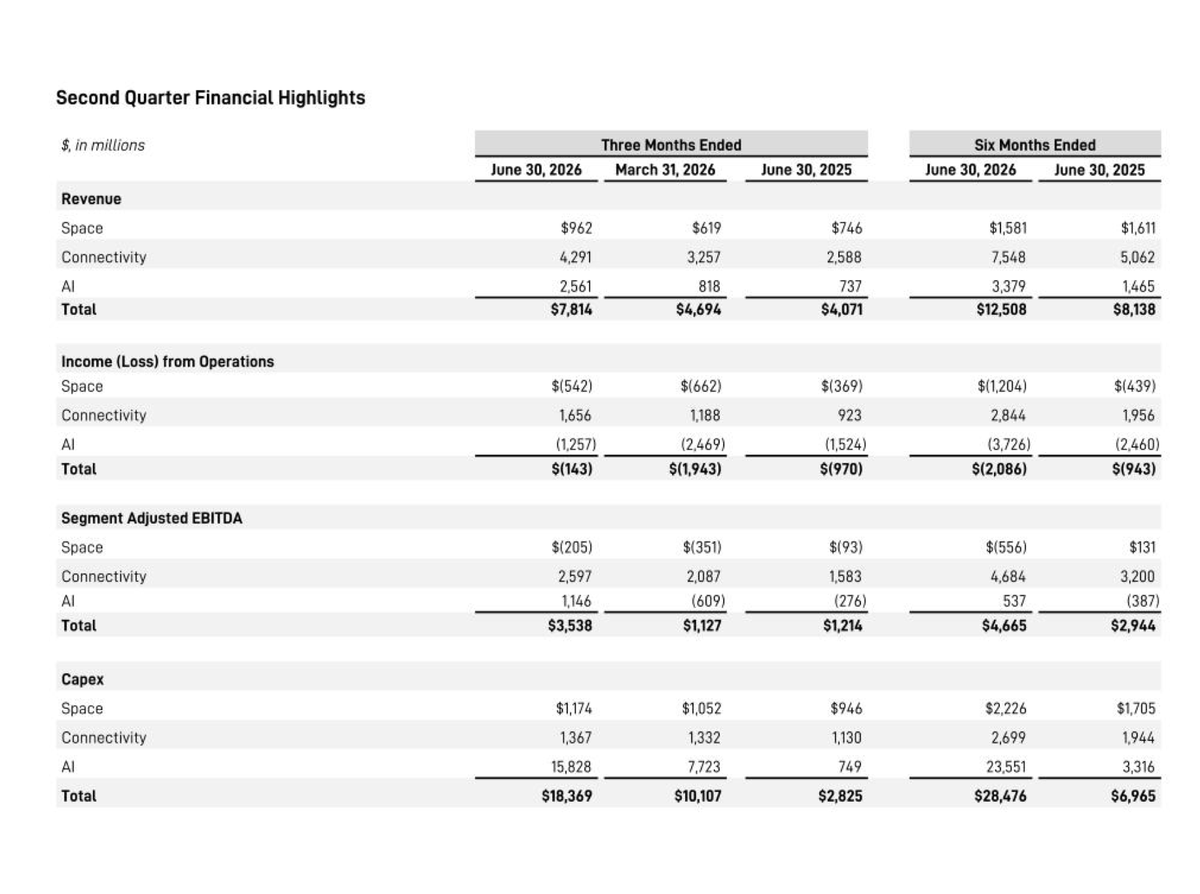
SpaceX's official Q2 2026 earnings deck is now public, confirming and expanding on the headline numbers. Adjusted EBITDA tripled year-over-year to $3.5 billion, underscoring dramatic margin expansion alongside the 92% revenue surge. The company also disclosed a $48 billion contract backlog, signaling strong forward visibility. Most notably, SpaceX revealed $15.8 billion in AI capital expenditure for Q2 alone — a figure that dwarfs most tech companies' full-year AI spend and signals an aggressive push into AI infrastructure beyond its launch and Starlink businesses.
| Metric | Q2 2026 |
|---|---|
| Revenue | $7.8B (+92% YoY) |
| Adjusted EBITDA | $3.5B (3× YoY) |
| Cash on Hand | $100B |
| Contract Backlog | $48B |
| AI CapEx (Q2) | $15.8B |
📌 UPDATE — August 4, 2026
A major new detail from SpaceX's Q2 2026 report has emerged: AI revenues surged 213% sequentially and 247% year-over-year, reaching $2.6 billion for the quarter. The growth was driven by new Cloud Service Agreements, expanded AI solutions and infrastructure demand, and rising subscription revenues from Grok and 𝕏. This means AI alone now accounts for roughly 33% of SpaceX's total $7.81B quarterly revenue — a remarkable shift that underscores how quickly the company's business mix is evolving beyond launch and Starlink. The sequential jump of 213% in a single quarter suggests Cloud Service Agreement signings accelerated sharply in Q2, pointing to enterprise and government AI infrastructure as a fast-growing revenue pillar alongside Starlink's consumer base.
@SawyerMerritt · Aug 4, 2026
"AI revenues were up 213% sequentially and 247% year-over-year to $2.6 billion, primarily driven by an increase in AI solutions and infrastructure revenues from new Cloud Service Agreements, as well as an increase in Grok and 𝕏 subscription revenues."
📌 UPDATE — August 4, 2026
The 12 million Starlink subscriber figure reported in SpaceX's Q2 2026 earnings has been highlighted as a landmark milestone: it represents an exact doubling of the 6 million subscribers Starlink counted just one year ago. The year-over-year growth underscores how rapidly SpaceX is scaling its satellite internet business, adding roughly 6 million new subscribers in 12 months. At this pace, Starlink's subscriber trajectory is outrunning even the most bullish analyst forecasts heading into Q3 2026.
@wholemars · Aug 4, 2026
"Starlink now has 12 million subscribers — double last year's 6 million subscriber count $SPCX"
View tweet ↗
SpaceX just posted a blowout second quarter. The company reported $7.81 billion in revenue for Q2 2026 — up 92% year-over-year and comfortably above the $6.81 billion consensus expectation — while shrinking its net loss to $541 million and disclosing a $100 billion war chest of cash and marketable securities. The results, released this afternoon, are the first full quarter of numbers since SpaceX's June IPO, and they show a business that is no longer just a launch company: connectivity and AI are now doing the heavy lifting.

The headline numbers
The top-line story is acceleration. Revenue grew 92% year-over-year from $4.07 billion in Q2 2025, and — more strikingly — jumped 66% quarter-over-quarter from $4.69 billion in Q1. That kind of sequential growth is unusual for a company already at this scale, and it reflects Starlink's subscriber ramp, an expanding AI segment, and a heavier launch cadence.
Profitability is trending the right way, too. Loss from operations narrowed to $143 million from $970 million a year earlier, and net loss came in at $541 million versus $1.008 billion in Q2 2025. Adjusted EBITDA landed at $3.5 billion, a 191% jump from $1.2 billion in the same quarter last year. In plain terms: revenue nearly doubled, but costs didn't — that's the operating leverage CFO Bret Johnsen called out in the release.

Key Figures
| Metric | Q2 2026 | Q2 2025 | Change |
|---|---|---|---|
| Total Revenue | $7.81B | $4.07B | +92% |
| Net Loss | $541M | $1.008B | +$467M |
| Loss from Operations | $143M | $970M | +$827M |
| Adjusted EBITDA | $3.5B | $1.2B | +191% |
| Cash & Marketable Securities | $100B | — | — |
Where the growth came from
SpaceX now reports revenue across three segments, and the mix tells the story of a company that has quietly transformed from a rocket business into something much broader.
Connectivity ($4.29 billion, +66% YoY) — Starlink remains the anchor. According to the company, subscriber count doubled year-over-year to 12 million, with service now live in 167 countries. Connectivity is by itself larger than SpaceX's entire business was two years ago.
AI ($2.56 billion, +247% YoY) — This is the surprise. The AI segment more than tripled, driven by what SpaceX describes as $14.1 billion in newly contracted cloud service agreements and the July release of Grok 4.5. The pending $60 billion acquisition of Cursor, announced alongside the earnings, signals SpaceX intends to keep pressing this advantage.
Space ($962 million, +29% YoY) — The core launch and Starshield business grew more modestly in percentage terms but crossed a meaningful threshold: over $6 billion in multi-year U.S. government contracts for Starshield were awarded during the quarter, and SpaceX has completed 78 launches year-to-date. Two successful Starship V3 flight tests in the past 90 days also fall under this segment.

The $100 billion question
The cash figure is the number Wall Street will spend the most time on. SpaceX ended Q2 with $100 billion in cash, cash equivalents, and marketable securities on the balance sheet — a position that, according to the company's own disclosures, gives it more strategic firepower than most sovereign wealth funds.

CFO Bret Johnsen framed it this way: "2026 has been a momentous year so far, and the second quarter demonstrated the true power of SpaceX. Revenue growth accelerated across all our business segments and we delivered strong operating leverage."
Some of that cash was raised in June's IPO, which came in at roughly a $1.75 trillion initial valuation. The stock closed at $125.41 on August 4 — down about 8% from its debut — and the first major lock-up expiration is scheduled for August 6, 2026. That means early employees and investors will be able to sell shares in two days. Today's earnings beat is well-timed against that lock-up: it gives the market a fresh reason to absorb the coming supply of shares without a price shock.
What it means for the Tesla ecosystem
SpaceX and Tesla are separate companies, but the Musk-led ecosystem overlap is real. A few threads Tesla owners should watch:
Starlink in vehicles. With 12 million Starlink subscribers and expanding maritime, aviation, and roaming plans, the case for eventual Tesla-Starlink integration keeps getting stronger. Nothing was announced today, but a connectivity business this large gives Tesla more options for future in-car satellite services.
AI compute and Grok. The AI segment's 247% growth and Grok 4.5's July release matter to Tesla owners who use Grok in the vehicle. A well-funded, rapidly scaling AI arm inside the broader Musk sphere means more model updates, faster.
Capital flexibility. A $100 billion cash position doesn't directly help Tesla, but it does mean SpaceX is not competing with Tesla for external capital markets — a quiet positive for anyone watching Tesla's own funding runway.
What to watch next
Three near-term signals will shape how this quarter is remembered:
- August 6 lock-up expiration — how the stock absorbs the first tranche of unlocked shares will test whether today's numbers are enough to hold the valuation.
- Cursor deal close — a $60 billion acquisition is not trivial to integrate; watch for regulatory review and any changes to the AI segment guidance.
- Starship V3 cadence — two successful flights in 90 days is the fastest Starship progress to date. A third test before Q3 close would keep the Space segment growth story intact.
For a company that lost a billion dollars a quarter not long ago, cutting the loss nearly in half while doubling revenue is the kind of quarter that changes the conversation. The next one will need to answer whether SpaceX can turn that operating leverage into actual profitability — and whether $100 billion in the bank is a war chest or a target on its back.
🚀 Following the Starship program? See every test flight, official outcome and the next launch window in our SpaceX Starship Tracker.
Related Gear
Gear up your Tesla with tested, custom-fit BASENOR accessories — shop Tesla accessories →
Sources & reporting notes
The links below identify the material source records used for this report.
- @SawyerMerritt on X (2026-08-04T20:05:24.000Z) — Direct source
- @SawyerMerritt on X (2026-08-04T20:08:00.000Z) — Direct source
- @SawyerMerritt on X (2026-08-04T20:14:17.000Z) — Direct source
- @wholemars on X (2026-08-04T20:23:18.000Z) — Direct source
- @SawyerMerritt on X (2026-08-04T20:26:04.000Z) — Direct source
Source links are preserved as published or accessed. See our editorial standards and corrections policy.
The BASENOR Editorial Desk covers Tesla, SpaceX, and related technology, curating reporting from primary sources — official accounts, regulatory filings, and software release data. Every article passes source-record and fact-checking review before publication. About the newsroom.
This report was curated by the BASENOR Editorial Desk from the sources listed above. Read our editorial standards or email editorial@basenor.com to report an error.