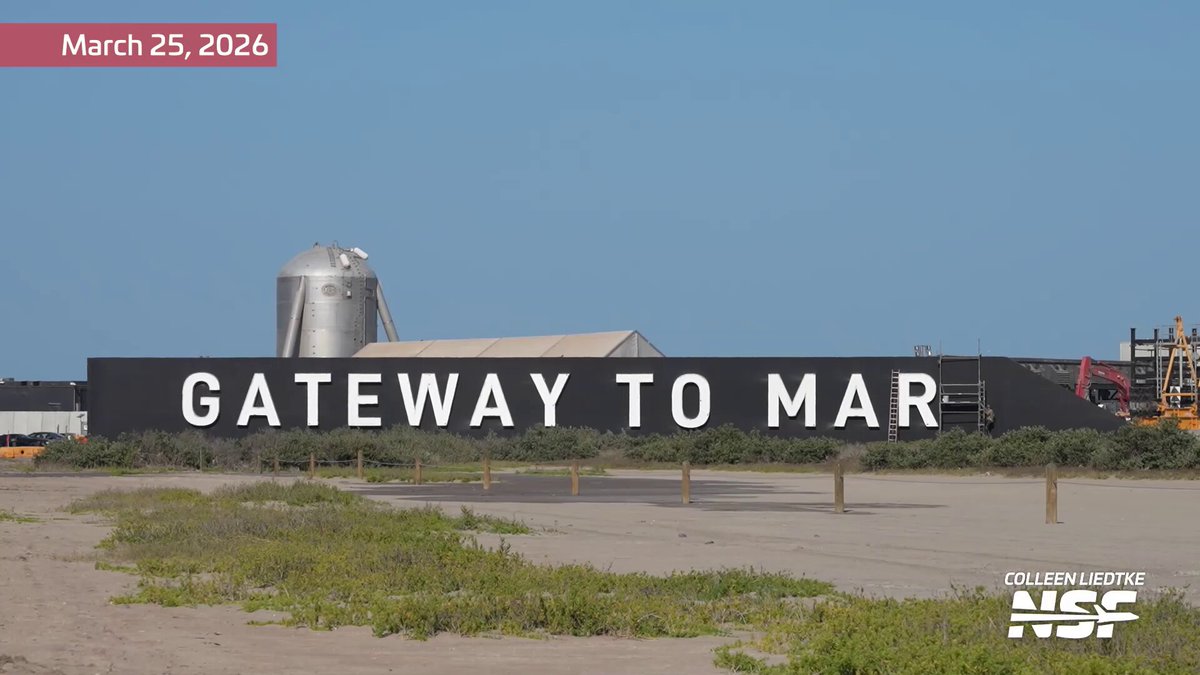
The News: SpaceX has reinstalled its iconic 'Gateway to Mars' sign at Pad 2 of its Starbase facility in Texas, coinciding with NASA's imminent Artemis II lunar mission.
Why It Matters: The sign's return — after being removed in 2023 to make way for Pad 2 construction — signals that Starbase's second launch pad is operationally ready and that SpaceX's Mars ambitions are very much alive and accelerating.
Source: @NASASpaceflight on X
SpaceX Reinstalls 'Gateway to Mars' Sign at Starbase Pad 2 — What It Signals About the Mars Timeline
A symbolic moment at Starbase: SpaceX has reinstalled its 'Gateway to Mars' sign at Pad 2 in Boca Chica, Texas. The sign — originally placed at the facility years ago before being taken down in 2023 to accommodate Pad 2 construction — is back, and its return carries more weight than just aesthetics. With NASA's Artemis II crew preparing to loop around the Moon in the coming days, the timing couldn't be more pointed.

📊 Key Figures
| Metric | Value | Context |
|---|---|---|
| Sign Removal (for Pad 2 construction) | 2023 | Pad 2 build begins |
| Sign Reinstallation | ~March 25, 2026 | Pad 2 construction complete |
| First Uncrewed Mars Flights (target) | Late 2026 | Starship-dependent |
| First Crewed Mars Flights (target) | ~2030 | If uncrewed landings succeed |
| Starship Max Payload (reusable) | 150 metric tons | 250 MT expendable |
Pad 2: More Than Just a Second Launch Site
Pad 2 isn't simply a copy of Pad 1. According to verified reporting, SpaceX incorporated significant design improvements based on lessons learned from Pad 1 operations — enhancements aimed at boosting efficiency, robustness, and safety across Starship launch cycles. The completion of Pad 2 effectively doubles Starbase's launch cadence potential, a critical factor if SpaceX intends to hit its aggressive Mars timeline.
The 'Gateway to Mars' sign being reinstalled here — specifically at Pad 2, not Pad 1 — is a deliberate statement. This is the pad SpaceX is betting on for the next chapter of Starship's operational life.
The Moon-to-Mars Moment
The timing of this reinstallation is hard to ignore. NASA's Artemis II mission — the first crewed lunar flyby since Apollo 17 in 1972 — is days away from launch. While Artemis II uses a Boeing-built SLS rocket rather than Starship, SpaceX's Starship is already contracted as NASA's Human Landing System (HLS) for the subsequent Artemis III mission, which will return astronauts to the lunar surface.
In other words: as humanity prepares to return to the Moon, SpaceX is publicly signaling that the Moon is not the destination — it's the stepping stone. The 'Gateway to Mars' sign makes that philosophy impossible to miss.
🔭 The BASENOR Take
Timeline: Sign reinstalled ~March 25, 2026 | Artemis II launch imminent | First uncrewed Mars flights targeted late 2026
Impact Level: 🔴 High — Pad 2 completion is a genuine infrastructure milestone for Starship's operational cadence
Confidence: ⭐⭐⭐⭐ High — sign reinstallation confirmed by NASASpaceflight; Mars timelines are SpaceX targets, not guarantees
The sign itself is symbolic, but symbols matter at SpaceX. Elon Musk has consistently used visual and cultural cues to reinforce mission alignment across thousands of employees. Reinstalling 'Gateway to Mars' at a newly completed, more capable launch pad is a message to the workforce as much as it is to the public: the infrastructure is ready, now execute.
The more substantive signal is what Pad 2's completion represents operationally. SpaceX has publicly targeted the first uncrewed Starship flights to Mars for late 2026. That window is closing fast. Having two functional launch pads at Starbase — with Pad 2 incorporating lessons from Pad 1 — gives SpaceX the redundancy and cadence it needs to hit aggressive test and launch schedules without a single point of failure grounding the program.
Starship V3 development is also underway in parallel, with key HLS milestones including a long-duration flight test and an in-space propellant transfer demonstration both targeted for 2026. Propellant transfer in particular is a non-negotiable technical requirement for any crewed Mars mission — Starship needs to refuel in orbit before heading to the Red Planet. Progress on that front will be the real indicator of whether the late-2026 uncrewed Mars window is realistic or aspirational.
For context on scale: SpaceX's Mars settlement vision requires transporting millions of tons of cargo and ultimately over one million people to Mars. Starship, capable of carrying 150 metric tons in a fully reusable configuration, is the only vehicle on Earth's drawing board remotely sized for that task. Every Starship flight, every pad improvement, every propellant transfer test is a brick in that foundation. The 'Gateway to Mars' sign isn't just pointing toward the Red Planet — it's pointing toward a very specific, very ambitious engineering deadline. Follow our SpaceX coverage as Starship's 2026 milestones unfold.
🚀 Following the Starship program? See every test flight, official outcome and the next launch window in our SpaceX Starship Tracker.
Sources & reporting notes
The links below identify the material source records used for this report.
- @NASASpaceflight on X (2026-03-29T00:28:00.000Z) — Direct source
Source links are preserved as published or accessed. See our editorial standards and corrections policy.
The BASENOR Editorial Desk covers Tesla, SpaceX, and related technology, curating reporting from primary sources — official accounts, regulatory filings, and software release data. Every article passes source-record and fact-checking review before publication. About the newsroom.
This report was curated by the BASENOR Editorial Desk from the sources listed above. Read our editorial standards or email editorial@basenor.com to report an error.