SpaceX Starfactory & Giga Bay: Inside the Starship Megafactory Scale-Up
📋 The News: SpaceX is building two unprecedented mega-facilities — Starfactory and Gigabay — at Starbase in South Texas to support a future Starship launch cadence that could eventually exceed once per hour.
⚡ Why It Matters: This is the industrial backbone behind SpaceX's most ambitious timelines yet: 1,000 Starships per year, a self-sustaining lunar presence, and a path to Mars — and it's rising out of the South Texas desert right now.
🔗 Source: @NASASpaceflight on X

📊 Key Figures
| Metric | Figure | Context |
|---|---|---|
| Gigabay Height | ~380 feet | One of the world's largest industrial structures |
| Interior Volume | 46.5 million cu ft | 11× the square footage of existing Megabay |
| Work Cells | 24 dedicated cells | 19 more than current Megabay |
| Crane Capacity | 400 US tons | More than double current lifting capacity |
| Investment | $506 million | Gigabay facility alone |
| Annual Production Target | Up to 1,000 Starships/yr | Per Elon Musk's stated goal |
| Target Launch Cadence | >1 launch/hour (~2029–30) | 8,760+ launches per year at full scale |
| Employees Hired (Apr–Sep 2025) | 500 new hires | Specifically for Gigabay project |
| Gigabay Operational Target | December 2026 | Full operations at Starbase |
Two Giants Rising: What Starfactory and Gigabay Actually Are
Most people track Starship by its flight tests. But the more consequential story right now is happening on the ground — inside the walls of an industrial complex that is quietly becoming one of the most ambitious manufacturing buildouts in history.
Starfactory is SpaceX's primary Starship manufacturing plant at Starbase. It's where raw materials become rocket hardware — stainless steel rings, Raptor engine mounts, heat shield tiles, and dome assemblies. Think of it as the factory floor.
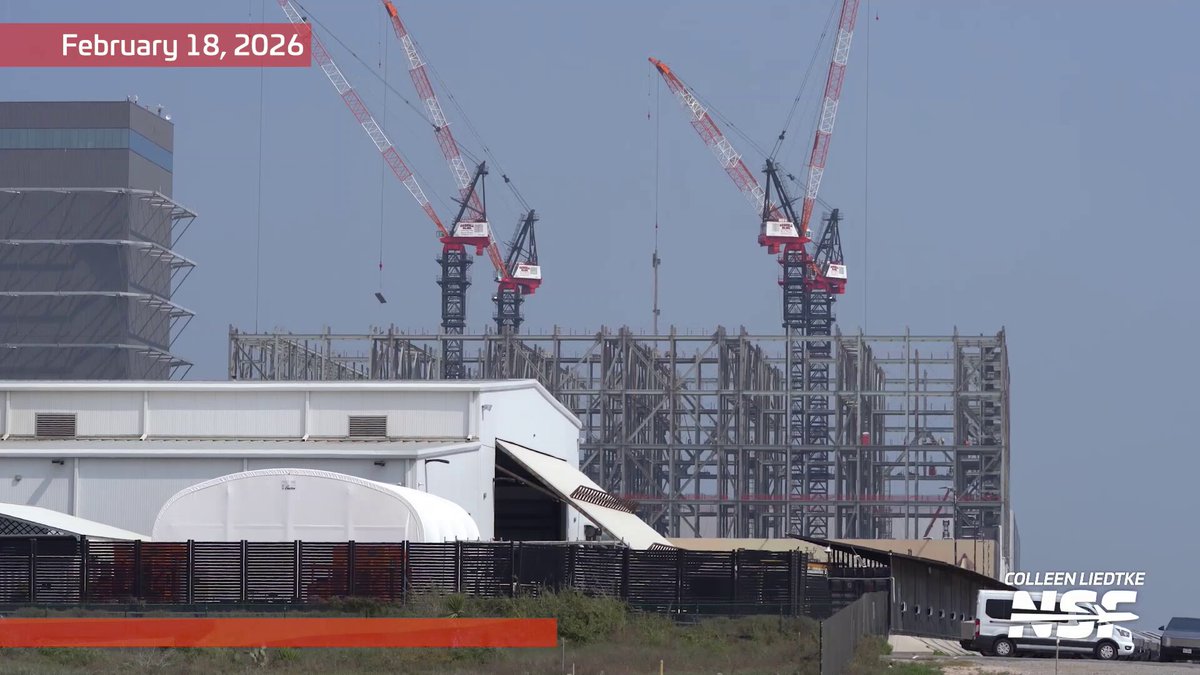
Gigabay is the new integration and assembly facility rising directly adjacent to Starfactory. Where Starfactory produces the parts, Gigabay is where the full Starship and Super Heavy stacks will be assembled, tested, and prepped for transport to the launch pad. At approximately 380 feet tall and encompassing 46.5 million cubic feet of interior space, it is projected to be among the largest industrial structures on Earth.
The two facilities are designed to work as a tandem system — a continuous pipeline from raw manufacturing through to launch-ready vehicles. As of early 2026, the Gigabay structure was already at three levels of columns and climbing, with full operations targeted for December 2026.
Why SpaceX Needs Factories This Big
The answer comes down to the math of SpaceX's stated ambitions. Elon Musk has outlined a goal of launching Starship more than once per hour within approximately 3–4 years — a cadence that translates to over 8,760 launches per year by around 2029–2030. To support that, SpaceX has stated Gigabay is designed to manufacture up to 1,000 Starship rockets annually.
For context, the entirety of NASA's Space Launch System program is targeting a cadence of 1–2 launches per year. SpaceX is planning infrastructure for a cadence that is literally thousands of times greater.
Gigabay's 24 dedicated work cells — compared to 5 in the existing Megabay — and cranes capable of lifting 400 US tons (more than double the current capacity) are the physical expression of that ambition. The facility also needs to handle increasingly large hardware: the upcoming Starship Block 4 will feature an 80-meter Super Heavy booster, pushing the physical limits of what current infrastructure can accommodate.
The Florida Expansion: A Second Production Corridor
Starbase isn't the only site scaling up. SpaceX is simultaneously constructing a second Gigabay near its HangarX facility at NASA's Kennedy Space Center in Florida, with the same specifications: 24 work cells, 400-ton crane capacity, and a target operational date by end of 2026.
Initially, fully assembled Super Heavy boosters and Starship upper stages will be transported from Starbase to Florida via barge. SpaceX intends to later establish co-located manufacturing in Florida as well, mirroring the Starfactory model. The FAA has approved up to 44 Starship launches and landings per year from Florida, with SpaceX planning three full launch pads at Cape Canaveral: one at LC-39A and two at SLC-37.
The dual-site strategy is significant — it provides geographic redundancy, doubles throughput potential, and brings SpaceX closer to equatorial launch trajectories that maximize payload efficiency for certain mission profiles.
🔭 The BASENOR Take
Timeline: Gigabay operational by December 2026 → Block 4 vehicles enter assembly → Expanded launch cadence begins 2027 onward → >1 launch/hour target ~2029–2030
Impact Level: VERY HIGH — This is the foundational infrastructure for the entire post-Falcon era of spaceflight economics.
Confidence: HIGH — Construction is physically underway and verifiable. Production and cadence targets carry SpaceX's typical aggressive timelines — treat the 2029–30 figures as aspirational benchmarks rather than hard commitments.
📰 Deep Dive
What makes the Starfactory + Gigabay combination strategically significant isn't just its physical scale — it's the manufacturing philosophy it encodes. SpaceX has consistently applied the same principle that made Falcon 9 dominant: drive down cost per launch through reusability and volume. With Starship, the ambition is to take that principle to an order of magnitude SpaceX never attempted with Falcon.
The $506 million investment in Gigabay alone signals that SpaceX is not hedging. This is a committed, long-duration buildout. The 500 employees hired specifically for the project between April and September 2025 — before the structure even reached three column levels — shows that staffing scale is being treated with the same urgency as the physical construction.
The near-term milestone to watch is the progression through Starship V3 flight tests in 2026, which is designed to carry approximately 100 tons to orbit per flight. That architecture, combined with Gigabay's work cell capacity, sets the stage for Block 4 — the 80-meter booster variant that the new facility is specifically dimensioned to accommodate.
SpaceX has also signaled a strategic pivot in destination priorities, with an uncrewed lunar landing now targeted for March 2027 ahead of its Mars ambitions. Whether that timeline holds, the infrastructure being constructed right now at Starbase is the physical prerequisite for all of it. The Giga Bay isn't a symbol of ambition — it's the factory floor ambition gets built on.
🚀 Following the Starship program? See every test flight, official outcome and the next launch window in our SpaceX Starship Tracker.
Sources & reporting notes
The links below identify the material source records used for this report.
- @NASASpaceflight on X (2026-02-22T23:58:17.000Z) — Direct source
Source links are preserved as published or accessed. See our editorial standards and corrections policy.
The BASENOR Editorial Desk covers Tesla, SpaceX, and related technology, curating reporting from primary sources — official accounts, regulatory filings, and software release data. Every article passes source-record and fact-checking review before publication. About the newsroom.
This report was curated by the BASENOR Editorial Desk from the sources listed above. Read our editorial standards or email editorial@basenor.com to report an error.