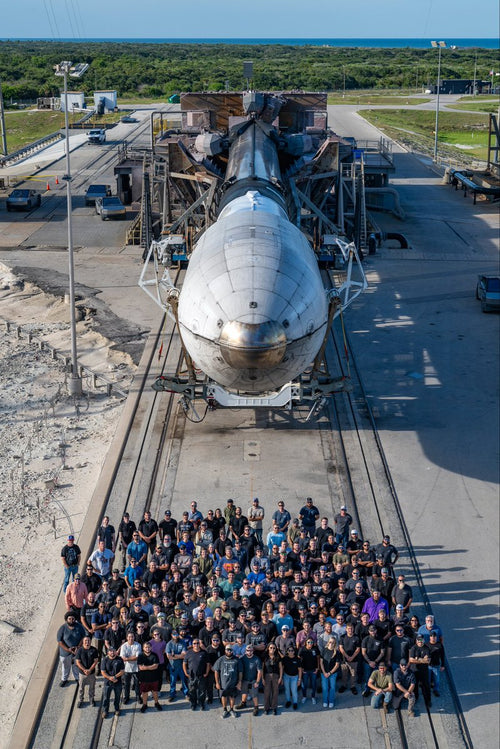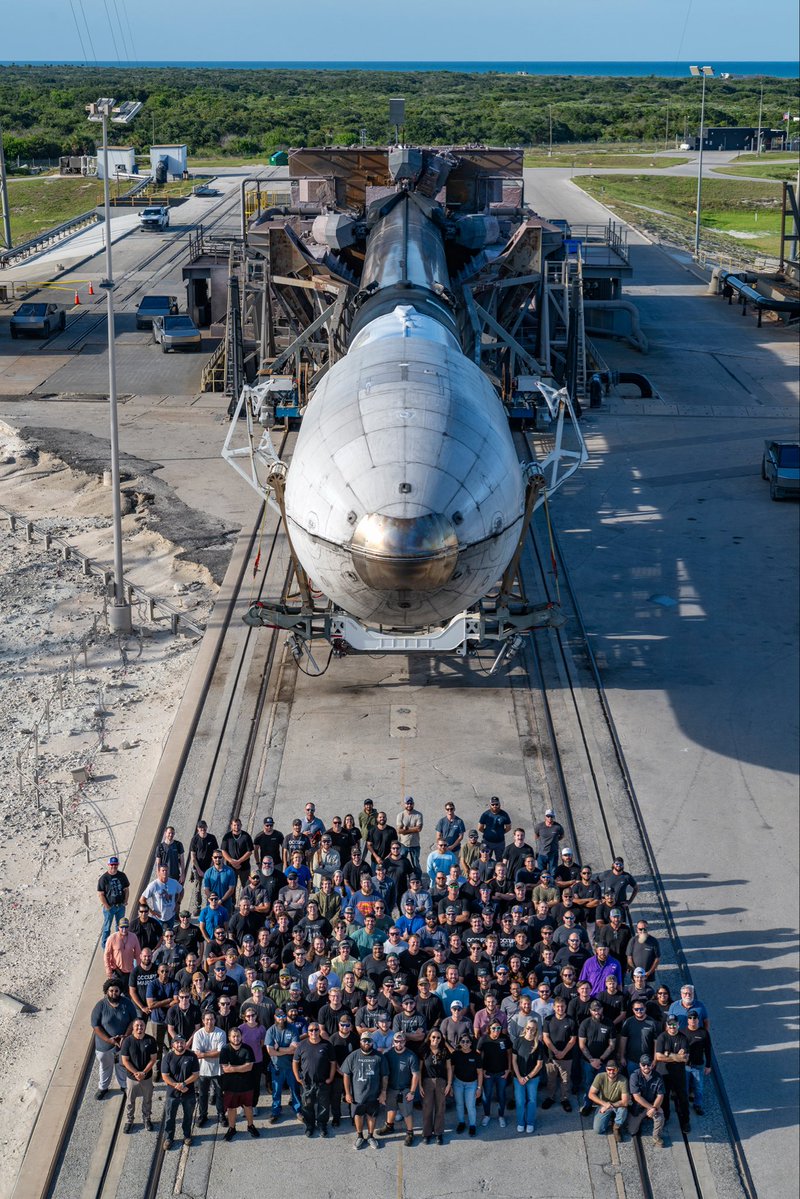
SpaceX is officially turning the page on the Falcon 9 era. On Tuesday morning, the company launched what it says is the last planned Falcon 9 Starlink mission from Florida, sending 29 satellites to orbit aboard a booster making a record-breaking 37th flight. The move — telegraphed for months by SpaceX leadership — confirms that Starlink deployment from the East Coast is being handed off to Starship, and that the workhorse rocket that reshaped the launch industry is entering its wind-down phase.
Space commentator Joe Tegtmeyer, who has been tracking the transition closely, flagged the shift on X, noting that recent operational changes point to a decisive Starship pivot rather than a gradual overlap.

What Actually Happened Today
According to Space.com and Spaceflight Now, the Starlink 10-49 mission lifted off at 5:33 a.m. EDT from Space Launch Complex 40 (SLC-40) at Cape Canaveral Space Force Station, delivering 29 Starlink satellites to low Earth orbit. The Falcon 9 first stage, tail number B1067, notched its 37th flight — a new company reuse record — before returning for a droneship landing in the Atlantic.
SpaceX's Vice President of Launch, Kiko Dontchev, confirmed the significance on X: future Starlink missions launching from Florida will fly on Starship, not Falcon 9. West Coast Falcon 9 Starlink flights out of Vandenberg will continue for now, but Cape Canaveral's role in the Starlink deployment chain is effectively closing.
The Musk Condition: "Once Starship Is Flying Reliably"
The wind-down isn't a hard cutoff — it's a rolling handover tied to Starship performance. Elon Musk stated on X on August 22, 2026, that the Falcon 9 program will be retired "once Starship is flying reliably several times per week," according to reporting from Teslarati and TradingView. The stated goal is to free up engineering bandwidth and production floor space so Starship can eventually hit a cadence of several launches per day.
That's the strategic logic behind moves that have been quietly unfolding for months:
- SpaceX has stopped accepting most new dedicated commercial Falcon 9 and rideshare bookings beyond late 2028, according to industry reporting.
- Production of certain expendable Falcon hardware has reportedly ended.
- President and COO Gwynne Shotwell said earlier in 2026 that Falcon launches would "tail off" as Starship comes online — language that now looks less like forward-guidance and more like an operational timeline.
Key Figures
| Metric | Value | Context |
|---|---|---|
| Final East Coast Falcon 9 Starlink launch | Aug 25, 2026 · 5:33 a.m. EDT | Starlink 10-49 from SLC-40 |
| Satellites deployed | 29 | Standard v2 Mini batch |
| Booster B1067 flights | 37 | New reuse record |
| Falcon 9 wind-down trigger | Starship at several launches/week | Per Musk, Aug 22, 2026 |
| Commercial booking horizon | Through late 2028 | New dedicated Falcon slots largely closed |
What Keeps Falcon 9 Flying — For Now
The retirement is not immediate. Industry reports referenced by Teslarati and Spaceflight Now suggest most Falcon 9 missions will taper off starting in 2028, with a small residual fleet reserved for critical NASA and U.S. Department of Defense customers potentially through 2030. Crew Dragon flights to the International Space Station, national security payloads that require Falcon's certified pedigree, and specific commercial contracts already on the books will keep the pad lights on at SLC-40 and LC-39A well beyond today's milestone.
What's changing is the Starlink workflow — the internal, high-cadence deployment channel that has driven the bulk of Falcon 9's flight rate. Shifting Starlink to Starship isn't just about hardware; it's about reallocating people. Every engineer no longer tuning a Merlin engine or refurbishing a Falcon interstage becomes an engineer working on Raptor, Super Heavy, or the Starship stack.
Why This Matters Beyond SpaceX
Falcon 9 didn't just launch satellites — it rewrote the economics of orbit. Reusable first stages, tens of flights per booster, and price-per-kilogram figures that undercut every competitor forced the entire industry to respond. Its wind-down closes one of the most consequential vehicle programs in commercial spaceflight history, and it happens on SpaceX's own timeline rather than because of any external pressure.
For competitors — Rocket Lab's Neutron, Blue Origin's New Glenn, ULA's Vulcan, and the growing field of medium-lift entrants — the Falcon 9 wind-down opens a window. Customers who preferred Falcon's proven cadence may be forced to shop the market for the first time in years. Whether Starship arrives at daily-launch reliability fast enough to prevent that reshuffle is now the question defining the next phase of the launch industry.
What to Watch Next
- Starship V3 flight cadence: the Musk condition of "several launches per week" requires a step-change from the current test tempo out of Starbase.
- Starlink-on-Starship debut: the first operational Starlink deployment from Starship is the next symbolic milestone.
- West Coast Falcon 9 activity: Vandenberg becomes the last regular home for Falcon 9 Starlink launches until Starship expands there.
- NASA and DoD certification: Starship needs to earn the same customer confidence Falcon 9 built over 400+ flights before those contracts fully migrate.
- Falcon Heavy's fate: not addressed in today's news, but its future is tied to Starship's heavy-lift performance.
Today's launch was routine in execution and historic in meaning. The rocket that made reusability real is stepping back so that the rocket built to make Mars real can step forward. If Starship delivers on its promised cadence, this will be remembered as the day the handover officially began. If it slips, SpaceX has left itself just enough Falcon runway to wait it out. Either way, the era of Falcon 9 as SpaceX's flagship workhorse is ending — on the company's terms, not the market's.
🚀 Following the Starship program? See every test flight, official outcome and the next launch window in our SpaceX Starship Tracker.
Sources & reporting notes
The links below identify the material source records used for this report.
- @JoeTegtmeyer on X (2026-08-25T21:18:45.000Z) — Direct source
Source links are preserved as published or accessed. See our editorial standards and corrections policy.
The BASENOR Editorial Desk covers Tesla, SpaceX, and related technology, curating reporting from primary sources — official accounts, regulatory filings, and software release data. Every article passes source-record and fact-checking review before publication. About the newsroom.
This report was curated by the BASENOR Editorial Desk from the sources listed above. Read our editorial standards or email editorial@basenor.com to report an error.