The News: SpaceX President and COO Gwynne Shotwell confirmed in a new interview that Mars remains the company's foundational long-term objective — and that Elon Musk's passion for it has never wavered.
Why It Matters: After Musk announced a 5–7 year delay on Mars missions to focus on the Moon, questions arose about SpaceX's commitment to its founding purpose. Shotwell's statement puts those doubts to rest.
Source: @SawyerMerritt on X
The Statement That Matters
SpaceX's number two executive doesn't give many interviews. So when Gwynne Shotwell speaks, it's worth paying close attention. In a new interview published March 26, 2026, Shotwell delivered one of the clearest reaffirmations of SpaceX's founding mission in recent memory:
"We haven't taken our eyes off Mars. In fact, the first time I met Elon Musk over 24 years ago, it was all about Mars. He has not lost that passion. I love working for Elon."

That's 24 years of consistent vision — from a company that didn't exist yet to one that has flown more rockets than any organization in history. Shotwell's framing is deliberate: this isn't a pivot away from Mars, it's a sequencing decision.
Context: The Lunar Detour
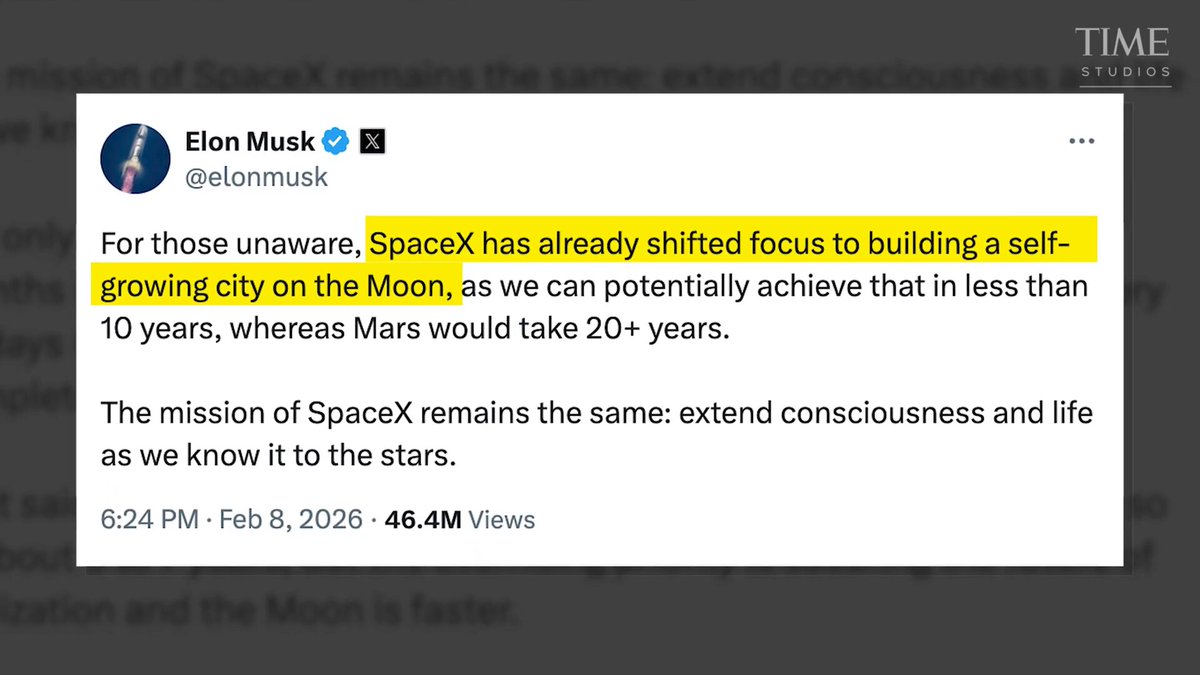
Shotwell's statement comes against a specific backdrop. On February 9, 2026, Elon Musk announced that SpaceX was delaying its Mars ambitions by approximately five to seven years to concentrate resources on lunar missions. That announcement prompted legitimate questions: was Mars being quietly deprioritized? Was the company's founding purpose being subordinated to near-term commercial opportunities?
Shotwell's answer is essentially: no. She frames the lunar focus as putting "more energy into the moon" — a temporary concentration of effort, not a strategic retreat. The Mars goal remains the destination. The Moon is a waypoint.

📊 Key Figures
| Metric | Value | Context |
|---|---|---|
| Years Musk has pursued Mars | 24+ | Since before SpaceX was founded |
| Mars delay announced | 5–7 years | Announced Feb 9, 2026; lunar focus cited |
| Previous uncrewed Mars target | 2026 | Announced Sept 2024; now pushed back |
| Shotwell's prior human Mars prediction | ~2034 | "Roughly a decade" — March 2024 |
| Musk's ultimate Mars colony target | 1 million people by 2050 | Self-sustaining city vision |
🔭 The BASENOR Take
Timeline: Long-term (2030s and beyond for crewed Mars missions)
Impact Level: Strategic — reaffirms SpaceX's foundational purpose amid a near-term pivot
Confidence: High — direct statement from SpaceX's #2 executive in a formal interview
What Shotwell said is worth parsing carefully. She didn't just say "we still care about Mars." She anchored it in the company's origin story — the very first conversation she had with Elon Musk, 24 years ago. That's not a talking point. That's institutional memory.
SpaceX's current lunar focus makes strategic sense regardless of the Mars timeline. NASA's Artemis program, commercial lunar contracts, and the broader cislunar economy represent near-term revenue that funds the long-term Mars architecture. Starship — the vehicle SpaceX needs for both the Moon and Mars — is being developed and refined on missions that generate real income. The lunar detour isn't a distraction from Mars; it's the proving ground for it.
Shotwell's comments also signal something important about SpaceX's internal culture. The Mars mission isn't just Musk's personal obsession — it's woven into how the company recruits, retains, and motivates its workforce. Shotwell saying "I love working for Elon" in the context of that shared vision tells you something about the alignment at the top of the organization. This is a company that still believes it's doing something historically significant, not just launching satellites.
For those tracking SpaceX's progress as it relates to Tesla's broader ecosystem, the Mars commitment matters in a less obvious way: it keeps Starship development on an aggressive trajectory. A faster, more capable Starship directly benefits Starlink satellite deployment — and Starlink's connectivity ambitions increasingly intersect with Tesla vehicles and energy products. The roadmap is more connected than it appears.
For our full SpaceX coverage, see SpaceX coverage.
📰 Deep Dive
The timing of Shotwell's interview is notable. SpaceX is navigating a complex moment: Starship is maturing rapidly, the Artemis lunar lander contract is active, and the company is simultaneously managing Starlink's global expansion. Against that backdrop, questions about whether Mars has slipped from priority to aspiration are legitimate — and Shotwell clearly felt they needed a direct answer.
Her reference to meeting Musk 24 years ago grounds the Mars mission in something deeper than a press release. SpaceX was incorporated in 2002 specifically because Musk couldn't find a way to send a small greenhouse to Mars affordably. The company's entire existence — every Falcon 9 launch, every Starlink satellite, every Starship test — is infrastructure for that original idea. Shotwell has been there for most of it.
The 5–7 year delay Musk announced in February 2026 shifts the realistic crewed Mars timeline into the mid-2030s at the earliest. That's a significant push from earlier projections — Shotwell herself said in March 2024 that she anticipated humans on Mars in "roughly a decade," which would have pointed to approximately 2034. A further delay of five to seven years from 2026 suggests the mid-2030s remains plausible, but only if the lunar program proceeds on schedule and Starship development hits its marks. Neither is guaranteed.
What Shotwell's statement does confirm is that the delay is tactical, not philosophical. SpaceX isn't abandoning Mars — it's sequencing the work. The Moon first, then Mars. Whether that sequence holds, or whether further delays accumulate, will depend on factors ranging from Starship's reliability record to NASA funding cycles to geopolitical competition in space. But the vision, at least, remains intact.
🚀 Following the Starship program? See every test flight, official outcome and the next launch window in our SpaceX Starship Tracker.
Sources & reporting notes
The links below identify the material source records used for this report.
- @SawyerMerritt on X (2026-03-26T21:39:18.000Z) — Direct source
- @SawyerMerritt on X (2026-03-26T21:39:18.000Z) — Direct source
Source links are preserved as published or accessed. See our editorial standards and corrections policy.
The BASENOR Editorial Desk covers Tesla, SpaceX, and related technology, curating reporting from primary sources — official accounts, regulatory filings, and software release data. Every article passes source-record and fact-checking review before publication. About the newsroom.
This report was curated by the BASENOR Editorial Desk from the sources listed above. Read our editorial standards or email editorial@basenor.com to report an error.