📌 UPDATE — April 14, 2026
Emirates has officially confirmed its adoption of Starlink for in-flight connectivity. Patrick Brannelly, a senior Emirates executive, explained the decision in a new interview, stating that legacy systems simply couldn't keep up with passenger demand — no matter the investment. Brannelly noted it was "impossible technically for everybody that wanted to connect to connect," making Starlink the only viable path forward for the airline's connectivity ambitions.

📌 UPDATE — April 13, 2026
Virgin Atlantic has accelerated its Starlink rollout, with the first equipped aircraft now expected in May 2026 — pulling forward from the previously announced Q3 2026 timeline. The UK carrier's faster-than-expected deployment makes it one of the swiftest European airline adopters to move from announcement to installation. This is a notable shift for transatlantic passengers who may now experience Starlink speeds on Virgin Atlantic flights sooner than anticipated.

via @SawyerMerritt · April 13, 2026 · 606K views
The News: Starlink is actively promoting its high-speed aviation internet service, enabling passengers to stream, game, and work at 35,000 feet via its low-Earth orbit satellite constellation.
Why It Matters: With 36 major airlines now committed — including British Airways, Virgin Atlantic, Lufthansa Group, and Southwest — Starlink Aviation is rapidly becoming the default in-flight internet standard. The era of slow, expensive cabin Wi-Fi is ending fast.
Source: @Starlink on X

What Starlink Aviation Actually Delivers
In-flight Wi-Fi has been a punchline for decades — throttled speeds, per-minute billing, and connections that drop over the ocean. Starlink Aviation is a fundamentally different product. Powered by a constellation of over 10,000 low-Earth orbit satellites linked by a laser mesh network, it maintains connectivity over oceans and polar regions where traditional geostationary systems go dark.
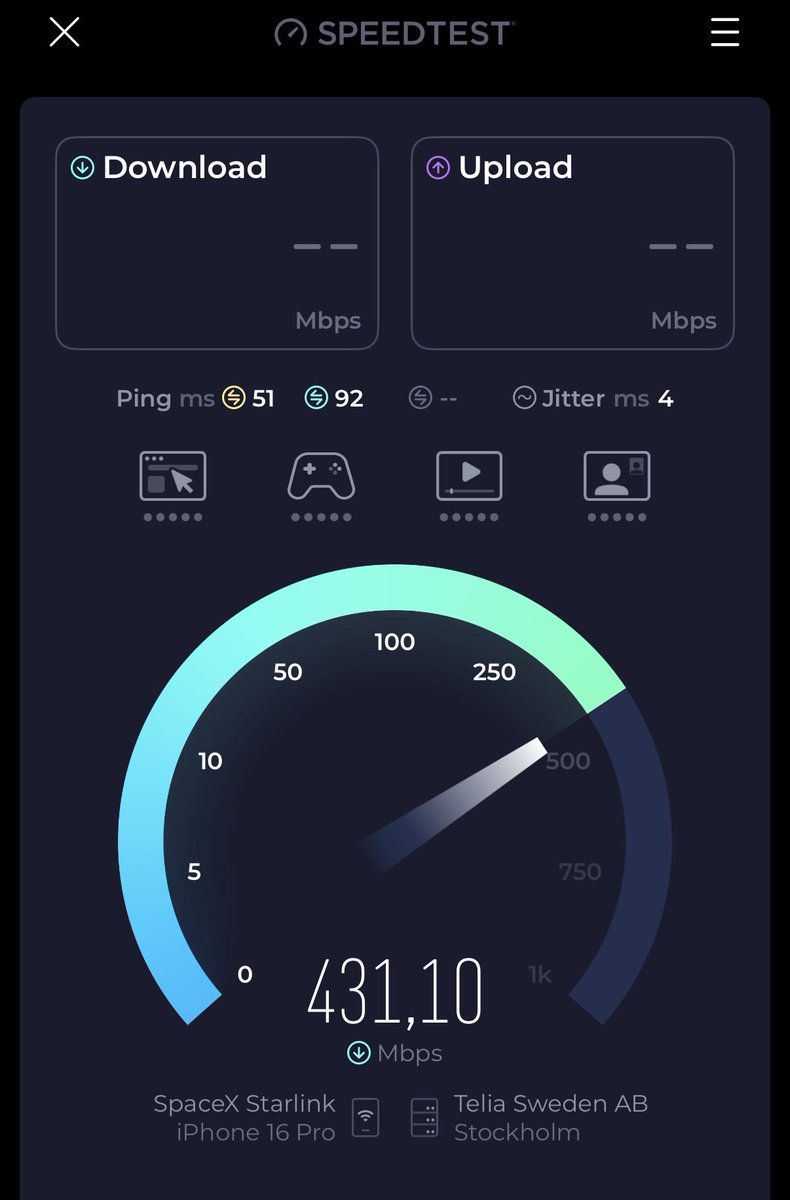
The numbers back it up: download speeds range from 135 to 310 Mbps in typical operation, with peaks reported above 450 Mbps. Upload sits between 20–44 Mbps, and latency comes in under 99 ms — low enough for video calls, real-time gaming, and secure VPN access. British Airways reportedly clocked speeds over 500 Mbps on early test flights.
📊 Starlink Aviation — Performance Specs
| Download Speed | 135–310 Mbps (peaks 450–500 Mbps) |
| Upload Speed | 20–44 Mbps |
| Latency | Under 99 ms |
| Coverage | Global — including oceans and polar routes |
| Supported Activities | 4K streaming, video calls, VPN, gaming |
| Antenna Size | ~45 cm (18 in), 7+ kg |
The Plan Tiers — What Airlines (and Private Operators) Pay
Starlink restructured its aviation pricing in March 2026, introducing speed-gated tiers. Standard Roam and Priority plans now have a 100 mph cap, making them unusable at cruise altitude. Aviation-specific plans are required, and they're priced accordingly.
| Plan | Monthly Cost | Data | Speed / Coverage |
|---|---|---|---|
| Aviation 300MPH | $250 | 20 GB (+$10/GB) | Up to 300 mph — land & coastal |
| Aviation 450MPH | $1,000 | 20 GB (+$50/GB) | Up to 450 mph — land & ocean |
| Aviation Jet 20GB | $2,000 | 20 GB (+$100/GB) | Any speed — land & ocean |
| Aviation Jet Unlimited | $10,000 | Unlimited | Any speed — land & ocean |
Hardware note: The Aero Terminal (antenna unit) carries an MSRP of $145,000 for most business jets, not including installation. Typical installation takes 10–14 days and is often combined with routine maintenance.
36 Airlines In — Who's Flying Starlink Now
As of April 10, 2026, 36 major airlines have committed to Starlink. The rollout pace has accelerated sharply in the past few months:
- British Airways — First Starlink flight launched April 2026 on a Boeing 787-8 (London to Houston). Free Wi-Fi across all cabins. Full fleet of 300+ planes targeted within two years.
- Virgin Atlantic — Starlink live on its Airbus A350 fleet from May 2026, with the first customer flight (VS153, London Heathrow to JFK) offering free Wi-Fi for Flying Club members. Full fleet coverage targeted by 2027.
- Copa Airlines — First Latin American airline to commit; Starlink appears on Boeing 737s from October 2026.
- IAG (Aer Lingus, British Airways, Iberia, Level, Vueling) — 500+ aircraft across the group being equipped, starting early 2026.
- Lufthansa Group — Deal announced January 2026. Rollout begins second half of 2026, full group coverage (including Austrian, Swiss, Eurowings, Brussels Airlines) targeted by 2029.
- Korean Air — Announced December 2025; service starting Q3 2026, prioritizing Boeing 777 and Airbus A350 fleets.
- Southwest Airlines — Hardware installation begins summer 2026, targeting its entire fleet of over 300 aircraft.
STCs (Supplemental Type Certificates) are now available for aircraft from Airbus, Boeing, Bombardier, Dassault, Embraer, Gulfstream, and more — meaning the certification infrastructure to scale is already in place.
🔭 The BASENOR Take
| Timeline | Active now — major airline deployments through 2026–2029 |
| Impact Level | 🔴 High — industry-wide shift in in-flight connectivity |
| Confidence | High — confirmed deployments, signed airline deals, active STCs |
📰 Deep Dive
What makes Starlink Aviation structurally different from legacy in-flight Wi-Fi isn't just speed — it's architecture. Traditional systems rely on geostationary satellites sitting 35,000 km above Earth, creating inherent latency of 600+ ms and dead zones over oceans. Starlink's LEO constellation orbits at roughly 550 km, cutting latency to under 100 ms and using inter-satellite laser links to route data without ground stations. That's why it works mid-Atlantic or over the Arctic — routes where previous systems simply couldn't maintain a usable connection.
The airline adoption curve is accelerating for a straightforward reason: passengers now expect terrestrial-grade connectivity in the air. British Airways launching free Starlink Wi-Fi across all cabins — not just business class — signals that the competitive pressure is real. When one major carrier offers 300 Mbps for free, others can't justify charging $30 for 2 Mbps. The economics are shifting from connectivity-as-revenue to connectivity-as-retention.
For private aviation operators, the calculus is different. The $145,000 hardware cost and up to $10,000/month for unlimited jet service is significant, but for operators already spending that on fuel per transatlantic leg, reliable video conferencing and real-time data access has clear business value. The 10–14 day installation window — often slotted alongside scheduled maintenance — removes a key adoption barrier.
The bigger picture: SpaceX is methodically converting its satellite infrastructure into recurring enterprise revenue. Aviation is one of the highest-value verticals — airlines, private operators, and charter services all represent long-term subscription contracts at premium price points. With 36 airlines committed and STC coverage spanning every major commercial airframe manufacturer, the network effect is already building. The question isn't whether Starlink dominates in-flight connectivity — it's how quickly legacy providers become irrelevant. For more on SpaceX's expanding connectivity ambitions, see our SpaceX coverage.
Sources & reporting notes
The links below identify the material source records used for this report.
- @Starlink on X (2026-04-12T22:38:23.000Z) — Direct source
- @SawyerMerritt on X (2026-04-13T00:14:20.000Z) — Direct source
- @SawyerMerritt on X (2026-04-14T00:03:09.000Z) — Direct source
- @SawyerMerritt on X (2026-04-14T00:03:10.000Z) — Direct source
Source links are preserved as published or accessed. See our editorial standards and corrections policy.
The BASENOR Editorial Desk covers Tesla, SpaceX, and related technology, curating reporting from primary sources — official accounts, regulatory filings, and software release data. Every article passes source-record and fact-checking review before publication. About the newsroom.
This report was curated by the BASENOR Editorial Desk from the sources listed above. Read our editorial standards or email editorial@basenor.com to report an error.