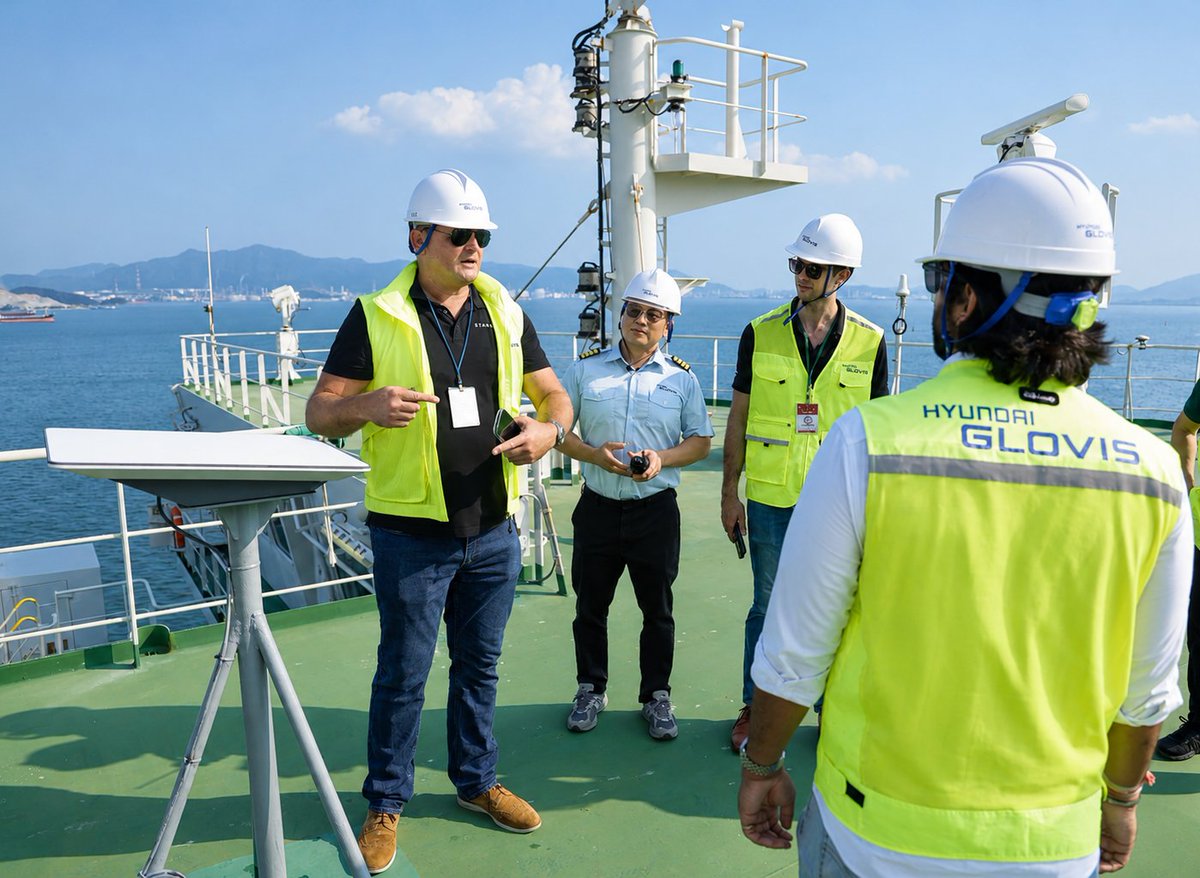
SpaceX's Starlink maritime business just landed a significant commercial contract. Hyundai Glovis — one of the world's largest vehicle and bulk cargo logistics operators — has deployed Starlink across its fleet, with a full rollout targeting 45 company-owned vessels. The partnership, officially announced in January 2026, is now generating public attention after Starlink highlighted it on social media this week. The implications reach well beyond crew Wi-Fi.

Why This Deal Is Bigger Than It Looks
Hyundai Glovis operates a mixed fleet of car carriers and bulk carriers, moving vehicles and raw materials across global trade routes. Connectivity at sea has historically been a bottleneck — geostationary satellite systems orbit at roughly 36,000 kilometers, introducing latency that makes real-time operational data impractical and crew communication frustrating at best.
Starlink's low-Earth orbit constellation sits at approximately 550 kilometers — about 65 times closer. According to reporting from Korea Herald and Korea JoongAng Daily, that difference translates directly into a measurable performance jump: downloading a 1.4-gigabyte file at sea drops from roughly 15 minutes to around two minutes. That's not a marginal improvement. For a logistics operator managing cargo timing, port coordination, and emergency response across ocean routes, the gap between 15 minutes and 2 minutes is operationally significant.
The Three Pillars Hyundai Glovis Is Building On
According to official statements from Hyundai Glovis, the deployment is structured around three priorities — and only the first one is about connectivity for its own sake.
Safety infrastructure. Real-time communication with shore during emergencies — vessel breakdowns, severe weather events, onboard accidents — is the stated primary driver. Geostationary systems can handle distress signals, but Starlink enables continuous, high-bandwidth coordination with land-based response teams throughout an incident, not just at the moment of the initial call.
Operational data infrastructure. Hyundai Glovis has explicitly named autonomous navigation and AI-powered predictive maintenance as next-generation targets. Neither is viable without persistent, low-latency connectivity. The Starlink installation is described internally as laying the groundwork for these capabilities — the bandwidth is the prerequisite, not the end goal.
Crew welfare. This one tends to get underplayed in press releases but matters for fleet operators competing for experienced maritime labor. Hyundai Glovis cited internet access comparable to onshore conditions — video calls, streaming — as a meaningful recruitment and retention factor. Months-long ocean voyages are more attractive when crew members can maintain normal contact with family.
Rollout Timeline and Scope
Installation is proceeding sequentially, prioritizing vessels calling at South Korean ports in 2026. The full 45-vessel target covers both the car carrier and bulk carrier segments of the Hyundai Glovis fleet. No completion date for the full rollout has been publicly confirmed, but the sequential port-based approach suggests the majority of the fleet will be equipped within the current year.
A Hyundai Glovis official was quoted as saying the Starlink adoption "lays the groundwork for safer and more efficient operations" and that the company would "continue adopting emerging technologies to strengthen our competitiveness." A separate official described low-Earth orbit satellite communication as "the foundation for simultaneously enhancing the safety and efficiency of ship operations."
What It Signals for Starlink Maritime
Starlink has been methodically expanding its maritime vertical — cruise lines, fishing fleets, container shipping operators — but the Hyundai Glovis deal carries a specific strategic weight. Hyundai Glovis is a subsidiary of Hyundai Motor Group, which means this isn't just a logistics contract. It's a data point about how one of the world's largest automotive conglomerates is thinking about connectivity infrastructure for its supply chain operations.
The deal also reinforces Starlink's positioning against legacy maritime VSAT providers. The performance numbers — 7x faster file transfers, low latency suitable for real-time AI applications — are the kind of concrete benchmarks that move procurement decisions in an industry that has historically been slow to adopt new satellite technology.
Whether Starlink can convert this momentum into broader adoption across the global commercial shipping industry — where fleet sizes run into the thousands, not dozens — will be the more consequential test. Hyundai Glovis's 45 vessels is a proof point. The question is how quickly that proof point becomes a template. For more on SpaceX's expanding commercial footprint, see our SpaceX coverage.
Sources & reporting notes
The links below identify the material source records used for this report.
- @Starlink on X (2026-08-19T00:43:50.000Z) — Direct source
Source links are preserved as published or accessed. See our editorial standards and corrections policy.
The BASENOR Editorial Desk covers Tesla, SpaceX, and related technology, curating reporting from primary sources — official accounts, regulatory filings, and software release data. Every article passes source-record and fact-checking review before publication. About the newsroom.
This report was curated by the BASENOR Editorial Desk from the sources listed above. Read our editorial standards or email editorial@basenor.com to report an error.