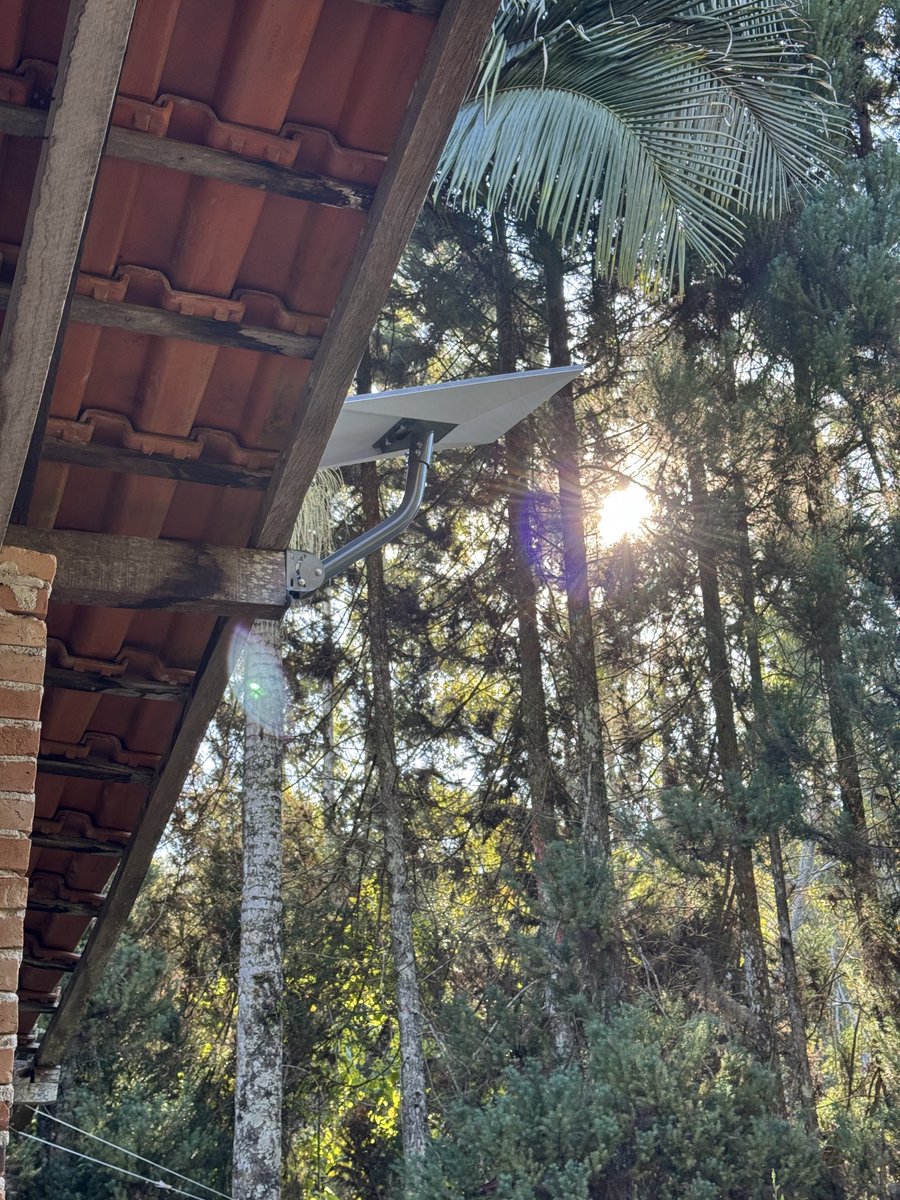
Starlink shared a brief but pointed message this week: reliable internet is reaching remote Brazil. Behind that simple post sits four years of rapid expansion, a dominant market position, and real-world impact on communities that fiber and cellular networks never reached. Here's what the numbers tell you.

1. From Zero to 662,000 Accesses in Four Years
Starlink launched in Brazil in May 2022 and expanded nationwide by early 2023, deliberately targeting rural and remote regions first. By February 2026, it had reached 662,000 active accesses — effectively doubling its base in a single year. According to Brazil's telecommunications regulator Anatel, the service ended 2025 with 606,200 active connections, representing 85% year-over-year growth. That kind of trajectory in a country of Brazil's geographic complexity is not routine.
2. 77.3% of the Satellite Broadband Market
Starlink didn't just enter Brazil's satellite internet market — it absorbed it. By July 2024, according to Anatel data, Starlink held a 42.5% market share among satellite internet providers. By February 2026, that figure had climbed to 77.3%. It is now the 13th largest fixed internet operator in the entire country, satellite or otherwise. Brazil is Starlink's second-largest user base globally, behind only the United States.
3. Speeds That Actually Work in the Amazon
The service isn't just present in remote Brazil — it performs there. In remote regions, Starlink delivers download speeds between 25 and 220 Mbps and upload speeds of 5 to 10 Mbps, with a 99.9% uptime commitment and typical latency of 20 to 50 milliseconds. Enterprise solutions push download speeds up to 400 Mbps. For communities on river islands like Marajó in the Amazon Delta — where the alternative has historically been no internet at all — those numbers represent a genuine infrastructure leap.
4. Real Applications: Farming, Medicine, and Government
The connectivity isn't abstract. According to verified reporting, Starlink in Brazil now supports precision agriculture and real-time equipment monitoring for rural producers, online learning platforms and virtual classrooms in areas without schools, and telemedicine consultations where clinical access is limited or nonexistent. Local governments have adopted it too — the city hall of Portel, deep in the Amazon, uses Starlink to run digital public services. These are use cases that fiber infrastructure won't reach on any near-term timeline.
5. A Deal to Keep the Amazon Legal
Expanded access comes with accountability obligations. In June 2025, Brazil's Federal Prosecutor's Office announced a two-year agreement with Starlink to prevent its services from being used in illegal mining and other criminal activity in the Amazon. Under the deal, Starlink requires identification and proof of residence from all new users in the Amazon region, shares registration and geolocation data with Brazilian authorities for units under investigation, and blocks service when illegal activity is confirmed. It's a notable precedent — a satellite internet provider actively cooperating with law enforcement to police its own network coverage area.
Anatel also approved an expansion of Starlink's operating rights in April 2025, authorizing an additional 7,500 satellites and bringing the licensed constellation to nearly 12,000 satellites, with the license valid through 2027. The infrastructure runway is there. The question now is how quickly the remaining unconnected communities — and there are still many — actually get reached. For more on SpaceX and Starlink developments, see our SpaceX coverage.
Sources & reporting notes
The links below identify the material source records used for this report.
- @Starlink on X (2026-07-18T22:32:57.000Z) — Direct source
Source links are preserved as published or accessed. See our editorial standards and corrections policy.
The BASENOR Editorial Desk covers Tesla, SpaceX, and related technology, curating reporting from primary sources — official accounts, regulatory filings, and software release data. Every article passes source-record and fact-checking review before publication. About the newsroom.
This report was curated by the BASENOR Editorial Desk from the sources listed above. Read our editorial standards or email editorial@basenor.com to report an error.