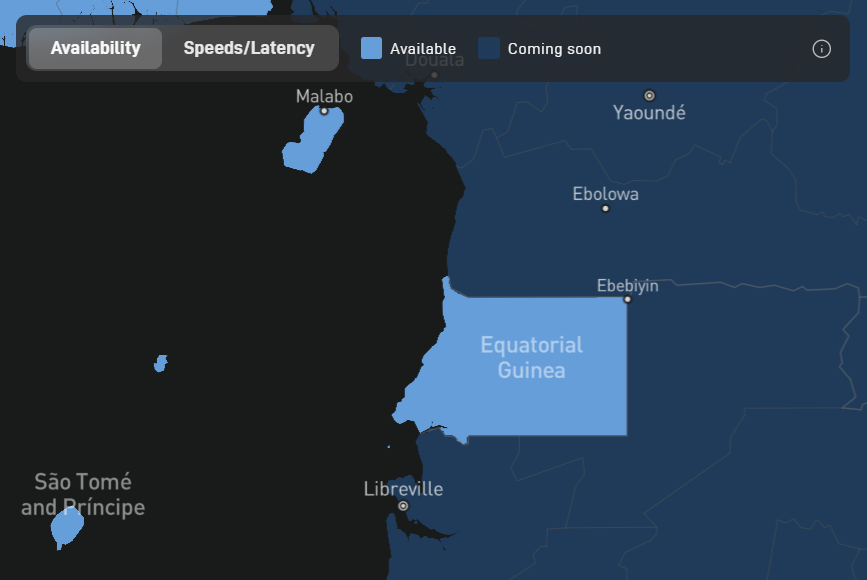
Starlink officially went live in Equatorial Guinea on August 29, 2026, confirmed simultaneously by the @Starlink account and Elon Musk himself. It's a small country by population — roughly 1.5 million people on the Central African coast — but the launch is another data point in SpaceX's methodical push to blanket the African continent with low-earth-orbit broadband.

1. The Announcement Came From the Top
Both the official @Starlink account and Elon Musk posted about the launch within 27 minutes of each other — Starlink at 6:46 AM UTC, Musk at 7:13 AM UTC. Musk's post drew over 600,000 views and 1,600 likes within hours, significantly amplifying reach beyond the core Starlink audience. Dual confirmation at that level signals this wasn't a soft rollout — it's a full commercial launch.
2. Equatorial Guinea Sits in a Historically Underserved Region
Equatorial Guinea is a small, oil-rich nation on the Gulf of Guinea, comprising a mainland territory and several islands including Bioko, where the capital Malabo is located. The island geography makes traditional fiber or cable infrastructure expensive and logistically difficult to deploy. Satellite internet — particularly low-earth-orbit service with Starlink's latency profile — is a practical fit for exactly this kind of fragmented geography.
3. Africa Remains Starlink's Most Active Expansion Frontier
Starlink has been steadily adding African nations to its coverage map over the past two years. The continent presents the clearest case for LEO broadband: large rural populations, limited fixed-line infrastructure, and governments increasingly open to licensing satellite operators. Equatorial Guinea's addition continues that pattern. For context on how SpaceX is building out global infrastructure, see our SpaceX coverage.
4. High-Speed, Low-Latency — What That Actually Means Here
Starlink's standard residential service typically delivers download speeds in the 50–200 Mbps range with latency under 60ms — a dramatic step up from geostationary satellite alternatives that can exceed 600ms of latency. For Equatorial Guinea residents and businesses currently relying on legacy satellite or slow mobile data, that latency difference alone changes what's possible: video calls, cloud applications, and real-time services that were previously impractical become viable.
5. Ordering Is Live Now
The @Starlink tweet linked directly to the Starlink availability page, indicating hardware orders are open. Prospective customers in Equatorial Guinea can visit starlink.com to check service availability at their address and order a kit. As with other recent African launches, availability may roll out by region rather than nationwide simultaneously — checking the address-level availability tool is the most reliable way to confirm service at a specific location.
Equatorial Guinea is unlikely to move the needle on Starlink's global subscriber count in a meaningful way on its own. But each new country added tightens the network's global footprint and, more practically, brings connectivity to people who had few real alternatives. The pace of African expansion suggests SpaceX isn't slowing down on that front.
Sources & reporting notes
The links below identify the material source records used for this report.
- @Starlink on X (2026-08-29T06:46:59.000Z) — Direct source
- @elonmusk on X (2026-08-29T07:13:20.000Z) — Direct source
Source links are preserved as published or accessed. See our editorial standards and corrections policy.
The BASENOR Editorial Desk covers Tesla, SpaceX, and related technology, curating reporting from primary sources — official accounts, regulatory filings, and software release data. Every article passes source-record and fact-checking review before publication. About the newsroom.
This report was curated by the BASENOR Editorial Desk from the sources listed above. Read our editorial standards or email editorial@basenor.com to report an error.