📌 UPDATE — August 29, 2026
Just one day after its 33-engine static fire, Booster 21 underwent a chopsticks test at Starbase's Pad 2 launch tower on the morning of August 29. The booster was lifted off the Orbital Launch Mount (OLM) and raised to the top of the tower — simulating the catch mechanics that are central to SpaceX's booster reusability program. According to @LabPadre, Booster 21 was subsequently lowered onto a booster transport stand and is expected to roll back to the production site later today for final pre-flight preparations ahead of Flight 14.
📹 Booster 21 lifted to the top of the tower — via @NASASpaceflight
📹 Booster 21 lowered at dawn ahead of rollback — via @LabPadre
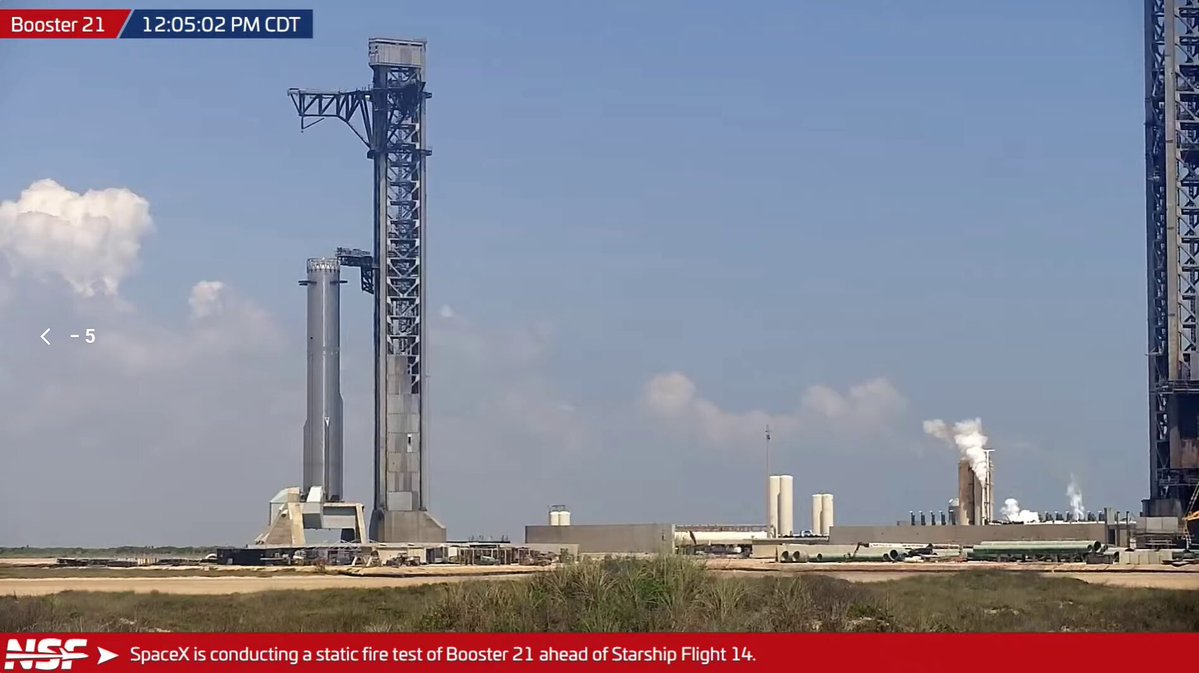
SpaceX cleared a critical milestone at Starbase on August 28 when Super Heavy Booster 21 successfully completed a 15-second static fire test with all 33 Raptor engines ignited. The test, confirmed by Avid Space's LabPadre live feed, moves the Flight 14 campaign into its final pre-stack phase — and puts an early-to-mid September launch window firmly in view.
How the Day Unfolded
The sequence followed a tight operational cadence. First, ground crews removed the transport stand from the pad — a standard step that clears the booster for propellant loading and signals the test is imminent.

NASASpaceflight then confirmed Booster 21 entered propellant load operations — the point at which cryogenic liquid oxygen and methane are loaded into the vehicle's tanks ahead of ignition.

Roughly 30 minutes later, LabPadre's cameras captured the ignition event itself.

Why This Test Matters for Flight 14
The 33-engine static fire is widely regarded as the final major ground test before Booster 21 is stacked with Ship 41 and cleared for launch. Ship 41 had already completed its own milestones earlier this month — a single-engine deorbit-burn demonstration on August 19, followed by a full six-engine, 60-second static fire on August 21 at SpaceX's Massey's Test Site. With both vehicles now through their respective engine tests, the campaign's remaining gating items are stacking operations and FAA sign-off.
Flight 14 carries a notably ambitious manifest. According to previous SpaceX announcements, the mission is expected to mark Starship's first attempt at a true orbital trajectory and is slated to carry approximately 20 operational Starlink V3 satellites — the first time the vehicle would deploy a commercial payload. Both B21 and S41 are Version 3 vehicles, an upgraded configuration SpaceX introduced in May 2026.
The catch picture for Flight 14 is more nuanced. SpaceX CEO Elon Musk indicated in early August that Flight 14 would attempt the first-ever launch tower catch of the Starship upper stage, but subsequent reporting suggests the Ship catch has been pushed back. A Super Heavy booster catch at the mechazilla arms, however, may still be on the table for this flight.
What Comes Next
The testing window for Booster 21's static fire was set between August 24 and September 5, so today's successful completion lands well within that schedule. If the stacking and FAA review process tracks with prior campaign timelines, an early-to-mid September launch attempt is plausible — though SpaceX has not announced an official target date. Follow our SpaceX coverage for stacking updates and any FAA licensing developments as they happen.
🚀 Following the Starship program? See every test flight, official outcome and the next launch window in our SpaceX Starship Tracker.
Sources & reporting notes
The links below identify the material source records used for this report.
- @NASASpaceflight on X (2026-08-28T17:06:49.000Z) — Direct source
- @NASASpaceflight on X (2026-08-28T17:56:49.000Z) — Direct source
- @LabPadre on X (2026-08-28T18:28:06.000Z) — Direct source
Source links are preserved as published or accessed. See our editorial standards and corrections policy.
The BASENOR Editorial Desk covers Tesla, SpaceX, and related technology, curating reporting from primary sources — official accounts, regulatory filings, and software release data. Every article passes source-record and fact-checking review before publication. About the newsroom.
This report was curated by the BASENOR Editorial Desk from the sources listed above. Read our editorial standards or email editorial@basenor.com to report an error.