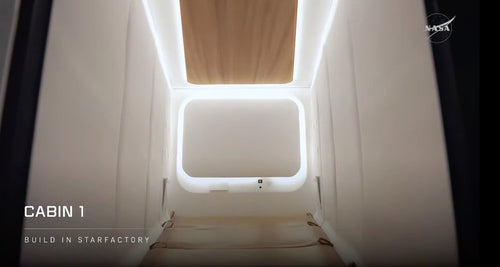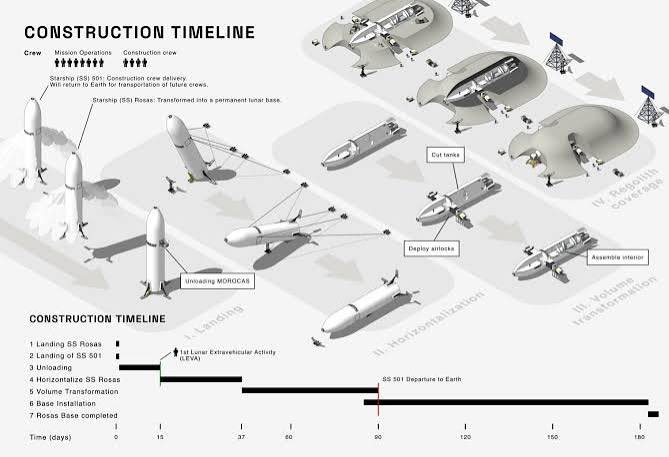
Concepts for converting SpaceX's Starship into a permanent surface habitat — laid on its side and buried under regolith — were on display at the Mars Society conference this week, offering one of the clearest public looks yet at how engineers are thinking about the vehicle's second life after landing. The approach addresses two of the most serious threats to long-duration surface missions: radiation exposure and micrometeorite impacts.

Why Horizontal, and Why Regolith
Starship is designed to land vertically, but the concepts shown at the Mars Society conference pivot the vehicle to a horizontal orientation once it reaches the surface. The logic is straightforward: a horizontal cylinder is far easier to bury than a 50-meter-tall vertical rocket, and burying it is the most practical way to pile on enough regolith to matter.
Earlier published proposals, including the "Rosas Base" concept that circulated in academic circles around 2021, suggested a regolith covering of approximately 5 meters — roughly 16 feet — as the target depth for meaningful radiation attenuation. On the Moon, where there is no magnetic field and no atmosphere, that kind of shielding is not optional for missions measured in months or years. Mars offers a thin atmospheric buffer, but solar particle events and galactic cosmic rays remain a serious concern there too.
The regolith layer also handles micrometeorite risk. The lunar surface is continuously peppered by high-velocity particles too small to track but capable of puncturing an unprotected habitat over time. A meter or more of compacted regolith absorbs those impacts before they reach the hull.
What Starship Brings to the Table
The vehicle's interior volume is what makes these concepts credible rather than speculative. Starship's pressurized payload bay offers roughly 1,000 cubic meters of usable space — comparable to the total pressurized volume of the International Space Station, which was assembled over more than a decade at enormous cost. Delivering that volume in a single landing changes the economics of surface habitation dramatically.
Beyond the main payload volume, the propellant tanks present an additional opportunity. The methane and liquid oxygen tanks — estimated at approximately 600 m³ and 800 m³ respectively — could be repurposed as additional pressurized areas once the vehicle is permanently grounded. That would push total available volume well beyond the ISS equivalent, potentially supporting a crew of meaningful size without requiring multiple habitat modules to be shipped separately.
SpaceX is already under contract with NASA to deliver a Starship Human Landing System for the Artemis program, meaning the vehicle will reach the lunar surface in a crewed context before any permanent base scenario plays out. That mission profile — land, operate, return — is distinct from the base camp concepts shown this week, but it establishes the operational foundation those concepts depend on.
From Conference Display to Engineering Reality
It is worth being precise about what was shown at the Mars Society conference. These are concepts — design studies and proposals, not funded programs or official SpaceX roadmap items. The Mars Society gathering is a forum where researchers, engineers, and enthusiasts present ideas that range from near-term mission architecture to longer-horizon speculation. The fact that multiple independent concepts are converging on the same horizontal-orientation-plus-regolith approach is meaningful as a signal of engineering consensus, but it does not represent a commitment from SpaceX or any space agency.
What has shifted is the credibility of the underlying premise. A few years ago, using Starship as a surface habitat was a thought experiment. Today, with Starship flying regularly and NASA's HLS contract in execution, the question is less "could this work in principle" and more "what would the conversion actually require." The conference concepts are beginning to answer that second question in concrete terms.
SpaceX has publicly stated its broader objective is a self-sustaining colony on Mars, and has at times described a goal of building what it calls a self-growing city on the Moon within a decade. Whether the horizontal base camp approach becomes the standard template for early surface infrastructure — or gets superseded by purpose-built habitat modules as launch cadence increases — is an open question. But the engineering case for repurposing the vehicle you already flew there, rather than shipping dedicated habitat hardware separately, is hard to argue against on cost grounds alone.
For more on SpaceX's broader mission architecture, see our SpaceX coverage.
🚀 Following the Starship program? See every test flight, official outcome and the next launch window in our SpaceX Starship Tracker.
Sources & reporting notes
The links below identify the material source records used for this report.
- @JoeTegtmeyer on X (2026-10-23T21:23:00.000Z) — Direct source
Source links are preserved as published or accessed. See our editorial standards and corrections policy.
The BASENOR Editorial Desk covers Tesla, SpaceX, and related technology, curating reporting from primary sources — official accounts, regulatory filings, and software release data. Every article passes source-record and fact-checking review before publication. About the newsroom.
This report was curated by the BASENOR Editorial Desk from the sources listed above. Read our editorial standards or email editorial@basenor.com to report an error.