📌 UPDATE — April 2, 2026
SpaceX President Gwynne Shotwell has now publicly confirmed Starlink's intent to launch in India, responding directly to Minister Jyotiraditya Scindia on X. In her post, Shotwell stated: "We look forward to bringing Starlink to your great nation." The exchange marks the clearest official, on-record confirmation from SpaceX leadership that an India launch is actively in motion — moving beyond signals and speculation into a direct public commitment.

— @Gwynne_Shotwell via X · April 2, 2026
The News: SpaceX President Gwynne Shotwell publicly expressed excitement to support Meghalaya's connectivity initiatives — the moment Starlink clears final regulatory approval in India.
Why It Matters: This is the clearest public signal yet from SpaceX leadership that a commercial India launch is imminent, not hypothetical — with three Indian states already signed up and waiting.
Source: @Gwynne_Shotwell on X

Gwynne Shotwell, President and COO of SpaceX, doesn't tweet often — which makes her April 2 post all the more significant. After meeting with Meghalaya Chief Minister Conrad Sangma at Meghalaya House, Shotwell publicly committed to supporting the state's connectivity ambitions as soon as Starlink receives full regulatory clearance to operate in India. The phrasing is deliberate: this isn't a maybe. It's a countdown.
📊 Key Figures
| Metric | Detail |
|---|---|
| Indian States with Starlink LoI | 3 — Maharashtra (Nov 2025), Gujarat (Feb 2026), Meghalaya (Apr 2026) |
| Gen1 Constellation License | Granted by IN-SPACe — 5-year license, ~4,408 LEO satellites |
| Gen2 Constellation License | Rejected by IN-SPACe — unmet technical specs, unpermitted frequency bands |
| Remaining Approvals Needed | DoT security clearance + commercial spectrum allocation |
| DoT Original Target | Spectrum allocation by December 2025 — now delayed |
| SpaceX India HQ | Established in Bengaluru — local hiring underway |
The Meghalaya Deal: Why This State Matters
Meghalaya isn't a headline market — it's a proof-of-concept. The northeastern Indian state is characterized by mountainous terrain, dense forest cover, and thousands of villages that fiber and 4G towers have never reached economically. It's precisely the kind of geography that Starlink was built for.
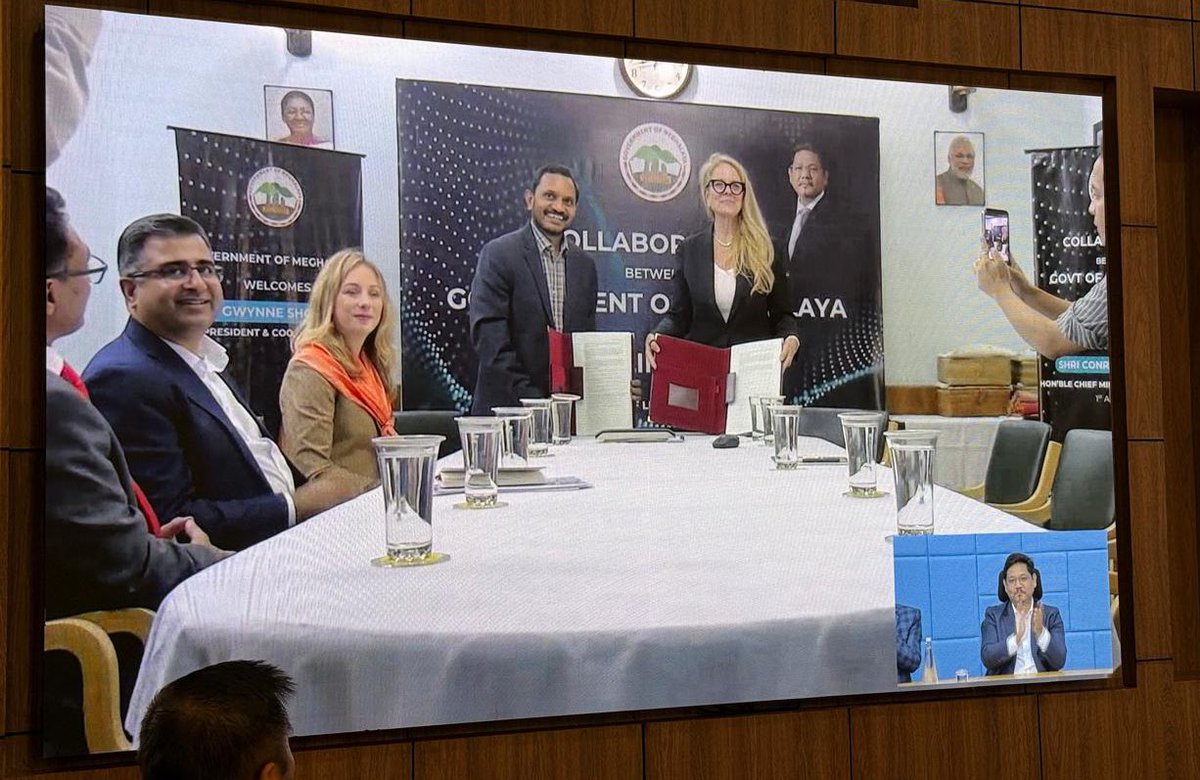
On April 1, 2026, the Meghalaya government signed a Letter of Intent with Starlink India to explore high-speed satellite internet connectivity, particularly targeting remote and inaccessible regions. Shotwell attended the signing and met with Chief Minister Conrad Sangma, then followed up with her public tweet the next day — a rare personal endorsement from SpaceX's second-in-command.
Meghalaya is the third Indian state to formally partner with Starlink, following Maharashtra in November 2025 and Gujarat in February 2026. The pattern is clear: SpaceX is building a coalition of state-level commitments to create political pressure for central government approval. It's a smart playbook.
Where Regulatory Approval Actually Stands
Shotwell's excitement is real — but so are the remaining hurdles. Here's an honest breakdown of where things stand:
What's already cleared: Starlink holds a Unified License in India and has received a five-year IN-SPACe license for its Gen1 satellite constellation. The company conducted compliance demo runs in Mumbai in October 2025 and has established a local headquarters in Bengaluru with Indian employees on the payroll.
What's still blocking launch: Two critical approvals remain outstanding. First, security clearance from the Department of Telecommunications (DoT) — India requires satellite communication providers to enable real-time government interception access and store user data locally within the country. Second, commercial spectrum allocation, which the DoT had originally targeted for December 2025 but has since slipped due to unresolved inter-departmental coordination and spectrum pricing disputes.
The Gen2 setback: IN-SPACe rejected Starlink's application for its newer Gen2 constellation due to unmet technical specifications and use of frequency bands not permitted under current Indian regulations. This effectively blocks Starlink from offering direct-to-device (D2D) services in India for now — a limitation that matters as SpaceX expands D2D partnerships globally.
⚠️ Approval Checklist
🔭 The BASENOR Take
| Timeline | Commercial launch possible mid-to-late 2026 if spectrum allocation resolves in Q2 |
| Impact Level | High — India is a 1.4 billion-person market with massive rural connectivity gaps |
| Confidence | Medium-High — political will is clearly there; bureaucratic timeline is the wildcard |
| Key Risk | Spectrum pricing dispute and DoT data localization requirements could push launch to 2027 |
📰 Deep Dive
Shotwell's tweet is more than a diplomatic courtesy — it's a strategic signal. By publicly naming Chief Minister Sangma and tying her excitement directly to regulatory approval, she's creating a form of public accountability that puts gentle pressure on India's central government. Three states are now on record wanting Starlink. Their populations are waiting. The political cost of continued delay is rising.
The timing of Shotwell's India visit is also notable. She met with Union Communications Minister Jyotiraditya Scindia on April 1 — the same day as the Meghalaya LoI signing. That's a coordinated push at both the state and central government levels in a single 24-hour window. SpaceX is clearly running a deliberate lobbying and partnership campaign, not waiting passively for bureaucratic processes to resolve themselves.
The Gen2 rejection is a real constraint worth watching. While Gen1 service will be functional for standard broadband, the inability to offer direct-to-device connectivity limits Starlink's competitive differentiation in India — particularly as local telecom giants like Jio and Airtel continue expanding 5G coverage in urban areas. Starlink's India value proposition is strongest in rural and mountainous regions, which is exactly why the Meghalaya partnership is the right first showcase. If Starlink can demonstrably connect villages in the northeastern hills that no terrestrial network reaches, the regulatory case for full approval becomes much harder to resist.
For those following SpaceX's global expansion, India represents one of the last major untapped markets. With Elon Musk having stated as far back as November 2025 that Starlink was operationally ready and awaiting only government sign-off, the bottleneck has never been technical. It's been political and bureaucratic. Shotwell's direct engagement — at the state level, at the ministerial level, and now publicly on X — suggests SpaceX has concluded that active diplomacy is the only way to accelerate that final step. For our full SpaceX coverage, including Starship and Starlink milestones, check the dedicated tag.
Sources & reporting notes
The links below identify the material source records used for this report.
- @Gwynne_Shotwell on X (2026-04-02T16:58:58.000Z) — Direct source
- @Gwynne_Shotwell on X (2026-04-02T17:06:29.000Z) — Direct source
Source links are preserved as published or accessed. See our editorial standards and corrections policy.
The BASENOR Editorial Desk covers Tesla, SpaceX, and related technology, curating reporting from primary sources — official accounts, regulatory filings, and software release data. Every article passes source-record and fact-checking review before publication. About the newsroom.
This report was curated by the BASENOR Editorial Desk from the sources listed above. Read our editorial standards or email editorial@basenor.com to report an error.